







 Chat with AI


Merchandising Mathematics for Retailing 5th Edition by Cynthia Easterling ,Ellen Flottman,Marian Jernigan ,Beth Wuest
Edition 5ISBN: 978-0132724166Merchandising Mathematics for Retailing 5th Edition by Cynthia Easterling ,Ellen Flottman,Marian Jernigan ,Beth Wuest
Edition 5ISBN: 978-0132724166 Exercise 3
Measuring Corporate Social Responsibility through P L Statement: Tensions between Profits and Sustainability for Online vs. Brick-and-Mortar Stores?
Gail Baugh, M.A.
San Francisco State University and Fashion Institute of Design and Merchandising, San Francisco
Connie Ulasewicz
San Francisco State University
In the twenty-first century, corporate social responsibility (CSR) is a term well used and a process that is expected for established organizations to follow. Defined by the Harvard University as, "how companies manage their economic, social, and environmental impacts as well as their relationships in all key spheres of influence: The workplace, the marketplace, the supply chain, the community, and the public policy realm" (Corporate Social Responsibility Initiative), it is often challenging for organizations to choose and integrate the appropriate socially responsible initiatives and maintain their profitability. Companies consume large amounts of energy through lighting, heating and cooling, packaging, and shipping methods. In this case study, an iconic retail brand will be investigated to gain a better understanding of their CSR goals and challenges and the choices they make to measure and maintain their profitability.
Macy's Inc., established in 1858, operates Macy's and Bloomingdales brands with fiscal 2010 sales of $25.0 billion, and over 840 stores in 45 states, along with the Macys.com and Bloomingdales.com Web sites ( Macy's annual report, 2010). Macy's Inc. strives to maintain their profitability, while developing and measuring their social responsibility and keeping the customer at the center of their decisions. Retailing the right fashion, at the right price, at the right time, and in the right quantity is essential for this organization. Another practice currently intertwined with retailing fashion and maintaining profitability and CSR is sustainability. Retail sustainability refers to the interconnectivity of the people, processes, and environment that produce, promote, sell, and distribute goods (Hethorn Ulasewicz, 2008). Fashion and retail are ripe for sustainable actions that can create efficiencies, while increasing profits, and being good for the planet. With our current global economic challenges and drive for CSR, sustainable practices must be planned into a business model so that they are part of a fixed expense structure.
As a leading national retailer, Macy's is committed to developing business practices that are sustainable and measurable. They are redefining their profit and loss (P L) so that their business reflects their values. On their Web site (http://www.macysinc.com/aboutus/sustainability/five-point-action-plan.aspx), they outline a five-point action plan of how they will contribute to a more sustainable environment, "whenever possible and sensible within the context of their business requirements." Briefly described here, the action plan includes the following:
1. We will be more aggressive in our drive to eliminate wasteful behavior
2. We will reduce our use of scarce resources in a meaningful way
3. We will pursue the most environmentally friendly solution
4. We will take a comprehensive approach to sustainability, involving everyone around us
5. We will measure what we do and strive toward quantifiable goals.
Macy's Inc. is challenged with the same basic four expenses to maintain and grow their business in a sustainable manner as their competitors: labor, rent, utilities, and promotional activities. Several tangible actions ( Macy's annual report, 2010) they have taken include the following:
• Installed solar power systems at 40 Macy's and Bloomingdales.
• Increased the proportion of recycled or certified paper used in marketing materials to 80% in shopping bags and 89% in gift boxes.
• Installed 130,000 LED light bulbs and cut energy consumption.
• Substituted biodegradable packing materials for the foam "peanuts" in shipping products bought online.
• Initiated recycling programs diverting more than 66 tons of waste from landfill.
Online sales are potentially one method to grow a business while increasing sustainable practices and profitability. Online sales for Macy's and Bloomingdales have risen by 20 percent or more in each of the past three years ( Macy's annual report, 2010). The question is, through a sustainable lens, how are labor, rent, utilities, and promotional activities different for an online vs. brick-and-mortar Macy's ? Does this retail method create efficiencies that are good for the planet and the bottom line? One simple difference between an online and brick-and-mortar store is the use of hangers to display merchandise. Macy's uses nearly, 300 million hangers in its stores each year (Macy's Inc. Announces New Sustainability Actions). In the fall of 2011, they will be switching from their clear hangers manufactured from new petroleum-based resins to black hangers manufactured using recycled plastic materials. Clearly, this is a sustainable initiative. Yet, are hangers used for their online stores?
Macy's has also moved forward with a new organizational format for Macys.com with a separate store division, buying team, and divisional structure. Included in this case study are two profit-and-loss statements that show estimated sales and expenses for the online store as it develops. Without the expense of operating a brick-and-mortar store, which requires hiring and training sales personnel and incurring physical store operating expenses, the Web-based store has the potential for higher profits than a physical store. With today's accelerating technology that is utilized in social networking media, mobile shopping, 3-D imaging, and smart phone applications, the online retailer now has a greater potential to reach their market than ever before. Therefore, comparing a brick-and-mortar store operating statement with that of a Web-based store is a useful endeavor to further understand Macy's CSR challenges and the choices they make to measure and maintain their profitability. What follows is an abbreviated profit-and-loss statement containing estimated numbers for your thought and reflection.
SOURCES
Corporate Social Responsibility Initiative. Retrieved from http://www.hks.harvard.edu/m-rcbg/CSRI/init_define.html
Hethorn, J. Ulasewicz, C. (2008). Sustainable Fashion: Why Now? New York: Fairchild Books.
Macy's Annual Report, Developing a Culture of Growth, Macy's Inc., 2011.
Macy's Inc. Announces New Sustainability Actions. Retrieved from http://www.macysinc.com/aboutus/sustainability/2011-sustainability-actions.pdf
Sustainability at Macy's Inc: A Five-Point Action Plan. Retrieved from http://www.macysinc.com/aboutus/sustainability/five-point-action-plan.aspx
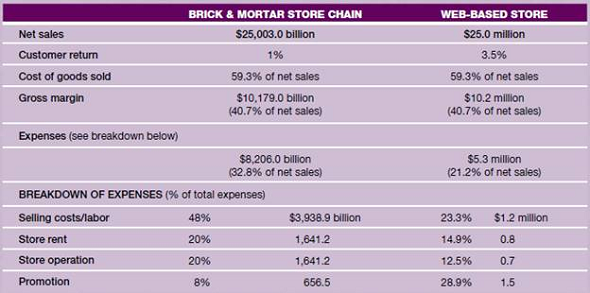
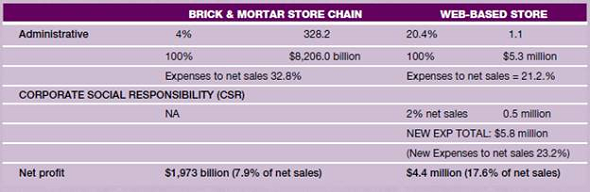
What is the net profit of the brick-and-mortar store if it uses a separate line item for corporate social responsibility (CSR), as defined here as of 2% of net sales?
Gail Baugh, M.A.
San Francisco State University and Fashion Institute of Design and Merchandising, San Francisco
Connie Ulasewicz
San Francisco State University
In the twenty-first century, corporate social responsibility (CSR) is a term well used and a process that is expected for established organizations to follow. Defined by the Harvard University as, "how companies manage their economic, social, and environmental impacts as well as their relationships in all key spheres of influence: The workplace, the marketplace, the supply chain, the community, and the public policy realm" (Corporate Social Responsibility Initiative), it is often challenging for organizations to choose and integrate the appropriate socially responsible initiatives and maintain their profitability. Companies consume large amounts of energy through lighting, heating and cooling, packaging, and shipping methods. In this case study, an iconic retail brand will be investigated to gain a better understanding of their CSR goals and challenges and the choices they make to measure and maintain their profitability.
Macy's Inc., established in 1858, operates Macy's and Bloomingdales brands with fiscal 2010 sales of $25.0 billion, and over 840 stores in 45 states, along with the Macys.com and Bloomingdales.com Web sites ( Macy's annual report, 2010). Macy's Inc. strives to maintain their profitability, while developing and measuring their social responsibility and keeping the customer at the center of their decisions. Retailing the right fashion, at the right price, at the right time, and in the right quantity is essential for this organization. Another practice currently intertwined with retailing fashion and maintaining profitability and CSR is sustainability. Retail sustainability refers to the interconnectivity of the people, processes, and environment that produce, promote, sell, and distribute goods (Hethorn Ulasewicz, 2008). Fashion and retail are ripe for sustainable actions that can create efficiencies, while increasing profits, and being good for the planet. With our current global economic challenges and drive for CSR, sustainable practices must be planned into a business model so that they are part of a fixed expense structure.
As a leading national retailer, Macy's is committed to developing business practices that are sustainable and measurable. They are redefining their profit and loss (P L) so that their business reflects their values. On their Web site (http://www.macysinc.com/aboutus/sustainability/five-point-action-plan.aspx), they outline a five-point action plan of how they will contribute to a more sustainable environment, "whenever possible and sensible within the context of their business requirements." Briefly described here, the action plan includes the following:
1. We will be more aggressive in our drive to eliminate wasteful behavior
2. We will reduce our use of scarce resources in a meaningful way
3. We will pursue the most environmentally friendly solution
4. We will take a comprehensive approach to sustainability, involving everyone around us
5. We will measure what we do and strive toward quantifiable goals.
Macy's Inc. is challenged with the same basic four expenses to maintain and grow their business in a sustainable manner as their competitors: labor, rent, utilities, and promotional activities. Several tangible actions ( Macy's annual report, 2010) they have taken include the following:
• Installed solar power systems at 40 Macy's and Bloomingdales.
• Increased the proportion of recycled or certified paper used in marketing materials to 80% in shopping bags and 89% in gift boxes.
• Installed 130,000 LED light bulbs and cut energy consumption.
• Substituted biodegradable packing materials for the foam "peanuts" in shipping products bought online.
• Initiated recycling programs diverting more than 66 tons of waste from landfill.
Online sales are potentially one method to grow a business while increasing sustainable practices and profitability. Online sales for Macy's and Bloomingdales have risen by 20 percent or more in each of the past three years ( Macy's annual report, 2010). The question is, through a sustainable lens, how are labor, rent, utilities, and promotional activities different for an online vs. brick-and-mortar Macy's ? Does this retail method create efficiencies that are good for the planet and the bottom line? One simple difference between an online and brick-and-mortar store is the use of hangers to display merchandise. Macy's uses nearly, 300 million hangers in its stores each year (Macy's Inc. Announces New Sustainability Actions). In the fall of 2011, they will be switching from their clear hangers manufactured from new petroleum-based resins to black hangers manufactured using recycled plastic materials. Clearly, this is a sustainable initiative. Yet, are hangers used for their online stores?
Macy's has also moved forward with a new organizational format for Macys.com with a separate store division, buying team, and divisional structure. Included in this case study are two profit-and-loss statements that show estimated sales and expenses for the online store as it develops. Without the expense of operating a brick-and-mortar store, which requires hiring and training sales personnel and incurring physical store operating expenses, the Web-based store has the potential for higher profits than a physical store. With today's accelerating technology that is utilized in social networking media, mobile shopping, 3-D imaging, and smart phone applications, the online retailer now has a greater potential to reach their market than ever before. Therefore, comparing a brick-and-mortar store operating statement with that of a Web-based store is a useful endeavor to further understand Macy's CSR challenges and the choices they make to measure and maintain their profitability. What follows is an abbreviated profit-and-loss statement containing estimated numbers for your thought and reflection.
SOURCES
Corporate Social Responsibility Initiative. Retrieved from http://www.hks.harvard.edu/m-rcbg/CSRI/init_define.html
Hethorn, J. Ulasewicz, C. (2008). Sustainable Fashion: Why Now? New York: Fairchild Books.
Macy's Annual Report, Developing a Culture of Growth, Macy's Inc., 2011.
Macy's Inc. Announces New Sustainability Actions. Retrieved from http://www.macysinc.com/aboutus/sustainability/2011-sustainability-actions.pdf
Sustainability at Macy's Inc: A Five-Point Action Plan. Retrieved from http://www.macysinc.com/aboutus/sustainability/five-point-action-plan.aspx
What is the net profit of the brick-and-mortar store if it uses a separate line item for corporate social responsibility (CSR), as defined here as of 2% of net sales?
Explanation Verified
Verified
The corporate social responsibility (CSR...

Merchandising Mathematics for Retailing 5th Edition by Cynthia Easterling ,Ellen Flottman,Marian Jernigan ,Beth Wuest

Why don’t you like this exercise?
Other Minimum 8 character and maximum 255 character
Character 255






