







 Chat with AI


Merchandising Mathematics for Retailing 5th Edition by Cynthia Easterling ,Ellen Flottman,Marian Jernigan ,Beth Wuest
Edition 5ISBN: 978-0132724166Merchandising Mathematics for Retailing 5th Edition by Cynthia Easterling ,Ellen Flottman,Marian Jernigan ,Beth Wuest
Edition 5ISBN: 978-0132724166 Exercise 3
Negotiations at the Footwear Market
Barbara Davis, M.S. The University of Alabama
Denise is a buyer for high-end footwear retailer, Chasseurs, which carries around 20 different designer footwear labels and has 10 stores throughout the United States. Because of a recent economic downturn, traffic into the store and, consequently, sales have been much slower than usual.
Denise decides to reevaluate each of her vendors to determine those that have and have not maintained profitability before and throughout the slow selling period. She intends to use this information to renegotiate terms, allowances, and discounts with the least profitable vendors at the upcoming June footwear market.
After analyzing each vendor and determining her plan and open-to-buy for the next season, Denise determines that, even with renegotiations, she will need to eliminate two vendors from her current assortment. The bottom four vendors-Bella Notte, Je Veux, Serge, and Rouge-are currently about even with each other in sell-through percent and gross margin and have consistently been lowest in profitability, even before the slow economy. At the June footwear market, Denise meets with each of the four vendors individually and informs them of her situation. Each vendor has agreed to offer the following new terms and discounts in hopes of continuing their business with Chasseurs:
Vendor #1-Bella Notte-is offering terms of 3/10, n 30 with a 5% markdown allowance.
Vendor #2-Je Veux-is offering terms of 2/10-50X with a quantity discount of 5% if the buyer purchases more than 1,200 pairs.
Vendor #3-Serge-is offering terms of 2/10, n 30 with a 2% damage allowance. Serge has also agreed to have an in-store designer personal appearance event each season at the three largest Chasseurs stores to help increase traffic and to promote the label.
Vendor #4-Rouge-is offering terms of Net 30 with a 5% markdown allowance. Since Rouge is Chasseurs's newest vendor, they are also offering a 2% promotional allowance at the beginning of the season and point-of-purchase posters and display fixtures to help advertise and promote the brand.
Denise is pleased that each of the vendors is willing to offer improved terms and discounts to help increase their profitability with Chasseurs. She consults her plan, open-to-buy and assortment needs to determine her purchases, while comparing the cost of each vendor. Listed below is information that Denise will need to consider:
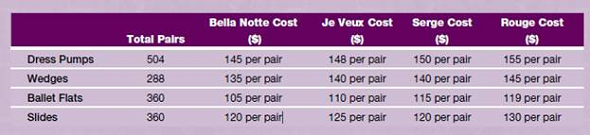
Denise has decided to place her orders with the smaller quantities from Question 2. Which two vendors should Denise keep and which two should she eliminate? Justify your answers.
Barbara Davis, M.S. The University of Alabama
Denise is a buyer for high-end footwear retailer, Chasseurs, which carries around 20 different designer footwear labels and has 10 stores throughout the United States. Because of a recent economic downturn, traffic into the store and, consequently, sales have been much slower than usual.
Denise decides to reevaluate each of her vendors to determine those that have and have not maintained profitability before and throughout the slow selling period. She intends to use this information to renegotiate terms, allowances, and discounts with the least profitable vendors at the upcoming June footwear market.
After analyzing each vendor and determining her plan and open-to-buy for the next season, Denise determines that, even with renegotiations, she will need to eliminate two vendors from her current assortment. The bottom four vendors-Bella Notte, Je Veux, Serge, and Rouge-are currently about even with each other in sell-through percent and gross margin and have consistently been lowest in profitability, even before the slow economy. At the June footwear market, Denise meets with each of the four vendors individually and informs them of her situation. Each vendor has agreed to offer the following new terms and discounts in hopes of continuing their business with Chasseurs:
Vendor #1-Bella Notte-is offering terms of 3/10, n 30 with a 5% markdown allowance.
Vendor #2-Je Veux-is offering terms of 2/10-50X with a quantity discount of 5% if the buyer purchases more than 1,200 pairs.
Vendor #3-Serge-is offering terms of 2/10, n 30 with a 2% damage allowance. Serge has also agreed to have an in-store designer personal appearance event each season at the three largest Chasseurs stores to help increase traffic and to promote the label.
Vendor #4-Rouge-is offering terms of Net 30 with a 5% markdown allowance. Since Rouge is Chasseurs's newest vendor, they are also offering a 2% promotional allowance at the beginning of the season and point-of-purchase posters and display fixtures to help advertise and promote the brand.
Denise is pleased that each of the vendors is willing to offer improved terms and discounts to help increase their profitability with Chasseurs. She consults her plan, open-to-buy and assortment needs to determine her purchases, while comparing the cost of each vendor. Listed below is information that Denise will need to consider:
Denise has decided to place her orders with the smaller quantities from Question 2. Which two vendors should Denise keep and which two should she eliminate? Justify your answers.
Explanation Verified
Verified
Selection and elimination of vendors
Bu...

Merchandising Mathematics for Retailing 5th Edition by Cynthia Easterling ,Ellen Flottman,Marian Jernigan ,Beth Wuest

Why don’t you like this exercise?
Other Minimum 8 character and maximum 255 character
Character 255






