







 Chat with AI


Merchandising Mathematics for Retailing 5th Edition by Cynthia Easterling ,Ellen Flottman,Marian Jernigan ,Beth Wuest
Edition 5ISBN: 978-0132724166Merchandising Mathematics for Retailing 5th Edition by Cynthia Easterling ,Ellen Flottman,Marian Jernigan ,Beth Wuest
Edition 5ISBN: 978-0132724166 Exercise 1
Permanent vs. Point-of-Sale Markdowns
Judi Toerge, MFA.
Academy of Art University
Mercedes is the buyer for sweaters for a five-store specialty retailer in the southern United States. The store traditionally holds two sales per year, one in fall and one in spring, during which merchandise is promotionally priced for two weeks, either as a permanent markdown or as a POS markdown. While Mercedes does not buy into her markdowns (i.e., buy merchandise that she anticipates will be marked down), the store does encourage each department to have a strong representation of markdowns on the floor during the first week of the sale. This is the vehicle by which each department remains clean and current. Mercedes's assortment, unlike that of her contemporary buyers in Collections, is item driven, so her range of styles is fewer, with more units being purchased to allow her to obtain a better gross margin because of lower costs.
This year, she has a total of six SKUs that will be involved in the fall semiannual sale. Mercedes's new merchandise manager is encouraging buyers to use a different approach in regard to the pricing strategy. Whereas in previous sales markdowns were taken permanently, Mercedes's merchandise manager is suggesting the strategy should become more aggressive with markdowns taken at the register or POS. Mercedes's goal is to minimize her markdowns, maximize her sales, attain a 100% sell-through, and achieve a 60% maintained markup. She is not convinced that her sell-throughs will be sufficient if she takes the markdowns at the POS level, as her customer is considered to be value/quality driven with a high degree of loyalty to the store. Therefore, Mercedes decides to continue using permanent markdowns by marking the merchandise to 30% off, and subsequently to 50%, and then 70% off for the last three days. Her assumption is that at the end of the sale all units will be purchased.
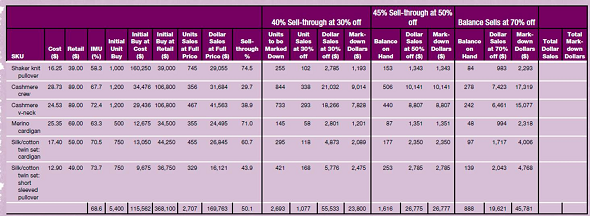
The following spreadsheet shows sales at full price and anticipated sales, using the 30%, 50%, and 70% markdown strategy.
Calculate total sales with this strategy.
Judi Toerge, MFA.
Academy of Art University
Mercedes is the buyer for sweaters for a five-store specialty retailer in the southern United States. The store traditionally holds two sales per year, one in fall and one in spring, during which merchandise is promotionally priced for two weeks, either as a permanent markdown or as a POS markdown. While Mercedes does not buy into her markdowns (i.e., buy merchandise that she anticipates will be marked down), the store does encourage each department to have a strong representation of markdowns on the floor during the first week of the sale. This is the vehicle by which each department remains clean and current. Mercedes's assortment, unlike that of her contemporary buyers in Collections, is item driven, so her range of styles is fewer, with more units being purchased to allow her to obtain a better gross margin because of lower costs.
This year, she has a total of six SKUs that will be involved in the fall semiannual sale. Mercedes's new merchandise manager is encouraging buyers to use a different approach in regard to the pricing strategy. Whereas in previous sales markdowns were taken permanently, Mercedes's merchandise manager is suggesting the strategy should become more aggressive with markdowns taken at the register or POS. Mercedes's goal is to minimize her markdowns, maximize her sales, attain a 100% sell-through, and achieve a 60% maintained markup. She is not convinced that her sell-throughs will be sufficient if she takes the markdowns at the POS level, as her customer is considered to be value/quality driven with a high degree of loyalty to the store. Therefore, Mercedes decides to continue using permanent markdowns by marking the merchandise to 30% off, and subsequently to 50%, and then 70% off for the last three days. Her assumption is that at the end of the sale all units will be purchased.
The following spreadsheet shows sales at full price and anticipated sales, using the 30%, 50%, and 70% markdown strategy.
Calculate total sales with this strategy.
Explanation Verified
Verified
Permanent Markdown: Permanent markdown i...

Merchandising Mathematics for Retailing 5th Edition by Cynthia Easterling ,Ellen Flottman,Marian Jernigan ,Beth Wuest

Why don’t you like this exercise?
Other Minimum 8 character and maximum 255 character
Character 255






