







 Chat with AI


Cornerstones of Cost Accounting 1st Edition by Don Hansen,Maryanne Mowen
Edition 1ISBN: 978-0538736787Cornerstones of Cost Accounting 1st Edition by Don Hansen,Maryanne Mowen
Edition 1ISBN: 978-0538736787 Exercise 16
ALLOCATING JOINT COSTS USING THE PHYSICAL UNITS METHOD
Appletime, Inc., purchases apples from local orchards and sorts them into four categories. Grade A are large blemish-free apples that can be sold to gourmet fruit sellers. Grade B apples are smaller and may be slightly out of proportion. These are packed in boxes and sold to grocery stores. Apples for slices are even smaller than Grade B apples and have blemishes. Apples for applesauce are of lower grade than apples for slices, yet still suitable for canning. Information on a recent purchase of 20,000 pounds of apples is as follows:
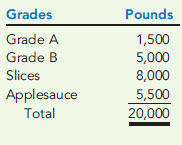
Total joint cost is $6,000.
Required:
1. Allocate the joint cost to the four grades of apples using the physical units method. (Carry out the percent calculations to four significant digits.)
2. Allocate the joint cost to the four grades of apples by finding the average joint cost per pound and multiplying it by the number of pounds in the grade. (Round all cost allocations to the nearest dollar.)
3. What if there were 2,000 pounds of Grade A apples and 4,500 pounds of Grade B? How would that affect the allocation of cost to these two grades? How would it affect the allocation of cost to the remaining common grades?
Appletime, Inc., purchases apples from local orchards and sorts them into four categories. Grade A are large blemish-free apples that can be sold to gourmet fruit sellers. Grade B apples are smaller and may be slightly out of proportion. These are packed in boxes and sold to grocery stores. Apples for slices are even smaller than Grade B apples and have blemishes. Apples for applesauce are of lower grade than apples for slices, yet still suitable for canning. Information on a recent purchase of 20,000 pounds of apples is as follows:
Total joint cost is $6,000.
Required:
1. Allocate the joint cost to the four grades of apples using the physical units method. (Carry out the percent calculations to four significant digits.)
2. Allocate the joint cost to the four grades of apples by finding the average joint cost per pound and multiplying it by the number of pounds in the grade. (Round all cost allocations to the nearest dollar.)
3. What if there were 2,000 pounds of Grade A apples and 4,500 pounds of Grade B? How would that affect the allocation of cost to these two grades? How would it affect the allocation of cost to the remaining common grades?
Explanation Verified
Verified
1.
The allocation of joint cost to the f...

Cornerstones of Cost Accounting 1st Edition by Don Hansen,Maryanne Mowen

Why don’t you like this exercise?
Other Minimum 8 character and maximum 255 character
Character 255






