







 Chat with AI


Cornerstones of Cost Accounting 1st Edition by Don Hansen,Maryanne Mowen
Edition 1ISBN: 978-0538736787Cornerstones of Cost Accounting 1st Edition by Don Hansen,Maryanne Mowen
Edition 1ISBN: 978-0538736787 Exercise 15
ROI AND INVESTMENT DECISIONS
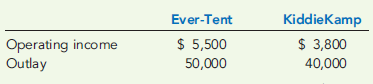
Refer to Exercise 10-7 for data. At the end of Year 2, the manager of the Camping Division is concerned about the division's performance. As a result, he is considering the opportunity to invest in two independent projects. The first is called the ''Ever-Tent''; it is a small two-person tent capable of withstanding the high winds at the top of Mt. Everest. While the market for actual Everest climbers is small, the manager expects that well-todo weekend campers will buy it due to the cachet of the name and its light weight. The second is a ''KiddieKamp'' kit which includes a child-sized sleeping bag and a colourful pup tent that can be set up easily in one's backyard. Without the investments, the division expects that Year 2 data will remain unchanged. The expected operating incomes and the outlay required for each investment are as follows:
Selfridge's corporate headquarters has made available up to $100,000 of capital for this division. Any funds not invested by the division will be retained by headquarters and invested to earn the company's minimum required rate of return, 9 percent.
Required:
1. Compute the ROI for each investment.
2. Compute the divisional ROI (rounded to four significant digits) for each of the following four alternatives:
a. The Ever-Tent is added.
b. The KiddieKamp is added.
c. Both investments are added.
d. Neither investment is made; the status quo is maintained. Assuming that divisional managers are evaluated and rewarded on the basis of ROI performance, which alternative do you think the divisional manager will choose?
Refer to Exercise 10-7 for data. At the end of Year 2, the manager of the Camping Division is concerned about the division's performance. As a result, he is considering the opportunity to invest in two independent projects. The first is called the ''Ever-Tent''; it is a small two-person tent capable of withstanding the high winds at the top of Mt. Everest. While the market for actual Everest climbers is small, the manager expects that well-todo weekend campers will buy it due to the cachet of the name and its light weight. The second is a ''KiddieKamp'' kit which includes a child-sized sleeping bag and a colourful pup tent that can be set up easily in one's backyard. Without the investments, the division expects that Year 2 data will remain unchanged. The expected operating incomes and the outlay required for each investment are as follows:
Selfridge's corporate headquarters has made available up to $100,000 of capital for this division. Any funds not invested by the division will be retained by headquarters and invested to earn the company's minimum required rate of return, 9 percent.
Required:
1. Compute the ROI for each investment.
2. Compute the divisional ROI (rounded to four significant digits) for each of the following four alternatives:
a. The Ever-Tent is added.
b. The KiddieKamp is added.
c. Both investments are added.
d. Neither investment is made; the status quo is maintained. Assuming that divisional managers are evaluated and rewarded on the basis of ROI performance, which alternative do you think the divisional manager will choose?
Explanation


This question doesn’t have an expert verified answer yet, let Quizplus AI Copilot help.

Cornerstones of Cost Accounting 1st Edition by Don Hansen,Maryanne Mowen

Why don’t you like this exercise?
Other Minimum 8 character and maximum 255 character
Character 255






