







 Chat with AI


Cornerstones of Cost Accounting 1st Edition by Don Hansen,Maryanne Mowen
Edition 1ISBN: 978-0538736787Cornerstones of Cost Accounting 1st Edition by Don Hansen,Maryanne Mowen
Edition 1ISBN: 978-0538736787 Exercise 10
EXPLOITING INTERNAL LINKAGES
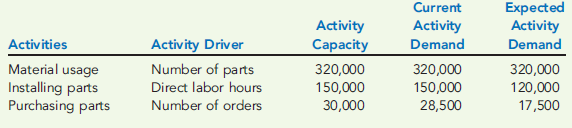
Thomas Inc., is currently producing a motorcycle that uses five specialized parts. Engineering has proposed replacing these specialized parts with commodity parts, which will cost less and can be purchased in larger order quantities. Current activity capacity and demand (with specialized parts required) and expected activity demand (with only commodity parts required) are provided.
Additionally, the following activity cost data are provided:
Material usage : $40 per specialized part used; $20 per commodity part; no fixed activity cost.
Installing parts : $15 per direct labor hour; no fixed activity cost.
Purchasing parts : Five salaried clerks, each earning a $40,000 annual salary; each clerk is capable of processing 6,000 purchase orders. Variable activity costs: $0.75 per purchase order processed for forms, postage, etc.
Required:
1. Calculate the cost reduction produced by using commodity parts instead of specialized parts.
2. Suppose that 64,000 units are being produced and sold for $9,000 per unit and that the price per unit will be reduced by the per-unit savings. What is the new price for the configured product?
3. What if the expected activity demand for purchase orders was 11,500? How would this affect the answers to Requirements 1 and 2?
Thomas Inc., is currently producing a motorcycle that uses five specialized parts. Engineering has proposed replacing these specialized parts with commodity parts, which will cost less and can be purchased in larger order quantities. Current activity capacity and demand (with specialized parts required) and expected activity demand (with only commodity parts required) are provided.
Additionally, the following activity cost data are provided:
Material usage : $40 per specialized part used; $20 per commodity part; no fixed activity cost.
Installing parts : $15 per direct labor hour; no fixed activity cost.
Purchasing parts : Five salaried clerks, each earning a $40,000 annual salary; each clerk is capable of processing 6,000 purchase orders. Variable activity costs: $0.75 per purchase order processed for forms, postage, etc.
Required:
1. Calculate the cost reduction produced by using commodity parts instead of specialized parts.
2. Suppose that 64,000 units are being produced and sold for $9,000 per unit and that the price per unit will be reduced by the per-unit savings. What is the new price for the configured product?
3. What if the expected activity demand for purchase orders was 11,500? How would this affect the answers to Requirements 1 and 2?
Explanation Verified
Verified
1).
Calculation of the cost reduction p...

Cornerstones of Cost Accounting 1st Edition by Don Hansen,Maryanne Mowen

Why don’t you like this exercise?
Other Minimum 8 character and maximum 255 character
Character 255






