







 Chat with AI


Cornerstones of Cost Accounting 1st Edition by Don Hansen,Maryanne Mowen
Edition 1ISBN: 978-0538736787Cornerstones of Cost Accounting 1st Edition by Don Hansen,Maryanne Mowen
Edition 1ISBN: 978-0538736787 Exercise 14
ACTIVITY-BASED MANAGEMENT, NON-VALUE-ADDED COSTS, TARGET COSTS, KAIZEN COSTING
Jerry Goff, president of Harmony Electronics, was concerned about the end-of-the-year marketing report that he had just received. According to Emily Hagood, marketing manager, a price decrease for the coming year was again needed to maintain the company's annual sales volume of integrated circuit boards (CBs). This would make a bad situation worse. The current selling price of $18 per unit was producing a $2-per-unit profit-half the customary $4-per-unit profit. Foreign competitors keep reducing their prices. To match the latest reduction would reduce the price from $18 to $14. This would put the price below the cost to produce and sell it. How could the foreign firms sell for such a low price? Determined to find out if there were problems with the company's operations, Jerry decided to hire Jan Booth, a well-known consultant who specializes in methods of continuous improvement. Jan indicated that she felt that an activity-based management system needed to be implemented. After three weeks, Jan had identified the following activities and costs:
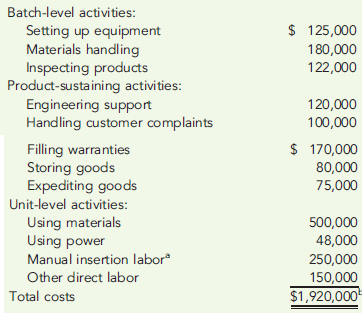
Jan indicated that some preliminary activity analysis shows that per-unit costs can be reduced by at least $7. Since Emily had indicated that the market share (sales volume) for the boards could be increased by 50 percent if the price could be reduced to $12, Jerry became quite excited.
Required:
1. What is activity-based management? What connection does it have to continuous improvement?
2. Identify as many non-value-added costs as possible. Compute the cost savings per unit that would be realized if these costs were eliminated.Was Jan correct in her preliminary cost reduction assessment? Discuss actions that the company can take to reduce or eliminate the non-value-added activities.
3. Compute the target cost required to maintain current market share, while earning a profit of $4 per unit. Now, compute the target cost required to expand sales by 50 percent. How much cost reduction would be required to achieve each target?
4. Assume that Jan suggested that kaizen costing be used to help reduce costs. The first suggested kaizen initiative is described by the following: switching to automated insertion would save $60,000 of engineering support and $90,000 of direct labor. Now, what is the total potential cost reduction per unit available? With these additional reductions, can Harmony achieve the target cost to maintain current sales? To increase it by 50 percent? What form of activity analysis is this kaizen initiative: reduction, sharing, elimination, or selection?
5. Calculate income based on current sales, prices, and costs. Now, calculate the income using a $14 price and a $12 price, assuming that the maximum cost reduction possible is achieved (including Requirement 4's kaizen reduction). What price should be selected?
Jerry Goff, president of Harmony Electronics, was concerned about the end-of-the-year marketing report that he had just received. According to Emily Hagood, marketing manager, a price decrease for the coming year was again needed to maintain the company's annual sales volume of integrated circuit boards (CBs). This would make a bad situation worse. The current selling price of $18 per unit was producing a $2-per-unit profit-half the customary $4-per-unit profit. Foreign competitors keep reducing their prices. To match the latest reduction would reduce the price from $18 to $14. This would put the price below the cost to produce and sell it. How could the foreign firms sell for such a low price? Determined to find out if there were problems with the company's operations, Jerry decided to hire Jan Booth, a well-known consultant who specializes in methods of continuous improvement. Jan indicated that she felt that an activity-based management system needed to be implemented. After three weeks, Jan had identified the following activities and costs:
Jan indicated that some preliminary activity analysis shows that per-unit costs can be reduced by at least $7. Since Emily had indicated that the market share (sales volume) for the boards could be increased by 50 percent if the price could be reduced to $12, Jerry became quite excited.
Required:
1. What is activity-based management? What connection does it have to continuous improvement?
2. Identify as many non-value-added costs as possible. Compute the cost savings per unit that would be realized if these costs were eliminated.Was Jan correct in her preliminary cost reduction assessment? Discuss actions that the company can take to reduce or eliminate the non-value-added activities.
3. Compute the target cost required to maintain current market share, while earning a profit of $4 per unit. Now, compute the target cost required to expand sales by 50 percent. How much cost reduction would be required to achieve each target?
4. Assume that Jan suggested that kaizen costing be used to help reduce costs. The first suggested kaizen initiative is described by the following: switching to automated insertion would save $60,000 of engineering support and $90,000 of direct labor. Now, what is the total potential cost reduction per unit available? With these additional reductions, can Harmony achieve the target cost to maintain current sales? To increase it by 50 percent? What form of activity analysis is this kaizen initiative: reduction, sharing, elimination, or selection?
5. Calculate income based on current sales, prices, and costs. Now, calculate the income using a $14 price and a $12 price, assuming that the maximum cost reduction possible is achieved (including Requirement 4's kaizen reduction). What price should be selected?
Explanation Verified
Verified
1.
Activity-based management:
Activity-...

Cornerstones of Cost Accounting 1st Edition by Don Hansen,Maryanne Mowen

Why don’t you like this exercise?
Other Minimum 8 character and maximum 255 character
Character 255






