







 Chat with AI


Cornerstones of Cost Accounting 1st Edition by Don Hansen,Maryanne Mowen
Edition 1ISBN: 978-0538736787Cornerstones of Cost Accounting 1st Edition by Don Hansen,Maryanne Mowen
Edition 1ISBN: 978-0538736787 Exercise 32
CYCLE TIME, VELOCITY, PRODUCT COSTING
Morrison, Inc., has a JIT system in place. Each manufacturing cell is dedicated to the production of a single product or major subassembly. One cell, dedicated to the production of small four wheelers, has four operations: machining, finishing, assembly, and qualifying (testing). The machining process is automated, using computers. In this process, the model's frame and engine are constructed. In finishing, the frame is sandblasted, buffed, and painted. In assembly, the frame and engine are assembled. Finally, each model is tested to ensure operational capability.
For the coming year, the four-wheeler cell has the following budgeted costs and cell time (both at theoretical capacity):

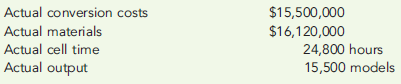
During the year, the following actual results were obtained:
Required:
1. Compute the velocity (number of models per hour) that the cell can theoretically achieve. Now, compute the theoretical cycle time (number of hours or minutes per model) that it takes to produce one model.
2. Compute the actual velocity and the actual cycle time.
3. Compute MCE. Comment on the efficiency of the operation.
4. Compute the budgeted conversion cost per minute. Using this rate, compute the conversion cost per model if theoretical output is achieved. Using this measure, compute the conversion cost per model for actual output. Does this product costing approach provide an incentive for the cell manager to reduce cycle time? Explain.
Morrison, Inc., has a JIT system in place. Each manufacturing cell is dedicated to the production of a single product or major subassembly. One cell, dedicated to the production of small four wheelers, has four operations: machining, finishing, assembly, and qualifying (testing). The machining process is automated, using computers. In this process, the model's frame and engine are constructed. In finishing, the frame is sandblasted, buffed, and painted. In assembly, the frame and engine are assembled. Finally, each model is tested to ensure operational capability.
For the coming year, the four-wheeler cell has the following budgeted costs and cell time (both at theoretical capacity):
During the year, the following actual results were obtained:
Required:
1. Compute the velocity (number of models per hour) that the cell can theoretically achieve. Now, compute the theoretical cycle time (number of hours or minutes per model) that it takes to produce one model.
2. Compute the actual velocity and the actual cycle time.
3. Compute MCE. Comment on the efficiency of the operation.
4. Compute the budgeted conversion cost per minute. Using this rate, compute the conversion cost per model if theoretical output is achieved. Using this measure, compute the conversion cost per model for actual output. Does this product costing approach provide an incentive for the cell manager to reduce cycle time? Explain.
Explanation Verified
Verified
1. Computation of the theoretical veloci...

Cornerstones of Cost Accounting 1st Edition by Don Hansen,Maryanne Mowen

Why don’t you like this exercise?
Other Minimum 8 character and maximum 255 character
Character 255






