







 Chat with AI


Labor Economics 5th Edition by George Borjas
Edition 5ISBN: 978-0073511368Labor Economics 5th Edition by George Borjas
Edition 5ISBN: 978-0073511368 Exercise 7
Suppose the union's resistance curve is summarized by the following data. The union's initial wage demand is $10 per hour. If a strike occurs, the wage demands change as follows:
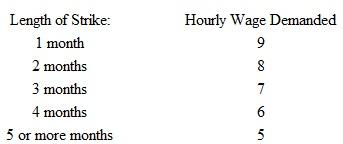 Consider the following changes to the union resistance curve and state whether the proposed change makes a strike more likely to occur, and whether, if a strike occurs, it is a longer strike.
(a) The drop in the wage demand from $10 to $5 per hour occurs within the span of 2 months, as opposed to 5 months.
(b) The union is willing to moderate its wage demands further after the strike has lasted for 6 months. In particular, the wage demand keeps dropping to $4 in the 6th month, $3 in the 7th month, and so on.
(c) The union's initial wage demand is $20 per hour, which then drops to $9 after the strike lasts one month, $8 after 2 months, and so on.
Consider the following changes to the union resistance curve and state whether the proposed change makes a strike more likely to occur, and whether, if a strike occurs, it is a longer strike. (a) The drop in the wage demand from $10 to $5 per hour occurs within the span of 2 months, as opposed to 5 months.
(b) The union is willing to moderate its wage demands further after the strike has lasted for 6 months. In particular, the wage demand keeps dropping to $4 in the 6th month, $3 in the 7th month, and so on.
(c) The union's initial wage demand is $20 per hour, which then drops to $9 after the strike lasts one month, $8 after 2 months, and so on.
Explanation Verified
Verified
(a)Occurrence of the strikes is affected...

Labor Economics 5th Edition by George Borjas

Why don’t you like this exercise?
Other Minimum 8 character and maximum 255 character
Character 255






