







 Chat with AI


The Economic Way of Thinking 13th Edition by David Prychitko, Peter Boettke, Paul Heyne
Edition 13ISBN: 9780132992695The Economic Way of Thinking 13th Edition by David Prychitko, Peter Boettke, Paul Heyne
Edition 13ISBN: 9780132992695 Exercise 8
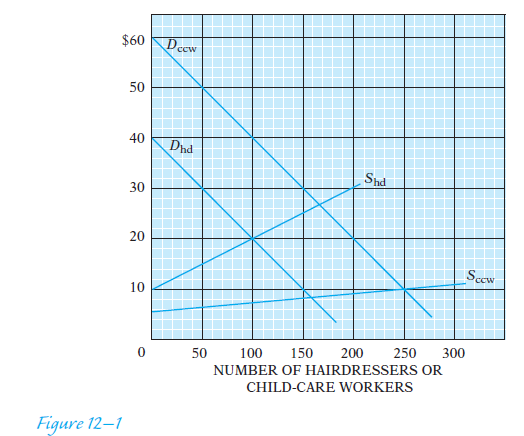
In what sense do relative prices reflect relative value? Here is a question to help you think about it. Suppose that the average wage of a hairdresser is twice the average wage of a child-care worker, and that prompts the following comment: "By paying hairdressers twice as much as child-care workers, this society is saying that people who cater to human vanity are twice as valuable as people who care for our children." Is that true in the situation summarized in Figure 12-1? D hd portrays the demand for hairdressers and D ccw the demand for child-care workers. S hd portrays the supply of qualified hairdressers and S ccw the supply of qualified child-care workers. The market-clearing wage is $20 for hairdressers and $10 for child-care workers.
(a) In what sense precisely is a hairdresser worth twice as much as a child-care worker in this society?
(b) The demand for child-care workers seems to be considerably greater than the demand for hairdressers. Why then do hairdressers command twice as high a wage?
(c) Do the supply curves tell us anything about the relative value people place on styling hair versus caring for children? If the social esteem attached to a particular job increases, what effect will this have on the supply of qualified people willing to work at that job? What effect will that have in turn on the market-clearing wage rate for the job?
(d) Use the information provided on the graph to make an argument that this society in fact places more than twice as much monetary value on the services of child-care workers than it places on the services of hairdressers.
(a) In what sense precisely is a hairdresser worth twice as much as a child-care worker in this society?
(b) The demand for child-care workers seems to be considerably greater than the demand for hairdressers. Why then do hairdressers command twice as high a wage?
(c) Do the supply curves tell us anything about the relative value people place on styling hair versus caring for children? If the social esteem attached to a particular job increases, what effect will this have on the supply of qualified people willing to work at that job? What effect will that have in turn on the market-clearing wage rate for the job?
(d) Use the information provided on the graph to make an argument that this society in fact places more than twice as much monetary value on the services of child-care workers than it places on the services of hairdressers.
Explanation Verified
Verified
A relative price is the ratio of two p...

The Economic Way of Thinking 13th Edition by David Prychitko, Peter Boettke, Paul Heyne

Why don’t you like this exercise?
Other Minimum 8 character and maximum 255 character
Character 255






