







 Chat with AI


Marketing 4th Edition by Dhruv Grewal,Michael Levy
Edition 4ISBN: 978-0077861025Marketing 4th Edition by Dhruv Grewal,Michael Levy
Edition 4ISBN: 978-0077861025 Exercise 1
WHOSE SIDE ARE YOU ON
Lauren Smith was recently hired by a large architecture and engineering firm as an assistant account manager in the government contracts division. The firm specializes in building hospitals, schools, and other large-scale projects. Lauren is excited to learn that she will be part of the marketing team that presents the firm's proposals to the clients. In this case the clients are primarily federal and state governmental agencies. The presentations are elaborate, often costing $50,000 or more to prepare. But the projects can be worth millions to the firm, so the investment is worth it. The firm has a solid record for building quality projects, on time, and the majority of the time within budget. The firm also has an impressive track record, being awarded government contracts an incredible 85 percent of the time. No other firm in the industry comes close to this record.
The first project Lauren is assigned to is an enormous project to design a new military hospital complex. The team leader, Brian Jenkins, has stressed how crucial it is for the firm to land this contract. He hints that if the team is successful the members will be well compensated. In fact, Lauren heard that the members of the winning team for the last contract this size each received a $10,000 bonus.
Not long after the project commences, Brian invites Lauren to have lunch so they can get to know each other better. During lunch, a man approaches Brian and asks if he has received the information. The man says that he knows that with this information the firm is a sure winner. He also reminds Brian that he is due a bonus for getting such crucial information. After he leaves Brian explains that the man is George Miller, who was the former head of the division awarding the hospital contract. George has been helping Brian by talking to the decision team and getting information relevant to the bid. Brian explains that the information George has gathered about the internal discussions among the buying team will be what makes their proposal a clear winner, obviously good news for the team since a winning bid means bonuses are almost assured.
After lunch Lauren looks at the firm's ethics manual that she was given just last week at a new employee orientation. Lobbying without disclosure and paying for insider information are clearly discussed as unethical practices in the manual. Yet Brian seemed perfectly comfortable discussing George's role with Lauren.
Lauren decides she should check with another team member about the use of insider information, so she asks Sue Garcia. Sue tells Lauren that this kind of thing happens all the time. She jokes that most of the people in the division have at one time or another worked for the government. They all still know people in the various agencies. As far as Sue is concerned, friends will talk and that is not illegal, so there is no problem. It's a win-win situation: the government will get its building, the firm its funding, and the employees their bonuses.
Lauren realizes that with her overdue credit card bill and her needed car repairs, the bonus money would really help out. Besides, she is the most junior member of the team. If all the others are comfortable with this practice, why should she be concerned After all, it is just friends talking, isn't it
Questions
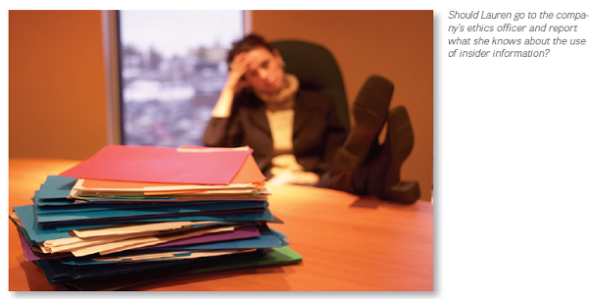
Using the framework for ethical decision making presented in the chapter (Exhibit 4.3 ), analyze Lauren's dilemma. Should she go to the company's ethics officer and report what she knows about the use of insider information
Lauren Smith was recently hired by a large architecture and engineering firm as an assistant account manager in the government contracts division. The firm specializes in building hospitals, schools, and other large-scale projects. Lauren is excited to learn that she will be part of the marketing team that presents the firm's proposals to the clients. In this case the clients are primarily federal and state governmental agencies. The presentations are elaborate, often costing $50,000 or more to prepare. But the projects can be worth millions to the firm, so the investment is worth it. The firm has a solid record for building quality projects, on time, and the majority of the time within budget. The firm also has an impressive track record, being awarded government contracts an incredible 85 percent of the time. No other firm in the industry comes close to this record.
The first project Lauren is assigned to is an enormous project to design a new military hospital complex. The team leader, Brian Jenkins, has stressed how crucial it is for the firm to land this contract. He hints that if the team is successful the members will be well compensated. In fact, Lauren heard that the members of the winning team for the last contract this size each received a $10,000 bonus.
Not long after the project commences, Brian invites Lauren to have lunch so they can get to know each other better. During lunch, a man approaches Brian and asks if he has received the information. The man says that he knows that with this information the firm is a sure winner. He also reminds Brian that he is due a bonus for getting such crucial information. After he leaves Brian explains that the man is George Miller, who was the former head of the division awarding the hospital contract. George has been helping Brian by talking to the decision team and getting information relevant to the bid. Brian explains that the information George has gathered about the internal discussions among the buying team will be what makes their proposal a clear winner, obviously good news for the team since a winning bid means bonuses are almost assured.
After lunch Lauren looks at the firm's ethics manual that she was given just last week at a new employee orientation. Lobbying without disclosure and paying for insider information are clearly discussed as unethical practices in the manual. Yet Brian seemed perfectly comfortable discussing George's role with Lauren.
Lauren decides she should check with another team member about the use of insider information, so she asks Sue Garcia. Sue tells Lauren that this kind of thing happens all the time. She jokes that most of the people in the division have at one time or another worked for the government. They all still know people in the various agencies. As far as Sue is concerned, friends will talk and that is not illegal, so there is no problem. It's a win-win situation: the government will get its building, the firm its funding, and the employees their bonuses.
Lauren realizes that with her overdue credit card bill and her needed car repairs, the bonus money would really help out. Besides, she is the most junior member of the team. If all the others are comfortable with this practice, why should she be concerned After all, it is just friends talking, isn't it
Questions
Using the framework for ethical decision making presented in the chapter (Exhibit 4.3 ), analyze Lauren's dilemma. Should she go to the company's ethics officer and report what she knows about the use of insider information
Explanation Verified
Verified
Case Study
Using the steps of the ethic...

Marketing 4th Edition by Dhruv Grewal,Michael Levy

Why don’t you like this exercise?
Other Minimum 8 character and maximum 255 character
Character 255






