







 Chat with AI


Marketing 4th Edition by Dhruv Grewal,Michael Levy
Edition 4ISBN: 978-0077861025Marketing 4th Edition by Dhruv Grewal,Michael Levy
Edition 4ISBN: 978-0077861025 Exercise 1
A NEXT-GENERATION CLEANSER
Taking an Iroquois directive-"In our every deliberation, we must consider the impact of our decisions on the next seven generations"-the consumer product company Seventh Generation has applied a distinctly modern sensibility to derive a long-term approach to the marketing environment. Although its mission statement might be focused on future generations, its efforts to appeal to current consumers are always responsive to their immediate demands.
From its start in Vermont in 1988, Seventh Generation has grown to become a national brand with over $150 million in revenues. Its growth has been sparked largely by consumer desires to buy more sustainable, environmentally safe, green products. Approximately 73 percent of consumers in a recent survey indicated that they thought it was important to buy green offerings, and consumer demand for products in a wide range of categories continues to grow.
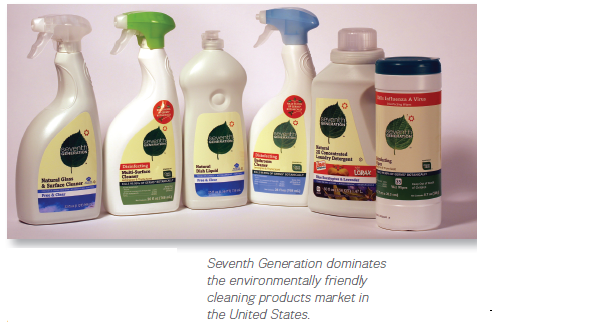
But even as more categories appear to offer promising green opportunities for marketers, the primary purchase area continues to be groceries and household products-exactly the space that Seventh Generation dominates. As it has gained brand recognition and trust, it also has proactively altered its market. That is, Seventh Generation does not simply wait for customers to request options. It creates entirely new categories.
With a new line of detergents, Seventh Generation began promoting the idea that perhaps chemical brighteners-common to virtually all commercially available detergents, even those that avoid dyes or fragrances-are not necessary. The company took care not to suggest these chemicals were dangerous. It just says they're unnecessary, and for consumers interested in environmental concerns, that may be enough.
Previously, household magazines such as Good Housekeeping or Real Simple might rank the best detergent, the best dishwashing soap, and the best surface cleaner. But the entry of companies such as Seventh Generation has created new categories: best green detergent, best green dishwashing soap, and best green cleaner. Seventh Generation products consistently emerge victorious in these new category contests.
In addition, to maintain its brand recognition, it uses extensive, multimedia marketing initiatives. In print ads, it highlights the environmentally friendly contents of its laundry detergent. It provides free samples to active bloggers, along with blacklights so these consumers can test their own clothes to see the residues left by other detergents. Dozens have posted the results of their own in-home experiments.
Yet its products also cost more, which offers a significant challenge in a recessionary economy. Many consumer product companies are touting their downmarket brands, even as Seventh Generation introduces a 4 × concentrated laundry detergent that costs significantly more. The new derivation avoids all volatile organic compounds and relies on enzymes to get clothes clean. That may be appealing to some consumers, but can they afford to pay for expensive enzymes included in every load of laundry
Questions
What consumer trends does Seventh Generation respond to most effectively
Taking an Iroquois directive-"In our every deliberation, we must consider the impact of our decisions on the next seven generations"-the consumer product company Seventh Generation has applied a distinctly modern sensibility to derive a long-term approach to the marketing environment. Although its mission statement might be focused on future generations, its efforts to appeal to current consumers are always responsive to their immediate demands.
From its start in Vermont in 1988, Seventh Generation has grown to become a national brand with over $150 million in revenues. Its growth has been sparked largely by consumer desires to buy more sustainable, environmentally safe, green products. Approximately 73 percent of consumers in a recent survey indicated that they thought it was important to buy green offerings, and consumer demand for products in a wide range of categories continues to grow.
But even as more categories appear to offer promising green opportunities for marketers, the primary purchase area continues to be groceries and household products-exactly the space that Seventh Generation dominates. As it has gained brand recognition and trust, it also has proactively altered its market. That is, Seventh Generation does not simply wait for customers to request options. It creates entirely new categories.
With a new line of detergents, Seventh Generation began promoting the idea that perhaps chemical brighteners-common to virtually all commercially available detergents, even those that avoid dyes or fragrances-are not necessary. The company took care not to suggest these chemicals were dangerous. It just says they're unnecessary, and for consumers interested in environmental concerns, that may be enough.
Previously, household magazines such as Good Housekeeping or Real Simple might rank the best detergent, the best dishwashing soap, and the best surface cleaner. But the entry of companies such as Seventh Generation has created new categories: best green detergent, best green dishwashing soap, and best green cleaner. Seventh Generation products consistently emerge victorious in these new category contests.
In addition, to maintain its brand recognition, it uses extensive, multimedia marketing initiatives. In print ads, it highlights the environmentally friendly contents of its laundry detergent. It provides free samples to active bloggers, along with blacklights so these consumers can test their own clothes to see the residues left by other detergents. Dozens have posted the results of their own in-home experiments.
Yet its products also cost more, which offers a significant challenge in a recessionary economy. Many consumer product companies are touting their downmarket brands, even as Seventh Generation introduces a 4 × concentrated laundry detergent that costs significantly more. The new derivation avoids all volatile organic compounds and relies on enzymes to get clothes clean. That may be appealing to some consumers, but can they afford to pay for expensive enzymes included in every load of laundry
Questions
What consumer trends does Seventh Generation respond to most effectively
Explanation Verified
Verified
Response of S Generation Company to the ...

Marketing 4th Edition by Dhruv Grewal,Michael Levy

Why don’t you like this exercise?
Other Minimum 8 character and maximum 255 character
Character 255






