







 Chat with AI


Marketing 4th Edition by Dhruv Grewal,Michael Levy
Edition 4ISBN: 978-0077861025Marketing 4th Edition by Dhruv Grewal,Michael Levy
Edition 4ISBN: 978-0077861025 Exercise 4
RACING TO CAPTURE CHINA'S LUXURY CAR MARKET
China's car market dates back just three decades, yet the Asian giant is well on its way to surpassing the United States as the world's most lucrative and strategically important auto market. Government investment in infrastructure, including the development of roads and bridges, has helped the nascent car industry, and sales growth in the overall market has soared by 30 percent annually for several years. Last year, Chinese consumers bought 2.2 million vehicles more than United States drivers purchased, and more than 60 percent of them were foreign-origin brands, produced in China through joint ventures.
Perhaps the fiercest arena of competition is China's luxury car market, projected to become the world's largest within five to seven years. The dominant players include Audi and BMW, as well as Mercedes-Benz and Buick. Audi has reported 61 percent increases in Chinese sales; BMW sales in China, Hong Kong, and Taiwan were projected to rise by 85.3 percent over their previous rates.
Yet these figures are not the whole story: China is a challenging market to penetrate, especially because of its continent-wide geographic area, complex cultural diversity, and growing gaps (both economic and social) between poorer rural regions and the booming cities on the coastline. Furthermore, prevailing stereotypes and images of particular car brands are rooted in history, and no foreign carmaker can safely ignore these strong opinions and ideas. Some foreign companies, such as Audi, have eased the path by entering into joint ventures.
Audi was the earliest entrant into the Chinese prestige car market, when its German owner, Volkswagen, struck a joint venture agreement with the Chinese carmaker Yiqi in 1988. By the time BMW opened a plant in China in 2003, Audi had secured a place on the central government's authorized purchase list, and its A6 line had become the de facto car of choice for Chinese bureaucrats. The company captured so much of China's government-car market that it has given rise to the stereotype that the sleek looking A6-invariably with dark, tinted windows-must be carrying a party technocrat whenever it appears on city streets.
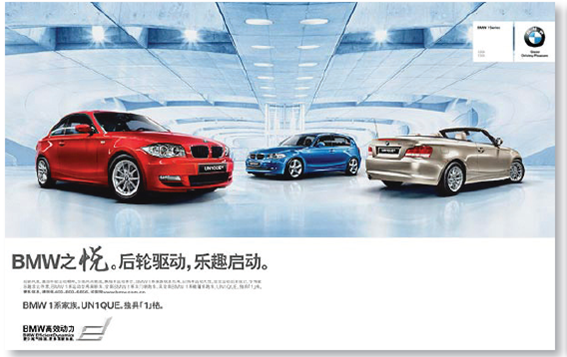
Audi has done well with this market segment. A basic Audi A6 costs 355,000 renminbi, or $56,000. Its key competitor, the BMW 5, is more expensive, at 428,000 renminbi, or $67,520. Audi's sales to the government accounts for approximately 20 percent of its Chinese revenues, and it sold 227,938 cars in China in 2010, more than twice the number that it sold in the United States.
Not to be outdone, U.S. carmakers have worked to establish effective brand perceptions and reputations, largely based on improving stereotyping about the car's "face." The American-made Buick seemed "damaged" at the start of the twenty-first century because of the car's longstanding popularity and association with older retirees, but in China, it played on unique historical connections to help ignite demand by reminding car buyers that China's last emperor and its one-time premier Zhou Enlai both drove Buicks. Thus the brand gained a strong position as a top-tier luxury carmaker. Its 2010 Chinese sales were more than triple its revenue in the United States. But for Mercedes-Benz, such stereotyping has persisted. Whereas most U.S. consumers view both these automobiles as cars for people with established wealth, the Mercedes in China may be for the wealthy, but it is still associated with older, retired drivers.
The most dynamic market niche for luxury cars reflects a rising class of young, affluent entrepreneurs with flashy buying habits. BMW, the world's top-selling luxury car brand, 75 has vigorously targeted these brash new drivers with exotic marketing campaigns. The Munich-based automaker began offering test drives and cross-country expeditions with its high-end X5 SUV in the deserts of Inner Mongolia and along Silk Road, enticing thrill-bound luxury car customers. Their campaign showcases new technology, and it has helped build brand loyalty: China is BMW's third-largest market.
Yet its targeting strategy has also left behind some negative Chinese attitudes that link BMW to careless, nouveau riche drivers. That stereotype grew after young BMW drivers, in separate incidents, were charged in fatal accidents. When a young woman intentionally ran over an indigent man after he dented her BMW X5, then settled out of court for $11,000, the story helped fan the tensions between China's rich and poor. In the cross-fire, BMW was tagged with a reputation for catering to the arrogant and the reckless. That tag now extends to other BMW drivers; government officials who show up in a BMW, rather than the typical, less expensive Audi, run the risk of being accused of corruption.
In a push to innovate and perhaps revive a broader appeal, BMW has launched a strategic alliance with Toyota, focused on sustainable technologies. The companies will collaborate on diesel engines, which dominate Europe's fuel-efficient car market. They also have agreed to develop a next-generation lithium battery, a key component of laptops and electric cars.
Other examples of market expansion by luxury carmakers include ventures into some of China's less developed cities. These second-and third-tier locations provide access to a new class of potential buyers, that is, affluent consumers who live farther from the major metropolitan centers. Major cities such as Beijing and Shanghai are limiting car purchases, because their streets cannot handle more traffic, but smaller cities in outlying provinces offer promising alternative markets.
Its early entrance into the market, through a joint venture with a Chinese carmaker, allowed Audi to become deeply entrenched in the government's purchasing system. But with BMW courting wealthier young drivers, the competition between these two foreign automakers is heating up. Strategic partnerships will continue to play a key role in shaping new opportunities, though limits on car registration in some major cities may shift those opportunities to other geographic segments. Amid all these dynamics, Chinese brand attitudes will continue to determine the buying decisions of drivers in the world's largest car market.
BMW has successfully targeted China's affluent, young car drivers, but the brand's success in that market has also provoked public backlash. What drives such public hostility to the brand, and how serious a problem is it What marketing approach, if any, should the company undertake in response
China's car market dates back just three decades, yet the Asian giant is well on its way to surpassing the United States as the world's most lucrative and strategically important auto market. Government investment in infrastructure, including the development of roads and bridges, has helped the nascent car industry, and sales growth in the overall market has soared by 30 percent annually for several years. Last year, Chinese consumers bought 2.2 million vehicles more than United States drivers purchased, and more than 60 percent of them were foreign-origin brands, produced in China through joint ventures.
Perhaps the fiercest arena of competition is China's luxury car market, projected to become the world's largest within five to seven years. The dominant players include Audi and BMW, as well as Mercedes-Benz and Buick. Audi has reported 61 percent increases in Chinese sales; BMW sales in China, Hong Kong, and Taiwan were projected to rise by 85.3 percent over their previous rates.
Yet these figures are not the whole story: China is a challenging market to penetrate, especially because of its continent-wide geographic area, complex cultural diversity, and growing gaps (both economic and social) between poorer rural regions and the booming cities on the coastline. Furthermore, prevailing stereotypes and images of particular car brands are rooted in history, and no foreign carmaker can safely ignore these strong opinions and ideas. Some foreign companies, such as Audi, have eased the path by entering into joint ventures.
Audi was the earliest entrant into the Chinese prestige car market, when its German owner, Volkswagen, struck a joint venture agreement with the Chinese carmaker Yiqi in 1988. By the time BMW opened a plant in China in 2003, Audi had secured a place on the central government's authorized purchase list, and its A6 line had become the de facto car of choice for Chinese bureaucrats. The company captured so much of China's government-car market that it has given rise to the stereotype that the sleek looking A6-invariably with dark, tinted windows-must be carrying a party technocrat whenever it appears on city streets.
Audi has done well with this market segment. A basic Audi A6 costs 355,000 renminbi, or $56,000. Its key competitor, the BMW 5, is more expensive, at 428,000 renminbi, or $67,520. Audi's sales to the government accounts for approximately 20 percent of its Chinese revenues, and it sold 227,938 cars in China in 2010, more than twice the number that it sold in the United States.
Not to be outdone, U.S. carmakers have worked to establish effective brand perceptions and reputations, largely based on improving stereotyping about the car's "face." The American-made Buick seemed "damaged" at the start of the twenty-first century because of the car's longstanding popularity and association with older retirees, but in China, it played on unique historical connections to help ignite demand by reminding car buyers that China's last emperor and its one-time premier Zhou Enlai both drove Buicks. Thus the brand gained a strong position as a top-tier luxury carmaker. Its 2010 Chinese sales were more than triple its revenue in the United States. But for Mercedes-Benz, such stereotyping has persisted. Whereas most U.S. consumers view both these automobiles as cars for people with established wealth, the Mercedes in China may be for the wealthy, but it is still associated with older, retired drivers.
The most dynamic market niche for luxury cars reflects a rising class of young, affluent entrepreneurs with flashy buying habits. BMW, the world's top-selling luxury car brand, 75 has vigorously targeted these brash new drivers with exotic marketing campaigns. The Munich-based automaker began offering test drives and cross-country expeditions with its high-end X5 SUV in the deserts of Inner Mongolia and along Silk Road, enticing thrill-bound luxury car customers. Their campaign showcases new technology, and it has helped build brand loyalty: China is BMW's third-largest market.
Yet its targeting strategy has also left behind some negative Chinese attitudes that link BMW to careless, nouveau riche drivers. That stereotype grew after young BMW drivers, in separate incidents, were charged in fatal accidents. When a young woman intentionally ran over an indigent man after he dented her BMW X5, then settled out of court for $11,000, the story helped fan the tensions between China's rich and poor. In the cross-fire, BMW was tagged with a reputation for catering to the arrogant and the reckless. That tag now extends to other BMW drivers; government officials who show up in a BMW, rather than the typical, less expensive Audi, run the risk of being accused of corruption.
In a push to innovate and perhaps revive a broader appeal, BMW has launched a strategic alliance with Toyota, focused on sustainable technologies. The companies will collaborate on diesel engines, which dominate Europe's fuel-efficient car market. They also have agreed to develop a next-generation lithium battery, a key component of laptops and electric cars.
Other examples of market expansion by luxury carmakers include ventures into some of China's less developed cities. These second-and third-tier locations provide access to a new class of potential buyers, that is, affluent consumers who live farther from the major metropolitan centers. Major cities such as Beijing and Shanghai are limiting car purchases, because their streets cannot handle more traffic, but smaller cities in outlying provinces offer promising alternative markets.
Its early entrance into the market, through a joint venture with a Chinese carmaker, allowed Audi to become deeply entrenched in the government's purchasing system. But with BMW courting wealthier young drivers, the competition between these two foreign automakers is heating up. Strategic partnerships will continue to play a key role in shaping new opportunities, though limits on car registration in some major cities may shift those opportunities to other geographic segments. Amid all these dynamics, Chinese brand attitudes will continue to determine the buying decisions of drivers in the world's largest car market.
BMW has successfully targeted China's affluent, young car drivers, but the brand's success in that market has also provoked public backlash. What drives such public hostility to the brand, and how serious a problem is it What marketing approach, if any, should the company undertake in response
Explanation Verified
Verified
Public Hostility
The following targetin...

Marketing 4th Edition by Dhruv Grewal,Michael Levy

Why don’t you like this exercise?
Other Minimum 8 character and maximum 255 character
Character 255






