







 Chat with AI


Environmental Economics 7th Edition by Barry Field,Martha k Field
Edition 7ISBN: 978-0078021893Environmental Economics 7th Edition by Barry Field,Martha k Field
Edition 7ISBN: 978-0078021893 Exercise 1
Economies grow by investing in new sources of productivity, new plants and equipment, infrastructure such as roads, and so on. How does this type of investment affect the flows depicted in Figure 2.1?
FIGURE 2.1 The Environment and the Economy
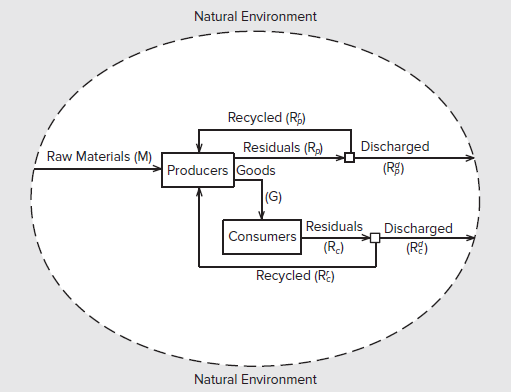
FIGURE 2.1 The Environment and the Economy
Explanation Verified
Verified
Residual balance model: production and consumption:
Two main functions of an economy are production and consumption, and these two are the core of circular flow of income in the economy. However, both the economic activities also produce residuals (leftover waste products).
But, some leftover waste products can be recycled, which further can be used in any production process. This way of analyzing both the production and consumption process to account for residuals discharged to the environment is defined as the residual balance model. The resource balance model can be understood from both the production and consumption point of view.
Thus, to compare the discharged leftover waste product to the environment in both the production
 and consumption
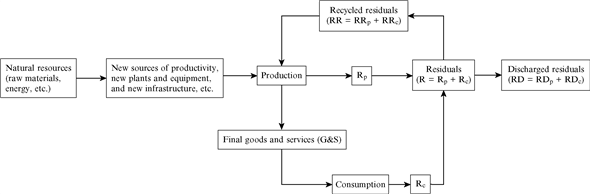
 processes with resources used in the production process, the resources balance model can be considered, which is shown in Figure-1.
Figure-1: The residual balance model
 Impact of investment up on the resources balance model:
Raw materials and energy combined with new sources of productivity, opening up of new plants, investment on new equipment, and infrastructure can boost the productivity of an economy and thereby lead to economic growth.
An increase in investment raises the real GDP of an economy, which means more final goods and services are available for consumption purpose.
Increase in final goods and services produced will produce more leftover waste products
 ; that is,
 will increase. Increase in final goods and services produced means more goods are available for consumption too. Consumption of final goods and services by individuals, households, and private organization also leads to leftover waste products
 ; that is,
 will increase. Thus, total amount of residuals (R) generated in an economy will increase.
It is learned that residuals can be recycled. However, 100 percent recycling is not possible. In the relative sense, recycled residual (RR) from both the production activity
 and consumption activity
 can increase. But, there will be absolute increase in the residuals discharged
 back to the environment.
Hence, it can be concluded that investment that causes increase in real GDP would lead to increase in absolute amount of residuals discharged back to the environment.
Two main functions of an economy are production and consumption, and these two are the core of circular flow of income in the economy. However, both the economic activities also produce residuals (leftover waste products).
But, some leftover waste products can be recycled, which further can be used in any production process. This way of analyzing both the production and consumption process to account for residuals discharged to the environment is defined as the residual balance model. The resource balance model can be understood from both the production and consumption point of view.
Thus, to compare the discharged leftover waste product to the environment in both the production
and consumption processes with resources used in the production process, the resources balance model can be considered, which is shown in Figure-1.Figure-1: The residual balance model
Impact of investment up on the resources balance model: Raw materials and energy combined with new sources of productivity, opening up of new plants, investment on new equipment, and infrastructure can boost the productivity of an economy and thereby lead to economic growth.
An increase in investment raises the real GDP of an economy, which means more final goods and services are available for consumption purpose.
Increase in final goods and services produced will produce more leftover waste products
; that is, will increase. Increase in final goods and services produced means more goods are available for consumption too. Consumption of final goods and services by individuals, households, and private organization also leads to leftover waste products ; that is, will increase. Thus, total amount of residuals (R) generated in an economy will increase.It is learned that residuals can be recycled. However, 100 percent recycling is not possible. In the relative sense, recycled residual (RR) from both the production activity
and consumption activity can increase. But, there will be absolute increase in the residuals discharged back to the environment.Hence, it can be concluded that investment that causes increase in real GDP would lead to increase in absolute amount of residuals discharged back to the environment.

Environmental Economics 7th Edition by Barry Field,Martha k Field

Why don’t you like this exercise?
Other Minimum 8 character and maximum 255 character
Character 255






