







 Chat with AI


Epidemiology for Public Health Practice 5th Edition by Robert Friis,Thomas Sellers
Edition 5ISBN: 978-1449665494Epidemiology for Public Health Practice 5th Edition by Robert Friis,Thomas Sellers
Edition 5ISBN: 978-1449665494 Exercise 10
Review Exhibit 1-2, Snow on Cholera. What do you believe was the purpose of each of the following observations by Snow?
a. "small white, flocculent particles" in the water from the Broad Street pump
b. the location of cholera deaths as shown in Figure 1
c. people who died avoided the pump in Marlborough Street and instead had the water from the Broad Street pump
d. "the greatest number of attacks in any one day occurred on the 1st of September,..."
e. "On September 8th-the day when the handle of the pump was removed..." To what extent do you think removing the pump handle was effective in stopping the disease outbreak?
Exhibit 1-2 Snow on Cholera
The most terrible outbreak of cholera which ever occurred in this kingdom, is probably that which took place in Broad Street, Golden Square, and the adjoining streets, a few weeks ago. Within two hundred and fifty yards of the spot where Cambridge Street joins Broad Street, there were upwards of five hundred fatal attacks of cholera in ten days. The mortality in this limited area probably equals any that was ever caused in this country, even by the plague; and it was much more sudden, as the greater number of cases terminated in a few hours. The mortality would undoubtedly have been much greater had it not been for the flight of the population. Persons in furnished lodgings left first, then other lodgers went away, leaving their furniture to be sent for when they could meet with a place to put it in. Many houses were closed altogether, owing to the death of the proprietors; and, in a great number of instances, the tradesmen who remained had sent away their families: so that in less than six days from the commencement of the outbreak, the most afflicted streets were deserted by more than three-quarters of their inhabitants.
There were a few cases of cholera in the neighbourhood of Broad Street, Golden Square, in the latter part of August; and the so-called outbreak, which commenced in the night between the 31st August and the 1 st September, was, as in all similar instances, only a violent increase of the malady. As soon as I became acquainted with the situation and extent of this irruption of cholera, I suspected some contamination of the water of the much-frequented street-pump in Broad Street, near the end of Cambridge Street; but on examining the water, on the evening of the 3rd September, I found so little impurity in it of an organic nature, that I hesitated to come to a conclusion. Further inquiry, however, showed me that there was no other circumstance or agent common to the circumscribed locality in which this sudden increase of cholera occurred, and not extending beyond it, except the water of the above mentioned pump. I found, moreover, that the water varied, during the next two days, in the amount of organic impurity, visible to the naked eye, on close inspection, in the form of small white, flocculent particles; and I concluded that, at the commencement of the outbreak, it might possibly have been still more impure. The deaths which occurred during this fatal outbreak of cholera are indicated in the accompanying map ( Figure 1 ), as far as I could ascertain them... The dotted line on the map surrounds the sub-districts of Golden Square, St. James's, and Berwick Street, St. James's, together with the adjoining portion of the sub-district of St. Anne, Soho, extending from Wardour Street to Dean Street, and a small part of the sub-district of St. James's Square enclosed by Marylebone Street, Titchfield Street, Great Windmill Street, and Brewer Street. All the deaths from cholera which were registered in the six weeks from 19th August to 30th September within this locality, as well as those of persons removed into Middlesex Hospital, are shown in the map by a black line in the situation of the house in which it occurred, or in which the fatal attack was contracted... The pump in Broad Street is indicated on the map, as well as all the surrounding pumps to which the public had access at the time. It requires to be stated that the water of the pump in Marlborough Street, at the end of Carnaby Street, was so impure that many people avoided using it. And I found that the persons who died near this pump in the beginning of September, had water from the Broad Street pump. With regard to the pump in Rupert Street, it will be noticed that some streets which are near to it on the map, are in fact a good way removed, on account of the circuitous road to it. These circumstances being taken into account, it will be observed that the deaths either very much diminished, or ceased altogether at every point where it becomes decidedly nearer to send to another pump than to the one in Broad Street. It may also be noticed that the deaths are most numerous near to the pump where the water could be more readily obtained... The greatest number of attacks in any one day occurred on the 1st of September, immediately after the outbreak commenced. The following day the attacks fell from one hundred and forty-three to one hundred and sixteen, and the day afterwards to fifty-four... The fresh attacks continued to become less numerous every day. On September the 8th-the day when the handle of the pump was removed-there were twelve attacks; on the 9th, eleven; on the 10th, five; on the 11th, five; on the 12th, only one; and after this time, there were never more than four attacks on one day. During the decline of the epidemic the deaths were more numerous than the attacks, owing to the decrease of many persons who had lingered for several days in consecutive fever ( Figure 2 ). ?
Source: Reprinted from Snow J. Snow on Cholera. Cambridge, MA: Harvard University Press: 1965:38-51.
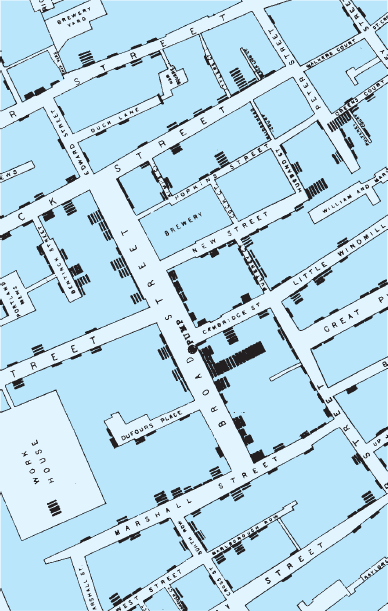
FIGURE 1 Cholera deaths in the neighborhood of Broad Street, August 19 to September 30, 1849.
Source: Reproduced from John Snow's dot map of the Broad Street and Golden Square area of London, in Snow on Cholera by John Snow, Commonwealth Fund: New York, 1936.
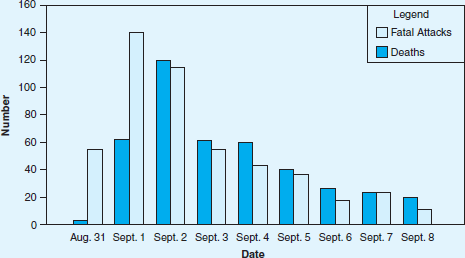
FIGURE 2 The 1849 cholera outbreak in Golden Square district, London. Fatal attacks and deaths, August 31-September 8.
Source: Data from Table I, Snow J. Snow on Cholera , p. 49, Harvard University Press, © 1965.
a. "small white, flocculent particles" in the water from the Broad Street pump
b. the location of cholera deaths as shown in Figure 1
c. people who died avoided the pump in Marlborough Street and instead had the water from the Broad Street pump
d. "the greatest number of attacks in any one day occurred on the 1st of September,..."
e. "On September 8th-the day when the handle of the pump was removed..." To what extent do you think removing the pump handle was effective in stopping the disease outbreak?
Exhibit 1-2 Snow on Cholera
The most terrible outbreak of cholera which ever occurred in this kingdom, is probably that which took place in Broad Street, Golden Square, and the adjoining streets, a few weeks ago. Within two hundred and fifty yards of the spot where Cambridge Street joins Broad Street, there were upwards of five hundred fatal attacks of cholera in ten days. The mortality in this limited area probably equals any that was ever caused in this country, even by the plague; and it was much more sudden, as the greater number of cases terminated in a few hours. The mortality would undoubtedly have been much greater had it not been for the flight of the population. Persons in furnished lodgings left first, then other lodgers went away, leaving their furniture to be sent for when they could meet with a place to put it in. Many houses were closed altogether, owing to the death of the proprietors; and, in a great number of instances, the tradesmen who remained had sent away their families: so that in less than six days from the commencement of the outbreak, the most afflicted streets were deserted by more than three-quarters of their inhabitants.
There were a few cases of cholera in the neighbourhood of Broad Street, Golden Square, in the latter part of August; and the so-called outbreak, which commenced in the night between the 31st August and the 1 st September, was, as in all similar instances, only a violent increase of the malady. As soon as I became acquainted with the situation and extent of this irruption of cholera, I suspected some contamination of the water of the much-frequented street-pump in Broad Street, near the end of Cambridge Street; but on examining the water, on the evening of the 3rd September, I found so little impurity in it of an organic nature, that I hesitated to come to a conclusion. Further inquiry, however, showed me that there was no other circumstance or agent common to the circumscribed locality in which this sudden increase of cholera occurred, and not extending beyond it, except the water of the above mentioned pump. I found, moreover, that the water varied, during the next two days, in the amount of organic impurity, visible to the naked eye, on close inspection, in the form of small white, flocculent particles; and I concluded that, at the commencement of the outbreak, it might possibly have been still more impure. The deaths which occurred during this fatal outbreak of cholera are indicated in the accompanying map ( Figure 1 ), as far as I could ascertain them... The dotted line on the map surrounds the sub-districts of Golden Square, St. James's, and Berwick Street, St. James's, together with the adjoining portion of the sub-district of St. Anne, Soho, extending from Wardour Street to Dean Street, and a small part of the sub-district of St. James's Square enclosed by Marylebone Street, Titchfield Street, Great Windmill Street, and Brewer Street. All the deaths from cholera which were registered in the six weeks from 19th August to 30th September within this locality, as well as those of persons removed into Middlesex Hospital, are shown in the map by a black line in the situation of the house in which it occurred, or in which the fatal attack was contracted... The pump in Broad Street is indicated on the map, as well as all the surrounding pumps to which the public had access at the time. It requires to be stated that the water of the pump in Marlborough Street, at the end of Carnaby Street, was so impure that many people avoided using it. And I found that the persons who died near this pump in the beginning of September, had water from the Broad Street pump. With regard to the pump in Rupert Street, it will be noticed that some streets which are near to it on the map, are in fact a good way removed, on account of the circuitous road to it. These circumstances being taken into account, it will be observed that the deaths either very much diminished, or ceased altogether at every point where it becomes decidedly nearer to send to another pump than to the one in Broad Street. It may also be noticed that the deaths are most numerous near to the pump where the water could be more readily obtained... The greatest number of attacks in any one day occurred on the 1st of September, immediately after the outbreak commenced. The following day the attacks fell from one hundred and forty-three to one hundred and sixteen, and the day afterwards to fifty-four... The fresh attacks continued to become less numerous every day. On September the 8th-the day when the handle of the pump was removed-there were twelve attacks; on the 9th, eleven; on the 10th, five; on the 11th, five; on the 12th, only one; and after this time, there were never more than four attacks on one day. During the decline of the epidemic the deaths were more numerous than the attacks, owing to the decrease of many persons who had lingered for several days in consecutive fever ( Figure 2 ). ?
Source: Reprinted from Snow J. Snow on Cholera. Cambridge, MA: Harvard University Press: 1965:38-51.
FIGURE 1 Cholera deaths in the neighborhood of Broad Street, August 19 to September 30, 1849.
Source: Reproduced from John Snow's dot map of the Broad Street and Golden Square area of London, in Snow on Cholera by John Snow, Commonwealth Fund: New York, 1936.
FIGURE 2 The 1849 cholera outbreak in Golden Square district, London. Fatal attacks and deaths, August 31-September 8.
Source: Data from Table I, Snow J. Snow on Cholera , p. 49, Harvard University Press, © 1965.
Explanation Verified
Verified
Purpose of the observations by Snow:
Fi...

Epidemiology for Public Health Practice 5th Edition by Robert Friis,Thomas Sellers

Why don’t you like this exercise?
Other Minimum 8 character and maximum 255 character
Character 255






