







 Chat with AI


Business 12th Edition by William Pride,Robert Hughes,Jack Kapoor
Edition 12ISBN: 978-1133595854Business 12th Edition by William Pride,Robert Hughes,Jack Kapoor
Edition 12ISBN: 978-1133595854 Exercise 1
A business plan is a carefully constructed guide for a person starting a business. The purpose of a well-prepared business plan is to show how practical and attainable the entrepreneur's goals are. It also serves as a concise document that potential investors can examine to see if they would like to invest or assist in financing a new venture. A business plan should include the following 12 components:
• Introduction
• Executive summary
• Benefits to the community
• Company and industry
• Management team
• Manufacturing and operations plan
• Labor force
• Marketing plan
• Financial plan
• Exit strategy
• Critical risks and assumptions
• Appendix
A brief description of each of these sections is provided in Chapter 5 (see also Table 5.3 on page 145).
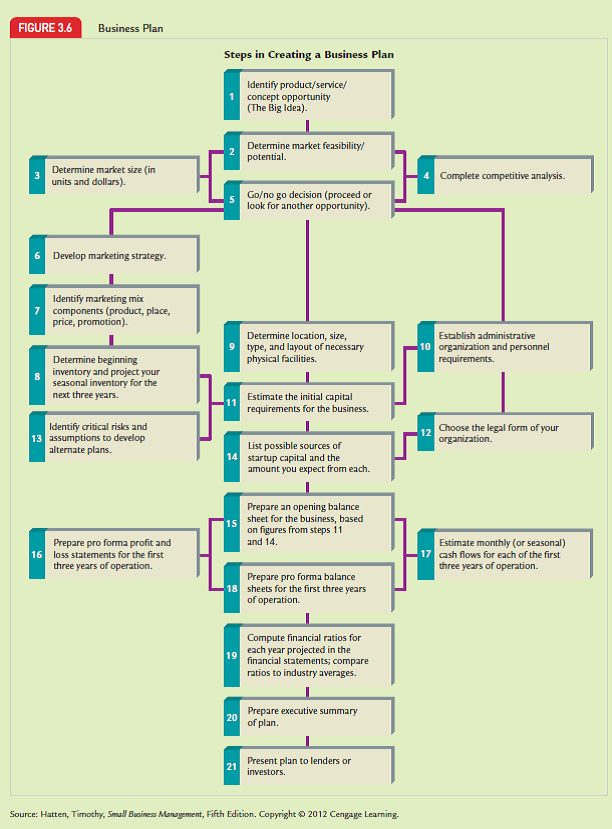
This is the first of seven exercises that appear at the ends of each of the seven major parts in this textbook. The goal of these exercises is to help you work through the preceding components to create your own business plan. For example, in the exercise for this part, you will make decisions and complete the research that will help you to develop the introduction for your business plan and the benefits to the community that your business will provide. In the exercises for Parts 2 through 7, you will add more components to your plan and eventually build a plan that actually could be used to start a business. The flowchart shown in Figure 3.6 gives an overview of the steps you will be taking to prepare your business plan.
THE FIRST STEP: CHOOSING YOUR BUSINESS
One of the first steps for starting your own business is to decide what type of business you want to start. Take some time to think about this decision. Before proceeding, answer the following questions:
• Why did you choose this type of business?
• Why do you think this business will be successful?
• Would you enjoy owning and operating this type of business?
Warning: Do not rush this step. This step often requires much thought, but it is well worth the time and effort. As an added bonus, you are more likely to develop a quality business plan if you really want to open this type of business.
Now that you have decided on a specific type of business, it is time to begin the planning process. The goal for this part is to complete the introduction and benefits-to-the-community components of your business plan.
Before you begin, it is important to note that the business plan is not a document that is written and then set aside. It is a living document that an entrepreneur should refer to continuously in order to ensure that plans are being carried through appropriately. As the entrepreneur begins to execute the plan, he or she should monitor the business environment continuously and make changes to the plan to address any challenges or opportunities that were not foreseen originally.
Throughout this course, you will, of course, be building your knowledge about business. Therefore, it will be appropriate for you to continually revisit parts of the plan that you have already written in order to refine them based on your more comprehensive knowledge. You will find that writing your plan is not a simple matter of starting at the beginning and moving chronologically through to the end. Instead, you probably will find yourself jumping around the various components, making refinements as you go. In fact, the second component-the executive summary- should be written last, but because of its comprehensive nature and its importance to potential investors, it appears after the introduction in the final business plan. By the end of this course, you should be able to put the finishing touches on your plan, making sure that all the parts create a comprehensive and sound whole so that you can present it for evaluation.
THE INTRODU CTION COMPONENT
1.1. Start with the cover page. Provide the business name, street address, telephone number, Web address (if any), name(s) of owner(s) of the business, and the date the plan is issued.
1.2. Next, provide background information on the company and include the general nature of the business: retailing, manufacturing, or service; what your product or service is; what is unique about it; and why you believe that your business will be successful.
1.3. Then include a summary statement of the business's financial needs, if any. You probably will need to revise your financial needs summary after you complete a detailed financial plan later in Part 6.
1.4. Finally, include a statement of confidentiality to keep important information away from potential competitors.
THE BENEFITS-TO-THE-COMMUNITY COMPONENT
In this section, describe the potential benefits to the community that your business could provide. Chapter 2 in your textbook, "Being Ethical and Socially Responsible," can help you in answering some of these questions. At the very least, address the following issues:
1.5. D escribe the number of skilled and nonskilled jobs the business will create, and indicate how purchases of supplies and other materials can help local businesses.
1.6. Next, describe how providing needed goods or services will improve the community and its standard of living.
1.7. Finally, state how your business can develop new technical, management, or leadership skills; offer attractive wages; and provide other types of individual growth.
REVIEW OF BUSINESS PLAN ACTIVITIES
Read over the information that you have gathered. Because the Building a Business Plan exercises at the end of Parts 2 through 7 are built on the work you do in Part 1, make sure that any weaknesses or problem areas are resolved before continuing. Finally, write a brief statement that summarizes all the information for this part of the business plan.
• Introduction
• Executive summary
• Benefits to the community
• Company and industry
• Management team
• Manufacturing and operations plan
• Labor force
• Marketing plan
• Financial plan
• Exit strategy
• Critical risks and assumptions
• Appendix
A brief description of each of these sections is provided in Chapter 5 (see also Table 5.3 on page 145).
This is the first of seven exercises that appear at the ends of each of the seven major parts in this textbook. The goal of these exercises is to help you work through the preceding components to create your own business plan. For example, in the exercise for this part, you will make decisions and complete the research that will help you to develop the introduction for your business plan and the benefits to the community that your business will provide. In the exercises for Parts 2 through 7, you will add more components to your plan and eventually build a plan that actually could be used to start a business. The flowchart shown in Figure 3.6 gives an overview of the steps you will be taking to prepare your business plan.
THE FIRST STEP: CHOOSING YOUR BUSINESS
One of the first steps for starting your own business is to decide what type of business you want to start. Take some time to think about this decision. Before proceeding, answer the following questions:
• Why did you choose this type of business?
• Why do you think this business will be successful?
• Would you enjoy owning and operating this type of business?
Warning: Do not rush this step. This step often requires much thought, but it is well worth the time and effort. As an added bonus, you are more likely to develop a quality business plan if you really want to open this type of business.
Now that you have decided on a specific type of business, it is time to begin the planning process. The goal for this part is to complete the introduction and benefits-to-the-community components of your business plan.
Before you begin, it is important to note that the business plan is not a document that is written and then set aside. It is a living document that an entrepreneur should refer to continuously in order to ensure that plans are being carried through appropriately. As the entrepreneur begins to execute the plan, he or she should monitor the business environment continuously and make changes to the plan to address any challenges or opportunities that were not foreseen originally.
Throughout this course, you will, of course, be building your knowledge about business. Therefore, it will be appropriate for you to continually revisit parts of the plan that you have already written in order to refine them based on your more comprehensive knowledge. You will find that writing your plan is not a simple matter of starting at the beginning and moving chronologically through to the end. Instead, you probably will find yourself jumping around the various components, making refinements as you go. In fact, the second component-the executive summary- should be written last, but because of its comprehensive nature and its importance to potential investors, it appears after the introduction in the final business plan. By the end of this course, you should be able to put the finishing touches on your plan, making sure that all the parts create a comprehensive and sound whole so that you can present it for evaluation.
THE INTRODU CTION COMPONENT
1.1. Start with the cover page. Provide the business name, street address, telephone number, Web address (if any), name(s) of owner(s) of the business, and the date the plan is issued.
1.2. Next, provide background information on the company and include the general nature of the business: retailing, manufacturing, or service; what your product or service is; what is unique about it; and why you believe that your business will be successful.
1.3. Then include a summary statement of the business's financial needs, if any. You probably will need to revise your financial needs summary after you complete a detailed financial plan later in Part 6.
1.4. Finally, include a statement of confidentiality to keep important information away from potential competitors.
THE BENEFITS-TO-THE-COMMUNITY COMPONENT
In this section, describe the potential benefits to the community that your business could provide. Chapter 2 in your textbook, "Being Ethical and Socially Responsible," can help you in answering some of these questions. At the very least, address the following issues:
1.5. D escribe the number of skilled and nonskilled jobs the business will create, and indicate how purchases of supplies and other materials can help local businesses.
1.6. Next, describe how providing needed goods or services will improve the community and its standard of living.
1.7. Finally, state how your business can develop new technical, management, or leadership skills; offer attractive wages; and provide other types of individual growth.
REVIEW OF BUSINESS PLAN ACTIVITIES
Read over the information that you have gathered. Because the Building a Business Plan exercises at the end of Parts 2 through 7 are built on the work you do in Part 1, make sure that any weaknesses or problem areas are resolved before continuing. Finally, write a brief statement that summarizes all the information for this part of the business plan.
Explanation


This question doesn’t have an expert verified answer yet, let Quizplus AI Copilot help.

Business 12th Edition by William Pride,Robert Hughes,Jack Kapoor

Why don’t you like this exercise?
Other Minimum 8 character and maximum 255 character
Character 255






