







 Chat with AI

Economics for Today 9th Edition by Irvin Tucker
Edition 9ISBN: 978-1305507111Economics for Today 9th Edition by Irvin Tucker
Edition 9ISBN: 978-1305507111 Exercise 2
RIGGING THE MARKET FOR MILK
Applicable Concept: price supports
Each year the milk industry faces an important question: What does the federal government plan to do about its dairy price support program, which has helped boost farmers' income since 1949? Under the price support program, the federal government agrees to buy storable milk products, such as cheese, butter, and dry milk. If the farmers cannot sell all their products to consumers at a price exceeding the price support level, the federal government will purchase any unsold grade A milk production. Although staterun dairy commissions set their own minimum prices for milk, state price supports closely follow federal levels and are kept within 3 percent of levels in bordering states to reduce interstate milk price competition.
Members of Congress who advocate changes in the price support programs worry that milk surpluses are costing taxpayers too much. Each year the federal government pays billions of dollars to dairy farmers for milk products held in storage at a huge cost. Moreover, the problem is getting worse because the federal government encourages dairy farmers to use ultramodern farming techniques to increase the production per cow. Another concern is that the biggest government price support checks go to the largest farmers, while the number of dairy farmers continues to decline.
Congress is constantly seeking a solution to the milk price support problem. The following are some of the ideas that have been considered:
• Freeze the current price support level. This prospect dismays farmers, who are subject to increasing expenses for feed, electricity, and other resources.
• Eliminate the price supports gradually in yearly increments over the next five years. This would subject the milk market to the price fluctuations of the free market, and farmers would suffer some bad years from low milk prices.
• Have the Department of Agriculture charge dairy farmers a tax of 50 cents for each 100 pounds of milk they produce.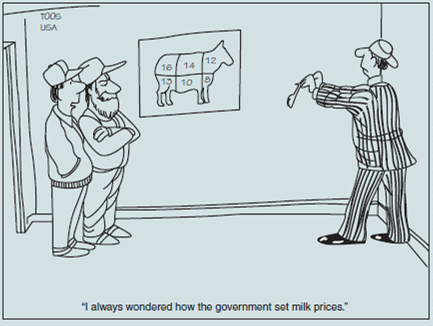
The farmers oppose this approach because it would discourage production and run small farmers out of business.
• Have the federal government implement a "whole herd buyout" program. The problem is that using taxpayers' money to get farmers out of the dairy business pushes up milk product prices and rewards dairy farmers who own a lot of cows. Besides, what does the government do with the cows after it purchases them?
Finally, opponents of the dairy price support program argue that the market for milk is inherently a competitive industry and that consumers and taxpayers would be better served without government price supports for milk.
Draw a supply and demand graph to illustrate the problem described in the case study, and prescribe your own solution.
Applicable Concept: price supports
Each year the milk industry faces an important question: What does the federal government plan to do about its dairy price support program, which has helped boost farmers' income since 1949? Under the price support program, the federal government agrees to buy storable milk products, such as cheese, butter, and dry milk. If the farmers cannot sell all their products to consumers at a price exceeding the price support level, the federal government will purchase any unsold grade A milk production. Although staterun dairy commissions set their own minimum prices for milk, state price supports closely follow federal levels and are kept within 3 percent of levels in bordering states to reduce interstate milk price competition.
Members of Congress who advocate changes in the price support programs worry that milk surpluses are costing taxpayers too much. Each year the federal government pays billions of dollars to dairy farmers for milk products held in storage at a huge cost. Moreover, the problem is getting worse because the federal government encourages dairy farmers to use ultramodern farming techniques to increase the production per cow. Another concern is that the biggest government price support checks go to the largest farmers, while the number of dairy farmers continues to decline.
Congress is constantly seeking a solution to the milk price support problem. The following are some of the ideas that have been considered:
• Freeze the current price support level. This prospect dismays farmers, who are subject to increasing expenses for feed, electricity, and other resources.
• Eliminate the price supports gradually in yearly increments over the next five years. This would subject the milk market to the price fluctuations of the free market, and farmers would suffer some bad years from low milk prices.
• Have the Department of Agriculture charge dairy farmers a tax of 50 cents for each 100 pounds of milk they produce.
The farmers oppose this approach because it would discourage production and run small farmers out of business.
• Have the federal government implement a "whole herd buyout" program. The problem is that using taxpayers' money to get farmers out of the dairy business pushes up milk product prices and rewards dairy farmers who own a lot of cows. Besides, what does the government do with the cows after it purchases them?
Finally, opponents of the dairy price support program argue that the market for milk is inherently a competitive industry and that consumers and taxpayers would be better served without government price supports for milk.
Draw a supply and demand graph to illustrate the problem described in the case study, and prescribe your own solution.
Explanation Verified
Verified
In this problem, we are asked to look at...

Economics for Today 9th Edition by Irvin Tucker

Why don’t you like this exercise?
Other Minimum 8 character and maximum 255 character
Character 255






