







 Chat with AI

Economics for Today 9th Edition by Irvin Tucker
Edition 9ISBN: 978-1305507111Economics for Today 9th Edition by Irvin Tucker
Edition 9ISBN: 978-1305507111 Exercise 28
RECESSION TAKES A BITE OUT OF GATOR PROFITS
Applicable Concepts: short-run and long-run competitive equilibrium
In the late 1980s, many farmers who were tired of milking cows, roping steers, and slopping hogs decided to try their hand at a new animal. Anyone feeding this animal, however, could require a gun for protection.
Prior to the late 1970s, alligators were on the endangered species list. Under this protection, their numbers grew so large that wandering alligators became pests in Florida neighborhoods and police were exhausted from chasing them around. Consequently, the ban on hunting was removed, and shrewd entrepreneurs began seeking big profits by turning gators into farm animals. In fact, gator farming became one of Florida's fastest-growing businesses.
The gators spawned several hot industries. The lizard "look" came back into vogue, and the fashionable sported gator-skin purses, shoes, and belts. Chic didn't come cheap. In New York, gator cowboy boots sold for $1,800, and attaché cases retailed for $4,000. And you could order gator meat at trendy restaurants all along the East Coast. "Why not gator?" asked Red Lobster spokesman Dick Monroe. "Today's two-income households are looking for more variety. And they think it's neat to eat an animal that can eat them."
To meet the demand, Florida doubled the number of its licensed alligator farms compared to the previous four years when they functioned almost entirely as tourist attractions. In 1985, Florida farmers raised 37,000 gators; in 1986, that figure increased by 50 percent. Revenues soared as well. Frank Godwin, owner of Gatorland in Orlando, netted an estimated $270,000 from the 1,000 animals he harvested annually. Improved technology was applied to gator farming in order to boost profits even higher. Lawler Wells, for example, owner of Hilltop Farms in Avon Park, raised 7,000 gators in darkened hothouses that accelerated their growth.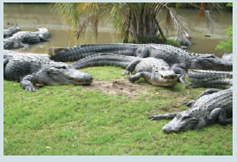
Seven years later, a 1993 article in The Washington Post continued the gator tale: "During the late 1980s, gator ranching was booming, and the industry was being compared to a living gold mine. People rushed into the industry. Some farmers became temporarily rich."
In 1995, a USA Today interview with a gator hunter provided evidence of long-run equilibrium: "Armed with a pistol barrel attached to the end of an 8-foot wooden pole, alligator hunter Bill Chaplin fires his 'bank stick' and dispatches a six-footer with a single round of.44 magnum ammunition. What's in it for him? Financially, very little. At $3.50 a pound for the meat and $45 a foot for the hide, an alligator is worth perhaps $100 a foot. After paying for skinning and processing, neither hunter nor landowner gets rich."
A 2000 article in The Dallas Morning News provided further evidence: Mark Glass, who began raising gators in 1995 south of Atlanta stated, "I can honestly say I haven't made any money yet, but I hope that's about to change." And a 2003 article from Knight Ridder/Tribune Business News gave a pessimistic report for Florida: "Revenue from alligator harvesting has flattened in recent years, despite Florida's efforts to promote the alligator as part of a viable 'aquaculture' industry. It's a tough business." And beginning in 2009, alligator skin bags, belts, shoes, watch straps, and purses were victims of the recession. As a result, many alligator farms were overrun with an unprecedented surplus of unsold alligators and falling prices. Wayne Sagrera, co-owner of Vermilion Gator Farm near Lafayette, Louisiana, stated "We can't invest in eggs if the demand is not there. They're just not selling. Finally, a 2014 article in The Charlotte Observer provides further evidence on the alligator market. "In Florida, where alligator farming has been allowed since 1977, there are 65 licensed farms, but only 10 where active in 2012, according to the Florida Fish and Wildlife Conservation Commission."
Assuming gator farming is perfectly competitive; explain the long-run competitive equilibrium condition for the typical gator farmer and the industry as a whole.
Applicable Concepts: short-run and long-run competitive equilibrium
In the late 1980s, many farmers who were tired of milking cows, roping steers, and slopping hogs decided to try their hand at a new animal. Anyone feeding this animal, however, could require a gun for protection.
Prior to the late 1970s, alligators were on the endangered species list. Under this protection, their numbers grew so large that wandering alligators became pests in Florida neighborhoods and police were exhausted from chasing them around. Consequently, the ban on hunting was removed, and shrewd entrepreneurs began seeking big profits by turning gators into farm animals. In fact, gator farming became one of Florida's fastest-growing businesses.
The gators spawned several hot industries. The lizard "look" came back into vogue, and the fashionable sported gator-skin purses, shoes, and belts. Chic didn't come cheap. In New York, gator cowboy boots sold for $1,800, and attaché cases retailed for $4,000. And you could order gator meat at trendy restaurants all along the East Coast. "Why not gator?" asked Red Lobster spokesman Dick Monroe. "Today's two-income households are looking for more variety. And they think it's neat to eat an animal that can eat them."
To meet the demand, Florida doubled the number of its licensed alligator farms compared to the previous four years when they functioned almost entirely as tourist attractions. In 1985, Florida farmers raised 37,000 gators; in 1986, that figure increased by 50 percent. Revenues soared as well. Frank Godwin, owner of Gatorland in Orlando, netted an estimated $270,000 from the 1,000 animals he harvested annually. Improved technology was applied to gator farming in order to boost profits even higher. Lawler Wells, for example, owner of Hilltop Farms in Avon Park, raised 7,000 gators in darkened hothouses that accelerated their growth.
Seven years later, a 1993 article in The Washington Post continued the gator tale: "During the late 1980s, gator ranching was booming, and the industry was being compared to a living gold mine. People rushed into the industry. Some farmers became temporarily rich."
In 1995, a USA Today interview with a gator hunter provided evidence of long-run equilibrium: "Armed with a pistol barrel attached to the end of an 8-foot wooden pole, alligator hunter Bill Chaplin fires his 'bank stick' and dispatches a six-footer with a single round of.44 magnum ammunition. What's in it for him? Financially, very little. At $3.50 a pound for the meat and $45 a foot for the hide, an alligator is worth perhaps $100 a foot. After paying for skinning and processing, neither hunter nor landowner gets rich."
A 2000 article in The Dallas Morning News provided further evidence: Mark Glass, who began raising gators in 1995 south of Atlanta stated, "I can honestly say I haven't made any money yet, but I hope that's about to change." And a 2003 article from Knight Ridder/Tribune Business News gave a pessimistic report for Florida: "Revenue from alligator harvesting has flattened in recent years, despite Florida's efforts to promote the alligator as part of a viable 'aquaculture' industry. It's a tough business." And beginning in 2009, alligator skin bags, belts, shoes, watch straps, and purses were victims of the recession. As a result, many alligator farms were overrun with an unprecedented surplus of unsold alligators and falling prices. Wayne Sagrera, co-owner of Vermilion Gator Farm near Lafayette, Louisiana, stated "We can't invest in eggs if the demand is not there. They're just not selling. Finally, a 2014 article in The Charlotte Observer provides further evidence on the alligator market. "In Florida, where alligator farming has been allowed since 1977, there are 65 licensed farms, but only 10 where active in 2012, according to the Florida Fish and Wildlife Conservation Commission."
Assuming gator farming is perfectly competitive; explain the long-run competitive equilibrium condition for the typical gator farmer and the industry as a whole.
Explanation Verified
Verified
The short run firm and industry competit...

Economics for Today 9th Edition by Irvin Tucker

Why don’t you like this exercise?
Other Minimum 8 character and maximum 255 character
Character 255






