







 Chat with AI

Economics for Today 9th Edition by Irvin Tucker
Edition 9ISBN: 978-1305507111Economics for Today 9th Edition by Irvin Tucker
Edition 9ISBN: 978-1305507111 Exercise 37
SHOULD COLLEGE ATHLETES BE PAID?
Applicable Concept: monopsony
It was perfect football weather on a beautiful autumn Saturday at Nebraska State's stadium. There was a hush in the crowd of 80,000 as the clock showed 5 seconds left in the game and the scoreboard read Home 26 Visitor 30. The Screaming Eagles were playing the Fighting Irish, and the season was on the line. With time running out, the Eagles All-American quarterback Joe Wyoming launched a desperation pass from his 45-yard line. The pass hit the extended fingers of a wide receiver who leaped over three defenders at the Irish 25-yard line and then ran into the end zone all alone. The home crowd roared with joy after staring defeat in the face.
So the season had been in the hands of Joe Wyoming, who received a full scholarship that cost the university more than $40,000 over four years. Because Joe led the Eagles to victory over Notre Dame, the team played in the Sugar Bowl, which paid Nebraska State $5 million for the appearance. In addition, the next year's ticket sales, alumni contributions, and trademark licensing boosted revenues $10 million, while applications for admission to the university increased sharply.
Economist John Leonard argued that college athletes are clearly underpaid because players cannot be paid salaries under National Collegiate Athletic Association (NCAA) rules. His study estimated that a star college football player who is named to an All-American team generates a marginal revenue product of $100,000 per year for the university. Yet that athlete is paid only a $10,000 scholarship per year.
In Chapter 10, a cartel was explained as a group of firms that use a collusive agreement to act as a monopoly. NCA A regulations serve as a collusive agreement among colleges and universities to act as a monopsony and hire the services of college-bound athletes. Just like an output or sellers' cartel, such as the Organization of Petroleum Exporting Countries (OPEC), the NCAA must enforce the rules against cheaters.
Because this agreement holds players' wages far below their marginal revenue product, the gap creates an incentive for schools to offer "illegal" inducements of cars, money, clothes, and trips to attract good players. Such cheating benefits the college athletes whose wages are raised closer to their marginal revenue products. A school that is not caught benefits by recruiting better players, achieving athletic success, and receiving greater sports revenue. Schools that follow the rules must depend on the NCAA to punish cheaters by taking away TV appearances, tournament play, bowl invitations, and scholarships.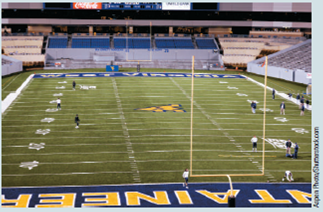
In January of 2015, the NCAA's "power five" conferences passed legislation that allows universities to provide stipends to cover the cost of attendance. The exact monetary value will vary by school and other conferences are implementing payments to athletes in addition to scholarships.
Do you favor paying college athletes salaries determined by a competitive labor market rather than by an NCAA agreement? Explain.
Applicable Concept: monopsony
It was perfect football weather on a beautiful autumn Saturday at Nebraska State's stadium. There was a hush in the crowd of 80,000 as the clock showed 5 seconds left in the game and the scoreboard read Home 26 Visitor 30. The Screaming Eagles were playing the Fighting Irish, and the season was on the line. With time running out, the Eagles All-American quarterback Joe Wyoming launched a desperation pass from his 45-yard line. The pass hit the extended fingers of a wide receiver who leaped over three defenders at the Irish 25-yard line and then ran into the end zone all alone. The home crowd roared with joy after staring defeat in the face.
So the season had been in the hands of Joe Wyoming, who received a full scholarship that cost the university more than $40,000 over four years. Because Joe led the Eagles to victory over Notre Dame, the team played in the Sugar Bowl, which paid Nebraska State $5 million for the appearance. In addition, the next year's ticket sales, alumni contributions, and trademark licensing boosted revenues $10 million, while applications for admission to the university increased sharply.
Economist John Leonard argued that college athletes are clearly underpaid because players cannot be paid salaries under National Collegiate Athletic Association (NCAA) rules. His study estimated that a star college football player who is named to an All-American team generates a marginal revenue product of $100,000 per year for the university. Yet that athlete is paid only a $10,000 scholarship per year.
In Chapter 10, a cartel was explained as a group of firms that use a collusive agreement to act as a monopoly. NCA A regulations serve as a collusive agreement among colleges and universities to act as a monopsony and hire the services of college-bound athletes. Just like an output or sellers' cartel, such as the Organization of Petroleum Exporting Countries (OPEC), the NCAA must enforce the rules against cheaters.
Because this agreement holds players' wages far below their marginal revenue product, the gap creates an incentive for schools to offer "illegal" inducements of cars, money, clothes, and trips to attract good players. Such cheating benefits the college athletes whose wages are raised closer to their marginal revenue products. A school that is not caught benefits by recruiting better players, achieving athletic success, and receiving greater sports revenue. Schools that follow the rules must depend on the NCAA to punish cheaters by taking away TV appearances, tournament play, bowl invitations, and scholarships.
In January of 2015, the NCAA's "power five" conferences passed legislation that allows universities to provide stipends to cover the cost of attendance. The exact monetary value will vary by school and other conferences are implementing payments to athletes in addition to scholarships.
Do you favor paying college athletes salaries determined by a competitive labor market rather than by an NCAA agreement? Explain.
Explanation Verified
Verified
The study by John Leonard estimated that...

Economics for Today 9th Edition by Irvin Tucker

Why don’t you like this exercise?
Other Minimum 8 character and maximum 255 character
Character 255






