







 Chat with AI


Economics for Today 9th Edition by Irvin Tucker
Edition 9ISBN: 978-1305507111Economics for Today 9th Edition by Irvin Tucker
Edition 9ISBN: 978-1305507111 Exercise 32
IS UTAH PIE'S SLICE OF THE PIE TOO SMALL?
Applicable Concept: Robinson-Patman Act
The following is a classic and controversial case: In the 1950s, the market for frozen dessert pies was small, but growing. The Salt Lake City market was supplied by distant plants in California that were owned by Carnation, Continental Baking, and Pet Milk. Until 1957, these three firms accounted for almost all the frozen fruit pies sold in the Salt Lake City market.
The Utah Pie Company had been baking dessert pies in Salt Lake City and selling them fresh for 30 years. This family-owned-and-operated business entered the frozen pie market in 1957. It was immediately successful and grabbed a huge share of the Salt Lake City market. During the relevant years, the market shares of the various competitors were as follows:
Utah Pie's strategy for penetrating the market was to set its prices below those of its competitors. Due to its immediate success, it built a new plant in 1958. Its local plants gave Utah Pie a locational advantage over its competitors. For most of the time in question, Utah Pie's prices were the lowest in the Salt Lake City market. The incumbent firms, of course, responded to Utah Pie's entry and lower prices by reducing their own prices. As a result, all the larger firms sold frozen-pies in Salt Lake City at prices lower than those charged for pies of like grade and quality in other geographic markets considerably closer to their California plants.
Utah Pie sued these three firms, claiming price discrimination. Ultimately, the case was reviewed by the Supreme Court in 1967, which took a dim view of such pricing behavior: "Sellers may not sell like goods to different purchasers at different prices if the result may be to injure competition in either the sellers' or the buyers' market unless such discriminations are justified as permitted by the Act." Consequently, the Supreme Court found the defendants guilty of price discrimination. Inasmuch as no competitors had been forced from the market, it appears that price discrimination does not have to have an obviously predatory impact to be ruled illegal. All the Court saw in this case was a pattern of falling prices. It feared that such a pattern could result in a lessening of competition if one or more competitors dropped out of the market.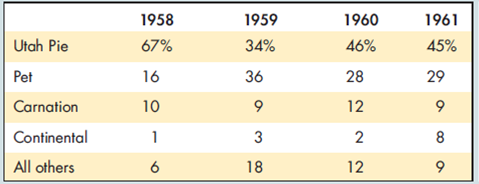
Source: David L. Kaserman and John W. Mayo, Government and Business: The Economics of Antitrust and Regulation (Fort Worth: Dryden Press, 1995), p. 282.
Utah Pie sued its three outside competitors under the Robinson-Patman Act. Some have criticized this case because it is an example of the type of bizarre result that can be produced by antitrust policy. Do you agree? Explain.
Applicable Concept: Robinson-Patman Act
The following is a classic and controversial case: In the 1950s, the market for frozen dessert pies was small, but growing. The Salt Lake City market was supplied by distant plants in California that were owned by Carnation, Continental Baking, and Pet Milk. Until 1957, these three firms accounted for almost all the frozen fruit pies sold in the Salt Lake City market.
The Utah Pie Company had been baking dessert pies in Salt Lake City and selling them fresh for 30 years. This family-owned-and-operated business entered the frozen pie market in 1957. It was immediately successful and grabbed a huge share of the Salt Lake City market. During the relevant years, the market shares of the various competitors were as follows:
Utah Pie's strategy for penetrating the market was to set its prices below those of its competitors. Due to its immediate success, it built a new plant in 1958. Its local plants gave Utah Pie a locational advantage over its competitors. For most of the time in question, Utah Pie's prices were the lowest in the Salt Lake City market. The incumbent firms, of course, responded to Utah Pie's entry and lower prices by reducing their own prices. As a result, all the larger firms sold frozen-pies in Salt Lake City at prices lower than those charged for pies of like grade and quality in other geographic markets considerably closer to their California plants.
Utah Pie sued these three firms, claiming price discrimination. Ultimately, the case was reviewed by the Supreme Court in 1967, which took a dim view of such pricing behavior: "Sellers may not sell like goods to different purchasers at different prices if the result may be to injure competition in either the sellers' or the buyers' market unless such discriminations are justified as permitted by the Act." Consequently, the Supreme Court found the defendants guilty of price discrimination. Inasmuch as no competitors had been forced from the market, it appears that price discrimination does not have to have an obviously predatory impact to be ruled illegal. All the Court saw in this case was a pattern of falling prices. It feared that such a pattern could result in a lessening of competition if one or more competitors dropped out of the market.
Source: David L. Kaserman and John W. Mayo, Government and Business: The Economics of Antitrust and Regulation (Fort Worth: Dryden Press, 1995), p. 282.
Utah Pie sued its three outside competitors under the Robinson-Patman Act. Some have criticized this case because it is an example of the type of bizarre result that can be produced by antitrust policy. Do you agree? Explain.
Explanation Verified
Verified
The Robinson-Patman Act of 1936 is a Uni...

Economics for Today 9th Edition by Irvin Tucker

Why don’t you like this exercise?
Other Minimum 8 character and maximum 255 character
Character 255






