







 Chat with AI

Economics for Today 9th Edition by Irvin Tucker
Edition 9ISBN: 978-1305507111Economics for Today 9th Edition by Irvin Tucker
Edition 9ISBN: 978-1305507111 Exercise 12
WHO WANTS TO BE A TRILLIONAIRE?
Applicable Concept: hyperinflation
The following articles are two historical examples of hyperinflation:
A Wall Street Journal 1985 article described hyperinflation in La Paz, Bolivia:
A courier stumbles into Banco Boliviano Americano, struggling under the weight of a huge bag of money he is carrying on his back. He announces that the sack contains 32 million pesos, and a teller slaps on a notation to that effect. The courier pitches the bag into a corner. "We don't bother counting the money anymore," explains Max Lowes Stah, a loan officer standing nearby. "We take the client's word for what's in the bag." Pointing to the courier's load, he says, "That's a small deposit." At that moment the 32 million pesos-enough bills to stuff a mail sack-were worth only $500. Today, less than two weeks later, they are worth at least $180 less. Life's like that with quadruple-digit inflation. …
Prices go up by the day, the hour or the customer. If the pace continues all year it would mean an annual rate of 116,000 percent. The 1,000-peso bill, the most commonly used, costs more to print than it purchases. To purchase an average-size television set with 1,000-peso bills, customers have to haul money weighing more than 68 pounds into the showroom. Inflation makes use of credit cards impossible here, and merchants generally can't take checks, either. Restaurant owners often covered their menus with cellophane and changed prices several times daily using a dry-erase marker.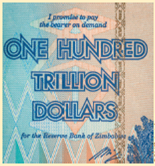
A San Francisco Chronicle article reported on hyperinflation in Zimbabwe:
What is happening is no laughing matter. (In 2008, the annual inflation rate was 231 million percent.) For untold numbers of Zimbabweans, bread, margarine, meat and even the morning cup of tea have become unimaginable luxuries. The city suffers rolling electrical blackouts because the state cannot afford parts or technicians to fix broken down power turbines. Mounds of uncollected garbage pile up on the streets of slums. Public-school fees and other ever-rising government surcharges have begun to exceed the monthly incomes of many urban families lucky enough to work. Those with spare cash put it not in banks, but in gilt-edged investments like bags of cornmeal and sugar, guaranteed not to lose their value.
In 2010, Zimbabwe's central bank announced the introduction of new 100 trillion, 50 trillion, 20 trillion, and 10 trillion notes. Want to be a trillionaire? Buy Zimbabwe notes.
A Newsweek article made the following thoughtful observation:
Hyperinflation is the worst economic malady that can befall a nation, wiping out the value of money, savings, assets, and thus work. It is worse even than a deep recession. Hyperinflation robs you of what you have now (savings), whereas a recession robs you of what you might have had (higher standards of living if the economy had grown). That's why it so often toppled governments and produced revolution. Recall that it was not the Great Depression that brought the Nazis to power in Germany but rather hyperinflation, which destroyed the middle class of that country by making its savings worthless.
Can you relate inflation psychosis to these excerpts? Give an example of a debtor-lender relationship that is jeopardized by hyperinflation.
Applicable Concept: hyperinflation
The following articles are two historical examples of hyperinflation:
A Wall Street Journal 1985 article described hyperinflation in La Paz, Bolivia:
A courier stumbles into Banco Boliviano Americano, struggling under the weight of a huge bag of money he is carrying on his back. He announces that the sack contains 32 million pesos, and a teller slaps on a notation to that effect. The courier pitches the bag into a corner. "We don't bother counting the money anymore," explains Max Lowes Stah, a loan officer standing nearby. "We take the client's word for what's in the bag." Pointing to the courier's load, he says, "That's a small deposit." At that moment the 32 million pesos-enough bills to stuff a mail sack-were worth only $500. Today, less than two weeks later, they are worth at least $180 less. Life's like that with quadruple-digit inflation. …
Prices go up by the day, the hour or the customer. If the pace continues all year it would mean an annual rate of 116,000 percent. The 1,000-peso bill, the most commonly used, costs more to print than it purchases. To purchase an average-size television set with 1,000-peso bills, customers have to haul money weighing more than 68 pounds into the showroom. Inflation makes use of credit cards impossible here, and merchants generally can't take checks, either. Restaurant owners often covered their menus with cellophane and changed prices several times daily using a dry-erase marker.
A San Francisco Chronicle article reported on hyperinflation in Zimbabwe:
What is happening is no laughing matter. (In 2008, the annual inflation rate was 231 million percent.) For untold numbers of Zimbabweans, bread, margarine, meat and even the morning cup of tea have become unimaginable luxuries. The city suffers rolling electrical blackouts because the state cannot afford parts or technicians to fix broken down power turbines. Mounds of uncollected garbage pile up on the streets of slums. Public-school fees and other ever-rising government surcharges have begun to exceed the monthly incomes of many urban families lucky enough to work. Those with spare cash put it not in banks, but in gilt-edged investments like bags of cornmeal and sugar, guaranteed not to lose their value.
In 2010, Zimbabwe's central bank announced the introduction of new 100 trillion, 50 trillion, 20 trillion, and 10 trillion notes. Want to be a trillionaire? Buy Zimbabwe notes.
A Newsweek article made the following thoughtful observation:
Hyperinflation is the worst economic malady that can befall a nation, wiping out the value of money, savings, assets, and thus work. It is worse even than a deep recession. Hyperinflation robs you of what you have now (savings), whereas a recession robs you of what you might have had (higher standards of living if the economy had grown). That's why it so often toppled governments and produced revolution. Recall that it was not the Great Depression that brought the Nazis to power in Germany but rather hyperinflation, which destroyed the middle class of that country by making its savings worthless.
Can you relate inflation psychosis to these excerpts? Give an example of a debtor-lender relationship that is jeopardized by hyperinflation.
Explanation Verified
Verified
Inflation psychosis is defined as the ir...

Economics for Today 9th Edition by Irvin Tucker

Why don’t you like this exercise?
Other Minimum 8 character and maximum 255 character
Character 255






