







 Chat with AI

Economics for Today 9th Edition by Irvin Tucker
Edition 9ISBN: 978-1305507111Economics for Today 9th Edition by Irvin Tucker
Edition 9ISBN: 978-1305507111 Exercise 18
HOW MUCH MORE DOES IT COST TO LAUGH?
Applicable Concept: consumer price index
Are we paying bigger bucks for smaller yuks? Or is it a lower fee for more glee? Is there a bone to pick with the price of rubber chickens? Is the price of Groucho glasses raising eyebrows, the cost of Mad magazine driving you mad, and, well, you get the idea. Malcolm Kushner, an attorney-turned- humor consultant based in Santa Cruz, California, developed an index based on a compilation of leading humor indicators to measure price changes in things that make us laugh. Kushner created the cost-of-laughing index to track how trends in laughter affect the bottom line. He is a humor consultant who advises corporate leaders on making humor work for business professionals. For example, humor can make executives better public speakers, and laughter reduces stress and can even cure illnesses. Kushner believes humor is America's greatest asset, and his consulting business gets a lot of publicity from publication of the index. To combat rising humor costs, Kushner has established a Web site at http://www.kushnergroup.com. It organizes links to databases of funny quotes, anecdotes, one-liners, and other material for business speakers and writers.
The exhibit with the Groucho face traces annual percentage changes in the cost of laughing that Kushner has reported to the media. On an annual basis, the inflation rate for laughing remained almost flat as a pancake at about 3 percent from 2000 through 2005. Then, in 2006, the humor index took a slippery slide on a banana peel to a disinflation rate of only one-tenth of 1 percent. In 2007, the index rode a roller coaster ride up to 4.7 percent, which was the largest increase since 1999, and then down to?1.4 percent in 2009. This deflation was the first negative percent change in the index history that began in 1987. And since 2010 the index has fallen to a modest 1.7 percent in 2013 and 2014.
Closer examination of the cost-of-laughing index over the years and some other items gives both smiley and sad faces. The good news in 2014 is that the price of most items remained flat the New York Comic Strip decreased, but the bad news is that the cost of rubber chickens flew up. The major reason for more expensive humor is the price of writing a half-hour television situation comedy. Just like the CPI, Kushner's index has been criticized. Note that the fee for writing a TV sitcom dominates the index. Kushner responds to this issue by saying, "Well, I wanted the index to be truly national. The fact that this price dominates the index reflects that TV comedy shows dominate our national culture. If you can laugh for free at a sitcom, you don't need to buy a rubber chicken or go to a comedy club."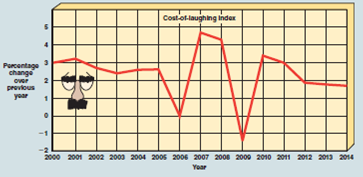
ANALYZE THE ISSUE
No question here. This one is just for fun.
Applicable Concept: consumer price index
Are we paying bigger bucks for smaller yuks? Or is it a lower fee for more glee? Is there a bone to pick with the price of rubber chickens? Is the price of Groucho glasses raising eyebrows, the cost of Mad magazine driving you mad, and, well, you get the idea. Malcolm Kushner, an attorney-turned- humor consultant based in Santa Cruz, California, developed an index based on a compilation of leading humor indicators to measure price changes in things that make us laugh. Kushner created the cost-of-laughing index to track how trends in laughter affect the bottom line. He is a humor consultant who advises corporate leaders on making humor work for business professionals. For example, humor can make executives better public speakers, and laughter reduces stress and can even cure illnesses. Kushner believes humor is America's greatest asset, and his consulting business gets a lot of publicity from publication of the index. To combat rising humor costs, Kushner has established a Web site at http://www.kushnergroup.com. It organizes links to databases of funny quotes, anecdotes, one-liners, and other material for business speakers and writers.
The exhibit with the Groucho face traces annual percentage changes in the cost of laughing that Kushner has reported to the media. On an annual basis, the inflation rate for laughing remained almost flat as a pancake at about 3 percent from 2000 through 2005. Then, in 2006, the humor index took a slippery slide on a banana peel to a disinflation rate of only one-tenth of 1 percent. In 2007, the index rode a roller coaster ride up to 4.7 percent, which was the largest increase since 1999, and then down to?1.4 percent in 2009. This deflation was the first negative percent change in the index history that began in 1987. And since 2010 the index has fallen to a modest 1.7 percent in 2013 and 2014.
Closer examination of the cost-of-laughing index over the years and some other items gives both smiley and sad faces. The good news in 2014 is that the price of most items remained flat the New York Comic Strip decreased, but the bad news is that the cost of rubber chickens flew up. The major reason for more expensive humor is the price of writing a half-hour television situation comedy. Just like the CPI, Kushner's index has been criticized. Note that the fee for writing a TV sitcom dominates the index. Kushner responds to this issue by saying, "Well, I wanted the index to be truly national. The fact that this price dominates the index reflects that TV comedy shows dominate our national culture. If you can laugh for free at a sitcom, you don't need to buy a rubber chicken or go to a comedy club."
ANALYZE THE ISSUE
No question here. This one is just for fun.
Explanation


This question doesn’t have an expert verified answer yet, let Quizplus AI Copilot help.

Economics for Today 9th Edition by Irvin Tucker

Why don’t you like this exercise?
Other Minimum 8 character and maximum 255 character
Character 255






