







 Chat with AI

Economics for Today 9th Edition by Irvin Tucker
Edition 9ISBN: 978-1305507111Economics for Today 9th Edition by Irvin Tucker
Edition 9ISBN: 978-1305507111 Exercise 32
HOW DOES THE FOMC REALLY WORK?
Applicable Concept: monetary policy
The Federal Open Market Committee (FOMC), which is the Fed's most powerful monetary policymaking group, meets eight times a year at the Federal Reserve in Washington, D.C. Often it seems that the whole world is watching for the results. Before the meeting, board members are given three books prepared by the Fed's staff. The "Green Book" forecasts aggregate demand and various prices based on a variety of equations and the assumptions that monetary policy does or does not change. The "Blue Book" might discuss as many as three monetary policy options, the rationale for each option, and the impact of each option on the economy. There is also a "Beige Book," published eight times per year, that gathers anecdotal information on current economic conditions obtained from interviews with key businesspersons, economists, bankers, and other sources.
The meeting begins at precisely 9 a.m. with a discussion of foreign currency operations and domestic open market operations illustrated with colorful graphics. Next, the staff presents their analysis of recent developments and forecasts for the economy laid out in the Green Book. Then each board member around the impressive 27-foot oval mahogany table expresses his or her views about the analyses, except for the chair, who may choose not to participate in this round. Now it's coffee time and everyone relaxes beneath a 23-foot ceiling with a 1,000-pound chandelier.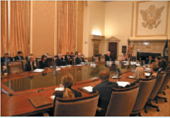
After the coffee break, the staff discusses each policy option from the "Blue Book" without recommending a particular option. Generally, three options are presented. Option A is always a decline in interest rates, Option B is always no change in interest rates, and Option C is always an increase. After the staff presentation, board members politely discuss the policy options, but with an important difference. In this policy round, the chair goes first. He or she leads the discussion and advocates a policy decision. After other board members express their views, the chair summarizes the consensus and reads a draft of the Directive to be voted on. The Directive gives instructions to the Fed's staff on how to conduct open market operations until the next FOMC meeting. For example, the New York Fed's trading desk may be instructed to increase the money supply in the range of 1 to 5 percent and lower interest rates by buying 90-day U.S. Treasury bills. After discussion, board members vote on the Directive, with the chair voting first and the decision going to the majority. The chair is always expected to be on the winning side. The Directive is sent to the New York Fed's trading desk, and soon about four dozen bond dealers receive the Fed's call. If there is a change in policy, it will be announced at 2:15 that afternoon.
The Fed communicates its changes in monetary policy by announcing changes in its targets for the federal funds rate. Recall that the Fed does not set this interest rate, but it can influence the rate through open market operations. If the Fed buys bonds, the supply of excess reserves in the banking system increases, and the rate falls. If the Fed sells bonds, the supply of excess reserves in the banking system decreases, and the rate increases. As a result, interest rates in general are influenced. The next chapter explains in more detail the link between changes in the interest rate and changes in other key macro measures. Between 2001 and 2003, for example, the Fed cut the federal funds rate target 13 times to support economic recovery. Then from 2004 to 2006, the Fed became concerned about inflation and increased the federal funds rate 17 times. When measuring inflation, the Fed pays closest attention to the core CPI-the CPI excluding food and fuel because it is less volatile than the total CPI inflation rate. In 2007, the Fed changed its focus again because it became concerned that a housing slump and credit crunch would slow the economy, and it cut this key rate for the first time in four years. Beginning in 2008, the Fed followed a policy called "quantitative easing (QE)" that used a sharp rise in purchases of Treasury and mortgage-backed securities to continuously increase the money supply and lower interest rates. In fact, the Fed continued cutting the federal funds rate until it reached a record low of almost zero in 2011. The annual rate for 2014 was also close to zero.
What happened at the last FOMC meeting? Visit http://www.federalreserve.gov/fomc/default.htm.
Applicable Concept: monetary policy
The Federal Open Market Committee (FOMC), which is the Fed's most powerful monetary policymaking group, meets eight times a year at the Federal Reserve in Washington, D.C. Often it seems that the whole world is watching for the results. Before the meeting, board members are given three books prepared by the Fed's staff. The "Green Book" forecasts aggregate demand and various prices based on a variety of equations and the assumptions that monetary policy does or does not change. The "Blue Book" might discuss as many as three monetary policy options, the rationale for each option, and the impact of each option on the economy. There is also a "Beige Book," published eight times per year, that gathers anecdotal information on current economic conditions obtained from interviews with key businesspersons, economists, bankers, and other sources.
The meeting begins at precisely 9 a.m. with a discussion of foreign currency operations and domestic open market operations illustrated with colorful graphics. Next, the staff presents their analysis of recent developments and forecasts for the economy laid out in the Green Book. Then each board member around the impressive 27-foot oval mahogany table expresses his or her views about the analyses, except for the chair, who may choose not to participate in this round. Now it's coffee time and everyone relaxes beneath a 23-foot ceiling with a 1,000-pound chandelier.
After the coffee break, the staff discusses each policy option from the "Blue Book" without recommending a particular option. Generally, three options are presented. Option A is always a decline in interest rates, Option B is always no change in interest rates, and Option C is always an increase. After the staff presentation, board members politely discuss the policy options, but with an important difference. In this policy round, the chair goes first. He or she leads the discussion and advocates a policy decision. After other board members express their views, the chair summarizes the consensus and reads a draft of the Directive to be voted on. The Directive gives instructions to the Fed's staff on how to conduct open market operations until the next FOMC meeting. For example, the New York Fed's trading desk may be instructed to increase the money supply in the range of 1 to 5 percent and lower interest rates by buying 90-day U.S. Treasury bills. After discussion, board members vote on the Directive, with the chair voting first and the decision going to the majority. The chair is always expected to be on the winning side. The Directive is sent to the New York Fed's trading desk, and soon about four dozen bond dealers receive the Fed's call. If there is a change in policy, it will be announced at 2:15 that afternoon.
The Fed communicates its changes in monetary policy by announcing changes in its targets for the federal funds rate. Recall that the Fed does not set this interest rate, but it can influence the rate through open market operations. If the Fed buys bonds, the supply of excess reserves in the banking system increases, and the rate falls. If the Fed sells bonds, the supply of excess reserves in the banking system decreases, and the rate increases. As a result, interest rates in general are influenced. The next chapter explains in more detail the link between changes in the interest rate and changes in other key macro measures. Between 2001 and 2003, for example, the Fed cut the federal funds rate target 13 times to support economic recovery. Then from 2004 to 2006, the Fed became concerned about inflation and increased the federal funds rate 17 times. When measuring inflation, the Fed pays closest attention to the core CPI-the CPI excluding food and fuel because it is less volatile than the total CPI inflation rate. In 2007, the Fed changed its focus again because it became concerned that a housing slump and credit crunch would slow the economy, and it cut this key rate for the first time in four years. Beginning in 2008, the Fed followed a policy called "quantitative easing (QE)" that used a sharp rise in purchases of Treasury and mortgage-backed securities to continuously increase the money supply and lower interest rates. In fact, the Fed continued cutting the federal funds rate until it reached a record low of almost zero in 2011. The annual rate for 2014 was also close to zero.
What happened at the last FOMC meeting? Visit http://www.federalreserve.gov/fomc/default.htm.
Explanation Verified
Verified
A meeting held in September 2016 to deci...

Economics for Today 9th Edition by Irvin Tucker

Why don’t you like this exercise?
Other Minimum 8 character and maximum 255 character
Character 255






