







 Chat with AI


Business Driven Technology 6th Edition by Paige Baltzan
Edition 6ISBN: 9780073376905Business Driven Technology 6th Edition by Paige Baltzan
Edition 6ISBN: 9780073376905 Exercise 117
Innovative Business Managers
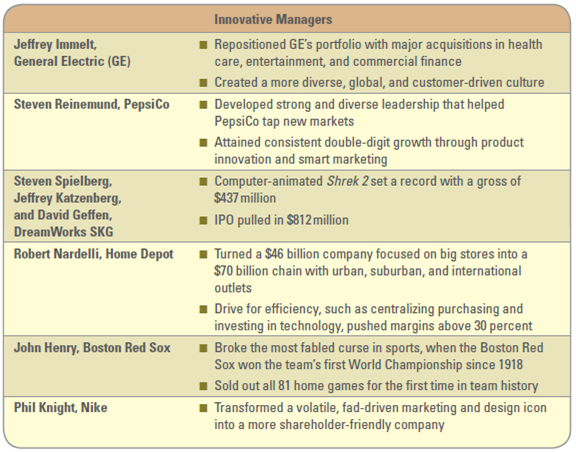
BusinessWeek magazine recognized several innovative managers who have demonstrated talent, vision, and the ability to identify excellent opportunities (see Figure B1.16).
Jeffrey Immelt, General Electric (GE)
When Jeffrey Immelt took over as CEO of General Electric, he had big shoes to fill. The former CEO, Jack Welch, had left an unprecedented record as one of the top CEOs of all time. Immelt proved his ability to run the company by creating a customer-driven global culture that spawns innovation and embraces technology.
Steven Reinemund, PepsiCo
Steven Reinemund has turned PepsiCo into a $27 billion food and beverage giant. "To be a leader in consumer products, it's critical to have leaders who represent the population we serve," states Reinemund, who created a diverse leadership group that defines the strategic vision for the company. Reinemund also takes a major role in mentoring and teaching his employees and demands that all senior executives do the same. The payoff: consistent double-digit earnings and solid sales at a time when many of the company's staple products-potato chips and soft drinks-are under attack for fears about childhood obesity and health concerns.
Steven Spielberg, Jeffrey Katzenberg, and David Geffen, DreamWorks
The DreamWorks studio, founded in 1994 by Steven Spielberg, Jeffrey Katzenberg, and David Geffen, suffered through its share of early bombs. Finally, the studio discovered a green ogre named Shrek and quickly became the hottest studio this side of Pixar Animation. DreamWorks Animation turned a $187 million loss in 2003 into a $196 million profit in 2004, with revenues of $1.1 billion. DreamWorks plans to release two animation films per year, each taking almost four years to produce.
Robert Nardelli, Home Depot
Robert Nardelli took several risks when he became CEO of Home Depot. First, he allocated $14 billion into upgrading merchandise, renovating outdated stores, and investing in new technology such as self-checkout lanes and cordless scan guns. Second, Nardelli expanded into Mexico, China, and other regions, tapping the growing homeowner market. Finally, Nardelli bet big on carrying products for aging baby boomers who wanted to spruce up their empty nests. The moves are paying off. The company sits on $3.4 billion in cash. With 2005 revenues headed to $80 billion, Home Depot is the number two U.S. retailer after Walmart.
John Henry, Boston Red Sox
John Henry earned his fortune in the global futures market by developing a proprietary futurestrading system that consistently produced double-digit returns. Henry's new system, Sabermetrics, helped him reverse the most fabled curse in sports history by leading the Boston Red Sox to the team's first World Championship since 1918. Sabermetrics mines baseball statistics to find undervalued players while avoiding long contracts for aging stars whose performance is likely to decline. With the help of Sabermetrics, Henry has built one of the most effective teams in baseball.
Philip Knight, Nike
Philip Knight, who got his start by selling Japanese sneakers from the trunk of his car, built the $12 billion sports behemoth Nike. Knight and his team transformed high-performance sports equipment into high-fashion gear and forever changed the rules of sports marketing with huge endorsement contracts and in-your-face advertising. Then, just as suddenly, Nike lost focus. In early 2000, kids stopped craving the latest sneaker, the company's image took a huge hit from its labor practices, sales slumped, and costs soared.
Thus began Knight's second act. He revamped management and brought in key outsiders to oversee finances and apparel lines. Knight devoted more energy to developing new information systems. Today, Nike's earnings are less volatile and less fad-driven. In 2004, Nike's earnings increased $1 billion.
FIGURE B1.16 Innovative Business Managers
Why is it important for all of DreamWorks' functional business areas to work together Provide an example of what might happen if the DreamWorks marketing department failed to work with its sales department.
BusinessWeek magazine recognized several innovative managers who have demonstrated talent, vision, and the ability to identify excellent opportunities (see Figure B1.16).
Jeffrey Immelt, General Electric (GE)
When Jeffrey Immelt took over as CEO of General Electric, he had big shoes to fill. The former CEO, Jack Welch, had left an unprecedented record as one of the top CEOs of all time. Immelt proved his ability to run the company by creating a customer-driven global culture that spawns innovation and embraces technology.
Steven Reinemund, PepsiCo
Steven Reinemund has turned PepsiCo into a $27 billion food and beverage giant. "To be a leader in consumer products, it's critical to have leaders who represent the population we serve," states Reinemund, who created a diverse leadership group that defines the strategic vision for the company. Reinemund also takes a major role in mentoring and teaching his employees and demands that all senior executives do the same. The payoff: consistent double-digit earnings and solid sales at a time when many of the company's staple products-potato chips and soft drinks-are under attack for fears about childhood obesity and health concerns.
Steven Spielberg, Jeffrey Katzenberg, and David Geffen, DreamWorks
The DreamWorks studio, founded in 1994 by Steven Spielberg, Jeffrey Katzenberg, and David Geffen, suffered through its share of early bombs. Finally, the studio discovered a green ogre named Shrek and quickly became the hottest studio this side of Pixar Animation. DreamWorks Animation turned a $187 million loss in 2003 into a $196 million profit in 2004, with revenues of $1.1 billion. DreamWorks plans to release two animation films per year, each taking almost four years to produce.
Robert Nardelli, Home Depot
Robert Nardelli took several risks when he became CEO of Home Depot. First, he allocated $14 billion into upgrading merchandise, renovating outdated stores, and investing in new technology such as self-checkout lanes and cordless scan guns. Second, Nardelli expanded into Mexico, China, and other regions, tapping the growing homeowner market. Finally, Nardelli bet big on carrying products for aging baby boomers who wanted to spruce up their empty nests. The moves are paying off. The company sits on $3.4 billion in cash. With 2005 revenues headed to $80 billion, Home Depot is the number two U.S. retailer after Walmart.
John Henry, Boston Red Sox
John Henry earned his fortune in the global futures market by developing a proprietary futurestrading system that consistently produced double-digit returns. Henry's new system, Sabermetrics, helped him reverse the most fabled curse in sports history by leading the Boston Red Sox to the team's first World Championship since 1918. Sabermetrics mines baseball statistics to find undervalued players while avoiding long contracts for aging stars whose performance is likely to decline. With the help of Sabermetrics, Henry has built one of the most effective teams in baseball.
Philip Knight, Nike
Philip Knight, who got his start by selling Japanese sneakers from the trunk of his car, built the $12 billion sports behemoth Nike. Knight and his team transformed high-performance sports equipment into high-fashion gear and forever changed the rules of sports marketing with huge endorsement contracts and in-your-face advertising. Then, just as suddenly, Nike lost focus. In early 2000, kids stopped craving the latest sneaker, the company's image took a huge hit from its labor practices, sales slumped, and costs soared.
Thus began Knight's second act. He revamped management and brought in key outsiders to oversee finances and apparel lines. Knight devoted more energy to developing new information systems. Today, Nike's earnings are less volatile and less fad-driven. In 2004, Nike's earnings increased $1 billion.
FIGURE B1.16 Innovative Business Managers
Why is it important for all of DreamWorks' functional business areas to work together Provide an example of what might happen if the DreamWorks marketing department failed to work with its sales department.
Explanation Verified
Verified
The company's functional business areas ...

Business Driven Technology 6th Edition by Paige Baltzan

Why don’t you like this exercise?
Other Minimum 8 character and maximum 255 character
Character 255






