







 Chat with AI


Business Driven Technology 6th Edition by Paige Baltzan
Edition 6ISBN: 9780073376905Business Driven Technology 6th Edition by Paige Baltzan
Edition 6ISBN: 9780073376905 Exercise 126
The Digital Hospital
For years, health care has missed the huge benefits that information technology has bestowed upon the rest of the economy. During the 1990s, productivity in health care services declined, according to estimates from Economy.com Inc. That is a huge underachievement in a decade of strong gains from the overall economy. This is beginning to change as hospitals, along with insurers and the government, are stepping up their IT investments. Hospitals are finally discarding their clumsy, sluggish first-generation networks and are beginning to install laptops, software, and Internet technologies.
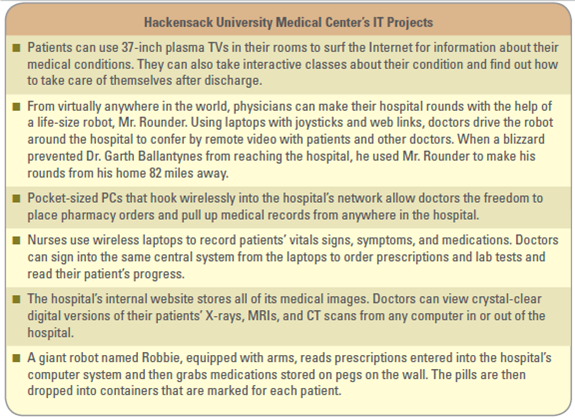
Hackensack University Medical Center in Hackensack, New Jersey, is one of the nation's most aggressive technology adopters, investing $72 million in IT projects. The IT investments are paying off for the hospital with patient mortality rates decreasing-down 16 percent in four years-and quality of care and productivity increasing. The most important piece of Hackensack's digital initiatives is the networked software that acts as the hospital's central nervous system. Using wireless laptops, nurses log in to the system to record patient information and progress. Doctors tap into the network via wireless devices to order prescriptions and lab tests. Everything is linked, from the automated pharmacy to the X-ray lab, eliminating the need for faxes, phone calls, and other administrative hassles. Figure B8.7 displays the hospital's IT systems development projects.
More important than saving money is saving lives. Poor information kills some 7,000 Americans each year just by missing drug-interaction problems, according to the National Academy of Sciences Institute of Medicine. Hospital errors result in 100,000 deaths annually. Early evidence indicates that proper technology can reduce this amount. Hospitals using electronic prescription systems have seen 80 percent fewer prescription errors.
FIGURE B8.7 Hospital IT Systems Development Projects
How would a hospital use each of the three OM planning strategies to improve its operations
For years, health care has missed the huge benefits that information technology has bestowed upon the rest of the economy. During the 1990s, productivity in health care services declined, according to estimates from Economy.com Inc. That is a huge underachievement in a decade of strong gains from the overall economy. This is beginning to change as hospitals, along with insurers and the government, are stepping up their IT investments. Hospitals are finally discarding their clumsy, sluggish first-generation networks and are beginning to install laptops, software, and Internet technologies.
Hackensack University Medical Center in Hackensack, New Jersey, is one of the nation's most aggressive technology adopters, investing $72 million in IT projects. The IT investments are paying off for the hospital with patient mortality rates decreasing-down 16 percent in four years-and quality of care and productivity increasing. The most important piece of Hackensack's digital initiatives is the networked software that acts as the hospital's central nervous system. Using wireless laptops, nurses log in to the system to record patient information and progress. Doctors tap into the network via wireless devices to order prescriptions and lab tests. Everything is linked, from the automated pharmacy to the X-ray lab, eliminating the need for faxes, phone calls, and other administrative hassles. Figure B8.7 displays the hospital's IT systems development projects.
More important than saving money is saving lives. Poor information kills some 7,000 Americans each year just by missing drug-interaction problems, according to the National Academy of Sciences Institute of Medicine. Hospital errors result in 100,000 deaths annually. Early evidence indicates that proper technology can reduce this amount. Hospitals using electronic prescription systems have seen 80 percent fewer prescription errors.
FIGURE B8.7 Hospital IT Systems Development Projects
How would a hospital use each of the three OM planning strategies to improve its operations
Explanation Verified
Verified
The hospital can use strategic planning ...

Business Driven Technology 6th Edition by Paige Baltzan

Why don’t you like this exercise?
Other Minimum 8 character and maximum 255 character
Character 255






