







 Chat with AI

Managerial Economics 13th Edition by James McGuigan,Charles Moyer,Frederick Harris
Edition 13ISBN: 978-1285420929Managerial Economics 13th Edition by James McGuigan,Charles Moyer,Frederick Harris
Edition 13ISBN: 978-1285420929 Exercise 20
INTERNATIONAL PERSPECTIVES
The Superjumbo Dilemma 25
Boeing finishes assembly of wide-bodied commercial aircraft in several sizes at the rate of about one per day. Customers first pay a deposit of one-third of $84 to $127 million for a 767, one-third of $134 to $185 million for a 777, and one-third of $165 to $200 million for a 747, depending on how the planes are equipped. The second third is due after final assembly when the aircraft is painted, and the final third is due at delivery. Final assembly requires 15-25 days, the entire production schedule is 11 months long, and of course, design modifications add months to the front end of each project. The largest of the Boeing planes (the 747-400) carries 432 passengers; by comparison, the largest Airbus plane (the A380) carries 550 passengers.
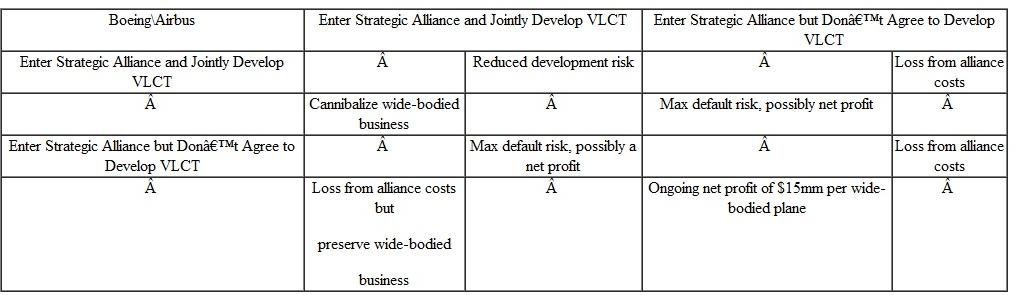
As early as 1993, Boeing and Airbus entered into discussions to jointly develop a very large commercial transport (VLCT) with perhaps 1,000 seats. If each firm proceeded independently, the market for VLCTs is so small relative to the massive R D costs that sizeable losses were assured. Either firm had superior profit available if it proceeded alone. Analyze this simultaneous play noncooperative product development game and predict what Boeing and Airbus would do and why.
In fact, both competitors decided to enter into a strategic alliance with the option to develop a superjumbo or withdraw and maintain a wide-bodied aircraft focus. Analyze Boeing's decision in light of its $45 million contribution margin on each 747 produced and sold. Net operating profit is about $15 million.
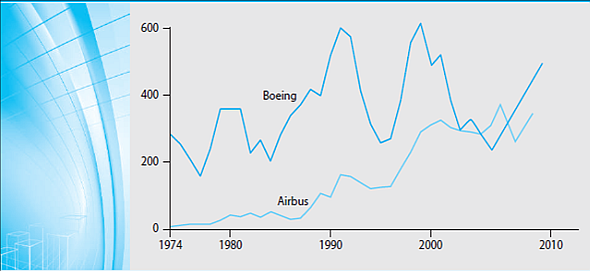
In 2004-2006, for the first time Boeing produced fewer planes than Airbus (see Figure). If Boeing finds itself less profitable at 60 percent market share than at 45 percent, what is the likely impact on the Airbus-Boeing tactical competition
FIGURE Wide-Bodied Aircraft Deliveries by Year
The Superjumbo Dilemma 25
Boeing finishes assembly of wide-bodied commercial aircraft in several sizes at the rate of about one per day. Customers first pay a deposit of one-third of $84 to $127 million for a 767, one-third of $134 to $185 million for a 777, and one-third of $165 to $200 million for a 747, depending on how the planes are equipped. The second third is due after final assembly when the aircraft is painted, and the final third is due at delivery. Final assembly requires 15-25 days, the entire production schedule is 11 months long, and of course, design modifications add months to the front end of each project. The largest of the Boeing planes (the 747-400) carries 432 passengers; by comparison, the largest Airbus plane (the A380) carries 550 passengers.
As early as 1993, Boeing and Airbus entered into discussions to jointly develop a very large commercial transport (VLCT) with perhaps 1,000 seats. If each firm proceeded independently, the market for VLCTs is so small relative to the massive R D costs that sizeable losses were assured. Either firm had superior profit available if it proceeded alone. Analyze this simultaneous play noncooperative product development game and predict what Boeing and Airbus would do and why.
In fact, both competitors decided to enter into a strategic alliance with the option to develop a superjumbo or withdraw and maintain a wide-bodied aircraft focus. Analyze Boeing's decision in light of its $45 million contribution margin on each 747 produced and sold. Net operating profit is about $15 million.
In 2004-2006, for the first time Boeing produced fewer planes than Airbus (see Figure). If Boeing finds itself less profitable at 60 percent market share than at 45 percent, what is the likely impact on the Airbus-Boeing tactical competition
FIGURE Wide-Bodied Aircraft Deliveries by Year
Explanation Verified
Verified
It is important to analyze the sequentia...

Managerial Economics 13th Edition by James McGuigan,Charles Moyer,Frederick Harris

Why don’t you like this exercise?
Other Minimum 8 character and maximum 255 character
Character 255






