







 Chat with AI


International Business 13th Edition by Donald Ball,Michael Geringer,Michael Minor ,Jeanne McNett
Edition 13ISBN: 978-0077606121International Business 13th Edition by Donald Ball,Michael Geringer,Michael Minor ,Jeanne McNett
Edition 13ISBN: 978-0077606121 Exercise 6
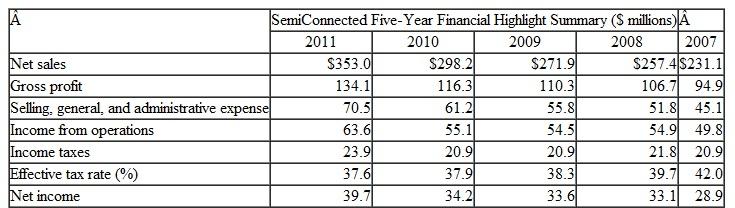
SemiConnected, Inc. manufactures specialized electronic and electrical connectors used on such diverse products as computers, home appliances, telecommunications, and the air bag and antiskid systems of automobiles. The company has been in business since 1984. The accompanying table provides a summary of the important financial information for the last five years.
For some time, SemiConnected has been exporting to Asia, where its major markets are Australia, Singapore, Malaysia, Thailand, South Korea, China, and Taiwan. When its foreign sales were confined to exports, the company functioned well with an export department whose manager reported to the company's marketing manager. In 2010, however, another American firm tried to enter the Taiwan market, and there were rumors that a Taiwanese firm from a related industry was searching for a licensor in the United States to supply it with manufacturing technology. As a result, SemiConnected decided to set up its first foreign plant in Taiwan. When it did, it hired financial and marketing people with Asian experience and established an international division at headquarters to oversee the Taiwan operation. The president felt that the situation would be repeated in China, Singapore, and perhaps other nations. These were all good export markets at the time, but it was reasonable to suppose that some competitor would soon set up manufacturing facilities in one or more of them, which could dramatically affect the potential for exporting to these markets. Having a small international division with some Asian expertise responsible for monitoring these markets would help the firm avoid being surprised by a competitor's move.
After the Taiwan SemiConnected plant was in production, more firms in that nation were willing to do business with the company than had been the case when it had served the market through exports. In fact, the major portion of the 2011 sales increase was due to improved sales to Taiwan. However, the new customers also brought the company into a new, higher level of competition than it had known before. Other Taiwanese competitors were bringing out new products at a considerably faster rate than SemiConnected. The president wondered if horizontal linkages across functions, such as the linkages automakers have used to reduce their design time, might help his firm. Also, on his trips to Taiwan, the marketing people told him things about the market and the competitors that were not being sent to the SemiCon-nected home office.
It was obvious to the president that overseas production and growth in overseas sales demanded a reorganization of the firm. Even though the company had only one plant overseas, in Taiwan, the president was confident that other plants would soon be needed. How should the company be organized to handle the new foreign production facilities? How can SemiConnected reduce the time needed to bring new designs to market?
For some time, SemiConnected has been exporting to Asia, where its major markets are Australia, Singapore, Malaysia, Thailand, South Korea, China, and Taiwan. When its foreign sales were confined to exports, the company functioned well with an export department whose manager reported to the company's marketing manager. In 2010, however, another American firm tried to enter the Taiwan market, and there were rumors that a Taiwanese firm from a related industry was searching for a licensor in the United States to supply it with manufacturing technology. As a result, SemiConnected decided to set up its first foreign plant in Taiwan. When it did, it hired financial and marketing people with Asian experience and established an international division at headquarters to oversee the Taiwan operation. The president felt that the situation would be repeated in China, Singapore, and perhaps other nations. These were all good export markets at the time, but it was reasonable to suppose that some competitor would soon set up manufacturing facilities in one or more of them, which could dramatically affect the potential for exporting to these markets. Having a small international division with some Asian expertise responsible for monitoring these markets would help the firm avoid being surprised by a competitor's move.
After the Taiwan SemiConnected plant was in production, more firms in that nation were willing to do business with the company than had been the case when it had served the market through exports. In fact, the major portion of the 2011 sales increase was due to improved sales to Taiwan. However, the new customers also brought the company into a new, higher level of competition than it had known before. Other Taiwanese competitors were bringing out new products at a considerably faster rate than SemiConnected. The president wondered if horizontal linkages across functions, such as the linkages automakers have used to reduce their design time, might help his firm. Also, on his trips to Taiwan, the marketing people told him things about the market and the competitors that were not being sent to the SemiCon-nected home office.
It was obvious to the president that overseas production and growth in overseas sales demanded a reorganization of the firm. Even though the company had only one plant overseas, in Taiwan, the president was confident that other plants would soon be needed. How should the company be organized to handle the new foreign production facilities? How can SemiConnected reduce the time needed to bring new designs to market?
Explanation Verified
Verified
SCI specializes in manufacturing electro...

International Business 13th Edition by Donald Ball,Michael Geringer,Michael Minor ,Jeanne McNett

Why don’t you like this exercise?
Other Minimum 8 character and maximum 255 character
Character 255






