







 Chat with AI


International Business 13th Edition by Donald Ball,Michael Geringer,Michael Minor ,Jeanne McNett
Edition 13ISBN: 978-0077606121International Business 13th Edition by Donald Ball,Michael Geringer,Michael Minor ,Jeanne McNett
Edition 13ISBN: 978-0077606121 Exercise 1
Microloan Bankers: Charity or For-Profit Business Model?
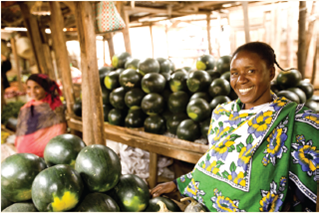
This is Sophia Maimu, a melon stand owner and microloan client of ACCION Tanzanian partner, Akiba Commercial Bank.
You might think it would be utter folly to lend money to the poor in a developing country. What about a loan to a new small business or entrepreneur such as a vegetable peddler, tailor, or candle maker? Worldwide, development organizations are finding that some of the world's poorest entrepreneurs repay their debts at rates approaching 100 percent. To encourage grassroots private business in Latin America, Asia, and Africa, microlending organizations are expanding programs that already lend thousands of small entrepreneurs amounts ranging from $50 to several hundred dollars. Tiny businesses in developing countries commonly repay these microloans faithfully because of community pressure and the security of a favorable credit rating. Microloans give them small spurts of working capital when they need it, allow them to establish credit, and let them borrow again in hard times. The money helps them start or expand their businesses-selling vegetables, sewing, repairing shoes, making furniture, and the like-and boosts the local economy.
The microcredit concept was developed by Professor Muhammad Yunus, a U.S.-trained Bangladeshi PhD economist, through the Grameen Bank in Bangladesh (which he established to administer his program), and ACCION, a U.S. microcredit organization. Dr. Yunus was awarded the Nobel Peace Prize in 2006 for his work fighting poverty.
The microloan repayment performance shines when compared with that of some sovereign nations. It also looks very good compared with a default rate of 13.8 percent among U.S. recipients of federally guaranteed student loans. ACCION reports a repayment rate over the life of its program of 97 percent. A Mexican program, Compatramos, reports a 1 percent default rate.
Critics point out, though, that one microloan is not going to pull a budding entrepreneur out of poverty, let alone a whole country. When Tufts University received an endowment to set up a microloan program, specialists were ready to warn Tufts of the ethical aspects of microloans: its program needs to be much more than banking. A series of loans is probably necessary, combined with training and support.
Recently, several not-for-profit microloan operations have changed. Because of their success, they have become banks, and in one case, Mexico's Banco Compartamos sold 30 percent of its shares to the public, with the IPO share price moving up 34 percent. Their 2007 IPO also brought a lot of difficult issues forward. Compartamos began as a charity grant program, then became a bank, and then a publicly listed bank. The move to private ownership that seeks a return on investment changes the microloan business model substantially, from charity to business. The charity model uses donated funds and funds from international financial institutions such as the World Bank and the European Bank for Reconstruction and Development, and they have low interest rates. Some of the microcredit organizations even make profits, but they are cooperatives, such as Grameen Bank, so their profit moves back into their stakeholder community. Compartamos, in contrast, now charges its credit customers in the range of 100 percent (on an annualized basis) to cover loan interest, fees, and taxes. That is three times the cost of borrowing from other microcredit lenders. To make matters a little more complicated, many of the shareholders who profited greatly from the Compartamos IPO are themselves microlenders, such as ACCION. Tufts University splits the revenues from its microloans 50?50 with the loan program and the university itself. In 2008, the university reported a $6.60 million payout from its share of the microlending operations. a
Is it right to profit from loans to the poor? Dr. Yunis thinks definitely not, and "refuses to mention the words Compartamos and microfinance in the same breath." b At the same time, here's an explanation from the two friends who founded Compartamos in 1990. They suggest that, much like food crisis and famine, the issue isn't the existence of the needed good; both food and money exist. The issue is one of distribution: the food and money frequently are not where they are needed most desperately. The argument is that a profit potential brings private capital in touch with the people who need it, the world's poor, quickly and efficiently. It is a way to align the world's wealth with the world's poor. Big investment firms and banks have begun to participate in profitable microlending. Firms such as CITI Group, Morgan Stanley, TIAA-CREF, and Deutsche Bank are active in the sector now. With returns like Compartamos has, at 53 percent, investors are interested. Here's how the loans work: they are small, usually to women, guaranteed by peers, paid off on time, and often followed immediately by another loan. c
In a disagreement over this very issue, Dr. Younis was ousted from his directorship of Grameen Bank in 2011. View a PBS video that explores this issue further at www.pbs.org/now/shows/338/.
So, what do you think, is profiting from microloans to the poor ethical?
This is Sophia Maimu, a melon stand owner and microloan client of ACCION Tanzanian partner, Akiba Commercial Bank.
You might think it would be utter folly to lend money to the poor in a developing country. What about a loan to a new small business or entrepreneur such as a vegetable peddler, tailor, or candle maker? Worldwide, development organizations are finding that some of the world's poorest entrepreneurs repay their debts at rates approaching 100 percent. To encourage grassroots private business in Latin America, Asia, and Africa, microlending organizations are expanding programs that already lend thousands of small entrepreneurs amounts ranging from $50 to several hundred dollars. Tiny businesses in developing countries commonly repay these microloans faithfully because of community pressure and the security of a favorable credit rating. Microloans give them small spurts of working capital when they need it, allow them to establish credit, and let them borrow again in hard times. The money helps them start or expand their businesses-selling vegetables, sewing, repairing shoes, making furniture, and the like-and boosts the local economy.
The microcredit concept was developed by Professor Muhammad Yunus, a U.S.-trained Bangladeshi PhD economist, through the Grameen Bank in Bangladesh (which he established to administer his program), and ACCION, a U.S. microcredit organization. Dr. Yunus was awarded the Nobel Peace Prize in 2006 for his work fighting poverty.
The microloan repayment performance shines when compared with that of some sovereign nations. It also looks very good compared with a default rate of 13.8 percent among U.S. recipients of federally guaranteed student loans. ACCION reports a repayment rate over the life of its program of 97 percent. A Mexican program, Compatramos, reports a 1 percent default rate.
Critics point out, though, that one microloan is not going to pull a budding entrepreneur out of poverty, let alone a whole country. When Tufts University received an endowment to set up a microloan program, specialists were ready to warn Tufts of the ethical aspects of microloans: its program needs to be much more than banking. A series of loans is probably necessary, combined with training and support.
Recently, several not-for-profit microloan operations have changed. Because of their success, they have become banks, and in one case, Mexico's Banco Compartamos sold 30 percent of its shares to the public, with the IPO share price moving up 34 percent. Their 2007 IPO also brought a lot of difficult issues forward. Compartamos began as a charity grant program, then became a bank, and then a publicly listed bank. The move to private ownership that seeks a return on investment changes the microloan business model substantially, from charity to business. The charity model uses donated funds and funds from international financial institutions such as the World Bank and the European Bank for Reconstruction and Development, and they have low interest rates. Some of the microcredit organizations even make profits, but they are cooperatives, such as Grameen Bank, so their profit moves back into their stakeholder community. Compartamos, in contrast, now charges its credit customers in the range of 100 percent (on an annualized basis) to cover loan interest, fees, and taxes. That is three times the cost of borrowing from other microcredit lenders. To make matters a little more complicated, many of the shareholders who profited greatly from the Compartamos IPO are themselves microlenders, such as ACCION. Tufts University splits the revenues from its microloans 50?50 with the loan program and the university itself. In 2008, the university reported a $6.60 million payout from its share of the microlending operations. a
Is it right to profit from loans to the poor? Dr. Yunis thinks definitely not, and "refuses to mention the words Compartamos and microfinance in the same breath." b At the same time, here's an explanation from the two friends who founded Compartamos in 1990. They suggest that, much like food crisis and famine, the issue isn't the existence of the needed good; both food and money exist. The issue is one of distribution: the food and money frequently are not where they are needed most desperately. The argument is that a profit potential brings private capital in touch with the people who need it, the world's poor, quickly and efficiently. It is a way to align the world's wealth with the world's poor. Big investment firms and banks have begun to participate in profitable microlending. Firms such as CITI Group, Morgan Stanley, TIAA-CREF, and Deutsche Bank are active in the sector now. With returns like Compartamos has, at 53 percent, investors are interested. Here's how the loans work: they are small, usually to women, guaranteed by peers, paid off on time, and often followed immediately by another loan. c
In a disagreement over this very issue, Dr. Younis was ousted from his directorship of Grameen Bank in 2011. View a PBS video that explores this issue further at www.pbs.org/now/shows/338/.
So, what do you think, is profiting from microloans to the poor ethical?
Explanation Verified
Verified
The commercial activities that cross nat...

International Business 13th Edition by Donald Ball,Michael Geringer,Michael Minor ,Jeanne McNett

Why don’t you like this exercise?
Other Minimum 8 character and maximum 255 character
Character 255






