







 Chat with AI


Economics: A Contemporary Introduction 9th Edition by William McEachern
Edition 9ISBN: 9780538453745Economics: A Contemporary Introduction 9th Edition by William McEachern
Edition 9ISBN: 9780538453745 Exercise 2
Case Study: The Electronic Cottage How has the development of personal computer hardware and software reversed some of the trends brought on by the Industrial Revolution?
Reference Case Study:
The Information Economy
The Electronic Cottage The Industrial Revolution shifted production from rural cottages to urban factories. But the Information Revolution spawned by the microchip and the Internet has decentralized the acquisition, analysis, and transmission of information. These days, someone who claims to work at a home office is not necessarily referring to corporate headquarters but to a spare bedroom. According to a recent survey, the number of telecommuters, or "remote workers," has more than doubled in the last decade. Pushing the trend are worsening traffic, higher gas prices, wider access to broadband, growing self-employment resulting from layoffs during the recession of 2007-2009, and even the threat of terrorism. The average commute is 23 miles, and eliminating that can save about $1,000 a year in gas and can avoid putting more than 6,000 pounds of carbon dioxide into the atmosphere. What's more, it often makes sense to try a new business at home before moving to a separate, more costly, location. Most small businesses are home-based, at least at the start.
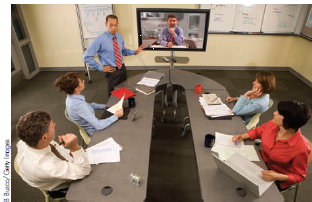
From home, people can write a document with coworkers scattered throughout the world, then discuss the project online in real time or have a videoconference on Skype (McDonald's saves millions in travel costs by videoconferencing). Software allows thousands of employees to share electronic files. A 2010 survey found the majority of those who use computers for most of their work believe they could work at home. When Accenture moved headquarters from Boston to a suburb, the company replaced 120 tons of paper records with an online database accessible anytime from anywhere in the world.
To support those who work at home, an entire industry has sprung up, with magazines, newsletters, Web sites, and national conferences. In fact, an office need not even be in a specific place. Some people now work in virtual offices, which have no permanent locations. With iPhones, BlackBerries, or other links, remote workers, can conduct business on the road-literally, "deals on wheels."
Chip technology is decentralizing production, shifting work from a central office either back to the household or to no place in particular. More generally, the Internet has reduced transaction costs, whether it's a market report authored jointly by researchers from around the world or a new computer system assembled from parts ordered over the Internet. Easier communication has even increased contact among distant research scholars. For example, economists living in distant cities are four times more likely to collaborate now than they were two decades ago.
Reference Case Study:
The Information Economy
The Electronic Cottage The Industrial Revolution shifted production from rural cottages to urban factories. But the Information Revolution spawned by the microchip and the Internet has decentralized the acquisition, analysis, and transmission of information. These days, someone who claims to work at a home office is not necessarily referring to corporate headquarters but to a spare bedroom. According to a recent survey, the number of telecommuters, or "remote workers," has more than doubled in the last decade. Pushing the trend are worsening traffic, higher gas prices, wider access to broadband, growing self-employment resulting from layoffs during the recession of 2007-2009, and even the threat of terrorism. The average commute is 23 miles, and eliminating that can save about $1,000 a year in gas and can avoid putting more than 6,000 pounds of carbon dioxide into the atmosphere. What's more, it often makes sense to try a new business at home before moving to a separate, more costly, location. Most small businesses are home-based, at least at the start.
From home, people can write a document with coworkers scattered throughout the world, then discuss the project online in real time or have a videoconference on Skype (McDonald's saves millions in travel costs by videoconferencing). Software allows thousands of employees to share electronic files. A 2010 survey found the majority of those who use computers for most of their work believe they could work at home. When Accenture moved headquarters from Boston to a suburb, the company replaced 120 tons of paper records with an online database accessible anytime from anywhere in the world.
To support those who work at home, an entire industry has sprung up, with magazines, newsletters, Web sites, and national conferences. In fact, an office need not even be in a specific place. Some people now work in virtual offices, which have no permanent locations. With iPhones, BlackBerries, or other links, remote workers, can conduct business on the road-literally, "deals on wheels."
Chip technology is decentralizing production, shifting work from a central office either back to the household or to no place in particular. More generally, the Internet has reduced transaction costs, whether it's a market report authored jointly by researchers from around the world or a new computer system assembled from parts ordered over the Internet. Easier communication has even increased contact among distant research scholars. For example, economists living in distant cities are four times more likely to collaborate now than they were two decades ago.
Explanation Verified
Verified
The Industrial Revolution brought on a l...

Economics: A Contemporary Introduction 9th Edition by William McEachern

Why don’t you like this exercise?
Other Minimum 8 character and maximum 255 character
Character 255






