







 Chat with AI


Economics: A Contemporary Introduction 9th Edition by William McEachern
Edition 9ISBN: 9780538453745Economics: A Contemporary Introduction 9th Edition by William McEachern
Edition 9ISBN: 9780538453745 Exercise 11
Case Study: The Mail Monopoly Can the U.S. Postal Service be considered a monopoly in first-class mail? Why or why not? What has happened to the price elasticity of demand for first class mail in recent years?
Reference Case Study:
Public Policy
The Mail Monopoly The U.S. Post Office was granted a monopoly in 1775 and has operated under federal protection ever since. In 1971, Congress converted the Post Office Department into a semi-independent agency called the U.S. Postal Service, or USPS, which had total revenue of about $70 billion in 2009. Because of the national recession, revenue in 2009 was down 9 percent from 2008 and about the same as in 2006. More than 650,000 employees at 37,000 post offices deliver an average of 177 billion pieces of mail a year to 144 million home and business addresses. This amounts to about 40 percent of the world's total mail delivery. USPS pays no taxes and is exempt from local zoning laws. It has a legal monopoly in delivering regular, first-class letters and has the exclusive right to use the space inside your mailbox. Other delivery services such as FedEx or UPS cannot deliver to mail boxes or post office boxes.
The USPS monopoly has suffered in recent years because of rising costs and growing competition from new technologies. The price of a first-class stamp climbed from 6 cents in 1970 to 44 cents by 2010-a growth rate twice that of inflation. Long distance phone service, one possible substitute for first-class mail, is much cheaper today than in 1970. New technologies such as email, ecards, online bill-payment, text messaging, and social-networking sites also displace USPS delivery services (email messages now greatly outnumber first-class letters). Because its monopoly applies only to regular first-class mail, USPS has lost chunks of other business to private firms offering lower rates and better service. The United Parcel Service (UPS), for example, is more mechanized and more containerized than the USPS and thus has lower costs and less breakage. The USPS has tried to emulate UPS but with only limited success. After Hurricane Katrina, it took seven months to reopen the USPS processing and distribution center in New Orleans. Rivals UPS, FedEx, and DHL all restored service within three weeks.
When the Postal Service raised third-class ("junk" mail) rates, businesses substituted other forms of advertising, including cable TV, telemarketing, and the Internet. UPS and other rivals now account for most ground-shipped packages. Even USPS's first-class monopoly is being threatened, because FedEx and others have captured 90 percent of the overnight mail business. Thus, USPS is losing business because of competition from overnight mail and from new technologies.
USPS has been fighting back, trying to leverage its monopoly power while increasing efficiency. On the electronic front, USPS tried to offer online postage purchases, online bill-paying service, and online document transmission service. But these new products were scrapped as failures. Changing technology and competition have been eroding USPS's government granted monopoly. USPS lost about $4 billion in 2009 and said that without drastic changes, losses would total $238 billion over the next decade. Even a legal monopoly can lose money. Proposed changes include postage increases and dropping Saturday delivery.
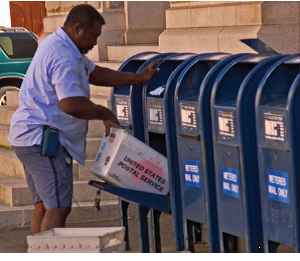
Reference Case Study:
Public Policy
The Mail Monopoly The U.S. Post Office was granted a monopoly in 1775 and has operated under federal protection ever since. In 1971, Congress converted the Post Office Department into a semi-independent agency called the U.S. Postal Service, or USPS, which had total revenue of about $70 billion in 2009. Because of the national recession, revenue in 2009 was down 9 percent from 2008 and about the same as in 2006. More than 650,000 employees at 37,000 post offices deliver an average of 177 billion pieces of mail a year to 144 million home and business addresses. This amounts to about 40 percent of the world's total mail delivery. USPS pays no taxes and is exempt from local zoning laws. It has a legal monopoly in delivering regular, first-class letters and has the exclusive right to use the space inside your mailbox. Other delivery services such as FedEx or UPS cannot deliver to mail boxes or post office boxes.
The USPS monopoly has suffered in recent years because of rising costs and growing competition from new technologies. The price of a first-class stamp climbed from 6 cents in 1970 to 44 cents by 2010-a growth rate twice that of inflation. Long distance phone service, one possible substitute for first-class mail, is much cheaper today than in 1970. New technologies such as email, ecards, online bill-payment, text messaging, and social-networking sites also displace USPS delivery services (email messages now greatly outnumber first-class letters). Because its monopoly applies only to regular first-class mail, USPS has lost chunks of other business to private firms offering lower rates and better service. The United Parcel Service (UPS), for example, is more mechanized and more containerized than the USPS and thus has lower costs and less breakage. The USPS has tried to emulate UPS but with only limited success. After Hurricane Katrina, it took seven months to reopen the USPS processing and distribution center in New Orleans. Rivals UPS, FedEx, and DHL all restored service within three weeks.
When the Postal Service raised third-class ("junk" mail) rates, businesses substituted other forms of advertising, including cable TV, telemarketing, and the Internet. UPS and other rivals now account for most ground-shipped packages. Even USPS's first-class monopoly is being threatened, because FedEx and others have captured 90 percent of the overnight mail business. Thus, USPS is losing business because of competition from overnight mail and from new technologies.
USPS has been fighting back, trying to leverage its monopoly power while increasing efficiency. On the electronic front, USPS tried to offer online postage purchases, online bill-paying service, and online document transmission service. But these new products were scrapped as failures. Changing technology and competition have been eroding USPS's government granted monopoly. USPS lost about $4 billion in 2009 and said that without drastic changes, losses would total $238 billion over the next decade. Even a legal monopoly can lose money. Proposed changes include postage increases and dropping Saturday delivery.
Explanation Verified
Verified
A monopoly is defined as a firm that has...

Economics: A Contemporary Introduction 9th Edition by William McEachern

Why don’t you like this exercise?
Other Minimum 8 character and maximum 255 character
Character 255






