







 Chat with AI


Marketing: Custom Edition for Texas A&M University 17th Edition by William Pride,Ferrell
Edition 17ISBN: 978-1285895321Marketing: Custom Edition for Texas A&M University 17th Edition by William Pride,Ferrell
Edition 17ISBN: 978-1285895321 Exercise 31
100 Years of Product Innovation at Chevrolet
General Motors' Chevrolet brand celebrated its 100th anniversary in 2011. In its 100-year history, Chevrolet embarked on many different vehicle models, some of them widely successful and others deleted from the product mix shortly after introduction. Over the years, it has transitioned from an American icon into a worldwide brand known for its quality and durability. Despite numerous ups and downs in its history, including the recent bankruptcy and bailout of parent company GM, Chevrolet is still going strong after a century of product innovation.
History of Product Innovation
Ironically, Chevrolet exists because of its top competitor, Ford Motor. William Durant founded Chevrolet in 1911 to compete head on with Ford's Model T. The brand was named after Louis Chevrolet, a top racer who was hired to design the first Chevrolet. Chevrolet's initial model cost $2,000. This was a high-priced vehicle at the time, which did not sit well with Durant, who wanted to compete directly against Ford on price. In 1915, Chevrolet released a less expensive model priced at $490, the same price as a Ford Model T. The company was acquired by General Motors in 1918, and Chevrolet went on to become one of GM's most popular brands.
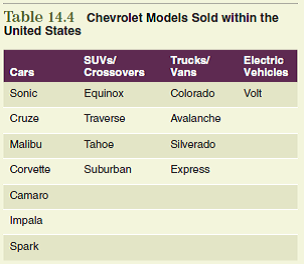
During much of its history, Chevrolet attempted to position itself as an iconic American brand, using patriotic slogans and courting racecar drivers as endorsers to create an image of quality and sportiness. Chevrolet is also credited with being the first automobile maker to come up with the idea of planned product obsolescence. Based on this concept, Chevrolet introduces a new car model each year, a type of product modification. Like all established companies, Chevrolet vehicles underwent several successes and failures. Some vehicles that Chevy thought would succeed failed miserably, often due to safety (the Corvair) or quality (the Vega) issues. On the other hand, its sporty Corvette was immensely popular and still exists today as a sports car icon. Table 14.4 shows the entire portfolio of Chevrolet vehicle models sold in the United States.
After nearly a century in business, Chevrolet faced its greatest threat with GM's bankruptcy in 2009. The company required a massive government bailout, and although GM has begun to rebound, its reputation will take a while to recover. According to GM CEO Dan Akerson, the company "failed because we failed to innovate." However, he sees hope in Chevrolet as an innovation powerhouse and believes the brand will bring GM back from the brink of collapse.
After the Bailout
Today, Chevrolet is a worldwide brand. It achieved record global sales of 4.76 million vehicles in 2011.
Although it sold the most vehicles in the United States, China saw a more than 9 percent increase in the number of Chevrolets sold at 595,068 vehicles in 2011. The company positions its vehicles along four values: durability, value, practicality, and friendliness. This lattermost value relies heavily on the customer service that Chevrolet offers among its sales staff and customer support personnel.
Chevrolet's vehicles are at all stages of the product life cycle. In the decline stage are its SUVs, as SUVs in general have become less popular due to a greater concern for the environment and rising gas prices. Rather than phasing out its SUVs, however, Chevrolet chose to revamp its SUVs to make them more eco-friendly. The company introduced SUV crossover vehicles and the Chevrolet Tahoe Hybrid in the hope of attracting those who like the style of SUVs without the gas inefficiencies. The Corvette is still going strong, although it has likely reached the maturity stage due to new product innovations and changing customer tastes. Additionally, the average Corvette owner is in his or her fifties. The Chevy Cruze is in the growth stage; in 2011, it was the best-selling compact car in the United States. Another car in the growth stage is the Chevrolet Camaro, a product that was initially deleted from the product mix in 2002. After fans demanded to have the Camaro resurrected, Chevrolet reintroduced a redesigned Camaro in 2010. The car went on to win the World Car Design of the Year. Even more popular than its cars are Chevrolet's pickup trucks. Chevrolet introduced its first truck in 1918, and sales of Chevrolet pickup trucks surpassed sales of its cars in 1989. Its Silverado pickup truck is currently in the growth stage as the second best-selling vehicle in 2011. Chevy is also seizing the opportunity to profit from a growing demand for electric vehicles with its introduction of the Chevrolet Volt. The Volt runs on electricity but will use gasoline if all of the electricity is used.
The Chevrolet brand is a model to which marketers aspire. Unlike so many other brands, it has lasted for a century due to its innovative product modifications and ability to rebound from failures. It must continue to seize market opportunities, constantly modify its products, and adapt its brand to changing customer tastes. Successfully meeting these criteria could enable the Chevrolet brand to succeed for another century.
What are the challenges for the Chevrolet brand in the future?
General Motors' Chevrolet brand celebrated its 100th anniversary in 2011. In its 100-year history, Chevrolet embarked on many different vehicle models, some of them widely successful and others deleted from the product mix shortly after introduction. Over the years, it has transitioned from an American icon into a worldwide brand known for its quality and durability. Despite numerous ups and downs in its history, including the recent bankruptcy and bailout of parent company GM, Chevrolet is still going strong after a century of product innovation.
History of Product Innovation
Ironically, Chevrolet exists because of its top competitor, Ford Motor. William Durant founded Chevrolet in 1911 to compete head on with Ford's Model T. The brand was named after Louis Chevrolet, a top racer who was hired to design the first Chevrolet. Chevrolet's initial model cost $2,000. This was a high-priced vehicle at the time, which did not sit well with Durant, who wanted to compete directly against Ford on price. In 1915, Chevrolet released a less expensive model priced at $490, the same price as a Ford Model T. The company was acquired by General Motors in 1918, and Chevrolet went on to become one of GM's most popular brands.
During much of its history, Chevrolet attempted to position itself as an iconic American brand, using patriotic slogans and courting racecar drivers as endorsers to create an image of quality and sportiness. Chevrolet is also credited with being the first automobile maker to come up with the idea of planned product obsolescence. Based on this concept, Chevrolet introduces a new car model each year, a type of product modification. Like all established companies, Chevrolet vehicles underwent several successes and failures. Some vehicles that Chevy thought would succeed failed miserably, often due to safety (the Corvair) or quality (the Vega) issues. On the other hand, its sporty Corvette was immensely popular and still exists today as a sports car icon. Table 14.4 shows the entire portfolio of Chevrolet vehicle models sold in the United States.
After nearly a century in business, Chevrolet faced its greatest threat with GM's bankruptcy in 2009. The company required a massive government bailout, and although GM has begun to rebound, its reputation will take a while to recover. According to GM CEO Dan Akerson, the company "failed because we failed to innovate." However, he sees hope in Chevrolet as an innovation powerhouse and believes the brand will bring GM back from the brink of collapse.
After the Bailout
Today, Chevrolet is a worldwide brand. It achieved record global sales of 4.76 million vehicles in 2011.
Although it sold the most vehicles in the United States, China saw a more than 9 percent increase in the number of Chevrolets sold at 595,068 vehicles in 2011. The company positions its vehicles along four values: durability, value, practicality, and friendliness. This lattermost value relies heavily on the customer service that Chevrolet offers among its sales staff and customer support personnel.
Chevrolet's vehicles are at all stages of the product life cycle. In the decline stage are its SUVs, as SUVs in general have become less popular due to a greater concern for the environment and rising gas prices. Rather than phasing out its SUVs, however, Chevrolet chose to revamp its SUVs to make them more eco-friendly. The company introduced SUV crossover vehicles and the Chevrolet Tahoe Hybrid in the hope of attracting those who like the style of SUVs without the gas inefficiencies. The Corvette is still going strong, although it has likely reached the maturity stage due to new product innovations and changing customer tastes. Additionally, the average Corvette owner is in his or her fifties. The Chevy Cruze is in the growth stage; in 2011, it was the best-selling compact car in the United States. Another car in the growth stage is the Chevrolet Camaro, a product that was initially deleted from the product mix in 2002. After fans demanded to have the Camaro resurrected, Chevrolet reintroduced a redesigned Camaro in 2010. The car went on to win the World Car Design of the Year. Even more popular than its cars are Chevrolet's pickup trucks. Chevrolet introduced its first truck in 1918, and sales of Chevrolet pickup trucks surpassed sales of its cars in 1989. Its Silverado pickup truck is currently in the growth stage as the second best-selling vehicle in 2011. Chevy is also seizing the opportunity to profit from a growing demand for electric vehicles with its introduction of the Chevrolet Volt. The Volt runs on electricity but will use gasoline if all of the electricity is used.
The Chevrolet brand is a model to which marketers aspire. Unlike so many other brands, it has lasted for a century due to its innovative product modifications and ability to rebound from failures. It must continue to seize market opportunities, constantly modify its products, and adapt its brand to changing customer tastes. Successfully meeting these criteria could enable the Chevrolet brand to succeed for another century.
What are the challenges for the Chevrolet brand in the future?
Explanation Verified
Verified
Environmental issues and increased fuel ...

Marketing: Custom Edition for Texas A&M University 17th Edition by William Pride,Ferrell

Why don’t you like this exercise?
Other Minimum 8 character and maximum 255 character
Character 255






