







 Chat with AI

Compensation 11th Edition by George Milkovich,Jerry Newman,Barry Gerhart
Edition 11ISBN: 978-0078029493Compensation 11th Edition by George Milkovich,Jerry Newman,Barry Gerhart
Edition 11ISBN: 978-0078029493 Exercise 8
We have focused quite a lot in Chapter 7 and elsewhere on examples of employers reducing pay level (U.S automobile and airline companies) and/or outsourcing production to parts of the world having relatively low pay (e.g., Apple) as a means of reducing labor costs to be competitive in the product market. We promise to also talk about more examples of companies (like Merrill Lynch) that have increased pay level to be more competitive in attracting and retaining talent that is needed to be competitive in the labor market. (We will, for example, talk about Google in the Chapter 8 Your Turn.) But, for now, we will stay with the labor cost reduction theme.
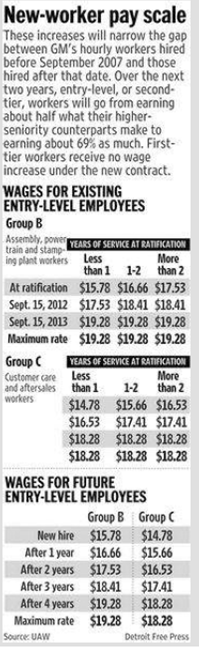
As noted earlier in this chapter, U.S. automakers are counting on two-tier wage structures to control labor costs over the next several years. A two-tier wage structure allows a company to pay new hires at a lower wage. At GM, for example, workers hired after September 2007 received an hourly (Tier II) wage of $14, about one-half of the wage, $28, of existing employees (Tier I). The difference in overall labor cost is larger than the $14 wage difference due to Tier II workers also having lower benefits costs. The average hourly labor cost for Tier 1 workers at a GM plant is about $56 versus $33 for Tier II workers. 66 The contract reached between GM and the United Autoworkers (UAW) in late 2011 will increase the wages of Tier II workers. So, that change will increase labor costs. However, Tier II worker pay will still be substantially lower than for Tier II workers, meaning that average labor costs for GM will fall relative to current levels every time a Tier I worker leaves and every time a Tier II worker is hired. The new two-tier wage structure at GM is shown on the right of this page. 67
As recently as the late 1990s, the automobile industry (including both domestic and overseas owned U.S. producers) employed 1,000,000 people in the United States. That number dropped to 550,000 during the recession and bankruptcies of late last decade. Now, the Center for Automotive Research projects that employment could grow to 650,000 in 2012 and could be more than 750,000 by 2015. 68
At the GM plant in Orion Township, Michigan, about 100 workers sort parts to be used on the assembly line to build the Chevrolet Sonic. What is notable is that these workers are not GM employees but rather (UAW-represented) employees of an outside supplier. Their average hourly labor cost is about $20 per hour, lower not only than that of Tier I GM workers, but also lower than Tier 2 GM workers. As a result of using a significant number of lower cost Tier II workers and (even lower cost) outside supplier workers, GM is expected to be able to reduce the labor cost per vehicle from $1,160 at a now (before bankruptcy and new labor contracts, the labor cost per vehicle would have been higher) typical GM plant to $710 per vehicle. All told, GM could save as much as much as $72 million per year. 69
Here are one question to consider:
Will the two-tier wage structure go away in the near future Summarize the pressures to eliminate it as well as the pressures to keep it. Be sure to consider labor costs and productivity of workers and plants at other companies and in other parts of the world. You may wish to do some research on the new Volkswagen plant in Chattanooga, Tennessee. Also, consider that the Automotive News estimates that the Ford Fiesta (a competitor to the Chevy Sonic) plant in Cuautitlan, Mexico may have labor costs as low as $150 per vehicle. 71
As noted earlier in this chapter, U.S. automakers are counting on two-tier wage structures to control labor costs over the next several years. A two-tier wage structure allows a company to pay new hires at a lower wage. At GM, for example, workers hired after September 2007 received an hourly (Tier II) wage of $14, about one-half of the wage, $28, of existing employees (Tier I). The difference in overall labor cost is larger than the $14 wage difference due to Tier II workers also having lower benefits costs. The average hourly labor cost for Tier 1 workers at a GM plant is about $56 versus $33 for Tier II workers. 66 The contract reached between GM and the United Autoworkers (UAW) in late 2011 will increase the wages of Tier II workers. So, that change will increase labor costs. However, Tier II worker pay will still be substantially lower than for Tier II workers, meaning that average labor costs for GM will fall relative to current levels every time a Tier I worker leaves and every time a Tier II worker is hired. The new two-tier wage structure at GM is shown on the right of this page. 67
As recently as the late 1990s, the automobile industry (including both domestic and overseas owned U.S. producers) employed 1,000,000 people in the United States. That number dropped to 550,000 during the recession and bankruptcies of late last decade. Now, the Center for Automotive Research projects that employment could grow to 650,000 in 2012 and could be more than 750,000 by 2015. 68
At the GM plant in Orion Township, Michigan, about 100 workers sort parts to be used on the assembly line to build the Chevrolet Sonic. What is notable is that these workers are not GM employees but rather (UAW-represented) employees of an outside supplier. Their average hourly labor cost is about $20 per hour, lower not only than that of Tier I GM workers, but also lower than Tier 2 GM workers. As a result of using a significant number of lower cost Tier II workers and (even lower cost) outside supplier workers, GM is expected to be able to reduce the labor cost per vehicle from $1,160 at a now (before bankruptcy and new labor contracts, the labor cost per vehicle would have been higher) typical GM plant to $710 per vehicle. All told, GM could save as much as much as $72 million per year. 69
Here are one question to consider:
Will the two-tier wage structure go away in the near future Summarize the pressures to eliminate it as well as the pressures to keep it. Be sure to consider labor costs and productivity of workers and plants at other companies and in other parts of the world. You may wish to do some research on the new Volkswagen plant in Chattanooga, Tennessee. Also, consider that the Automotive News estimates that the Ford Fiesta (a competitor to the Chevy Sonic) plant in Cuautitlan, Mexico may have labor costs as low as $150 per vehicle. 71
Explanation Verified
Verified
A two-tier wage system is a bicameral pa...

Compensation 11th Edition by George Milkovich,Jerry Newman,Barry Gerhart

Why don’t you like this exercise?
Other Minimum 8 character and maximum 255 character
Character 255






