







 Chat with AI

Cornerstones of Managerial Accounting 4th Edition by Maryanne Mowen, Don Hansen, Dan Heitger
Edition 4ISBN: 978-0324380767Cornerstones of Managerial Accounting 4th Edition by Maryanne Mowen, Don Hansen, Dan Heitger
Edition 4ISBN: 978-0324380767 Exercise 53
Activity-Based Supplier Costing
Bowman Company manufactures cooling systems. Bowman produces all the parts necessary for its product except for one electronic component, which is purchased from two local suppliers: Manzer Inc. and Buckner Company. Both suppliers are reliable and seldom deliver late; however, Manzer sells the component for $89 per unit, while Buckner sells the same component for $86. Bowman purchases 80% of its components from Buckner because of its lower price. The total annual demand is 4,000,000 components.
To help assess the cost effect of the two components, the following data were collected for supplier-related activities and suppliers:
I. Activity Data
II. Supplier Data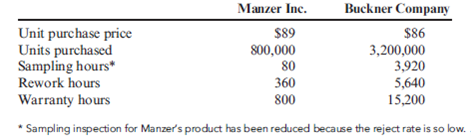
Required:
1. Calculate the cost per component for each supplier, taking into consideration the costs of the supplier-related activities and using the current prices and sales volume. ( Note : Round the unit cost to two decimal places.)
2. Suppose that Bowman loses $4,000,000 in sales per year because it develops a poor reputation due to defective units attributable to failed components. Using warranty hours, assign the cost of lost sales to each supplier. By how much would this change the cost of each supplier's component (Round to two decimal places.)
3. CONCEPTUAL CONNECTION Based on the analysis in Requirements 1 and 2, discuss the importance of activity-based supplier costing for internal decision making.
Bowman Company manufactures cooling systems. Bowman produces all the parts necessary for its product except for one electronic component, which is purchased from two local suppliers: Manzer Inc. and Buckner Company. Both suppliers are reliable and seldom deliver late; however, Manzer sells the component for $89 per unit, while Buckner sells the same component for $86. Bowman purchases 80% of its components from Buckner because of its lower price. The total annual demand is 4,000,000 components.
To help assess the cost effect of the two components, the following data were collected for supplier-related activities and suppliers:
I. Activity Data
II. Supplier Data
Required:
1. Calculate the cost per component for each supplier, taking into consideration the costs of the supplier-related activities and using the current prices and sales volume. ( Note : Round the unit cost to two decimal places.)
2. Suppose that Bowman loses $4,000,000 in sales per year because it develops a poor reputation due to defective units attributable to failed components. Using warranty hours, assign the cost of lost sales to each supplier. By how much would this change the cost of each supplier's component (Round to two decimal places.)
3. CONCEPTUAL CONNECTION Based on the analysis in Requirements 1 and 2, discuss the importance of activity-based supplier costing for internal decision making.
Explanation Verified
Verified
(1) Using the information given, we can ...

Cornerstones of Managerial Accounting 4th Edition by Maryanne Mowen, Don Hansen, Dan Heitger

Why don’t you like this exercise?
Other Minimum 8 character and maximum 255 character
Character 255






