







 Chat with AI


Lesikar's Business Communication: Connecting in a Digital World 13th Edition by Kathryn Rentz,Paula Lentz
Edition 13ISBN: 978-0073403212Lesikar's Business Communication: Connecting in a Digital World 13th Edition by Kathryn Rentz,Paula Lentz
Edition 13ISBN: 978-0073403212 Exercise 40
You serve as an assistant in the human resources department at Heckworth Holdings, a large manufacturer of machine tools. Three months ago, your company switched from a typical five-day work week to a four-day work week. Under the new arrangement, employees at Heckworth work 10-hour days, Monday through Thursday. The change was made to save money on utility expenses, specifically electricity. Under the new arrangement, the plant is completely closed on Friday, Saturday, and Sunday.
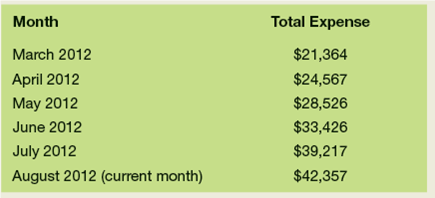
Your supervisor, Scott Morgan, the director of human resources, wants to know two things about the schedule change. First, have utility expenses actually decreased, and second, what do employees think about the schedule change? You make a visit to the accounting department, where you ask for the gas and electric bills for the previous six months. The total cost for utilities is displayed in Table 1 below:
Table 1 Previous 6 Months Gas and Electric Expenses for Heckworth Holdings
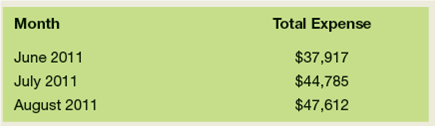
The accounting clerk, Shane Wang, suggests that you also look at the gas and electric bills for the same three months (June, July, and August) of last year. Total gas and electric expenses for those three months are displayed in Table 2:
Table 2 June-August 2011 Gas and Electric Expenses for Heckworth Holdings
After collecting this information, you begin to analyze the data from a survey that Mr. Morgan recently sent to all 1,500 employees at Heckworth, which asked their opinions on the scheduling change. A total of 871 employees responded to the survey. The survey asked a series of questions, but three in particular are of most interest to Mr. Morgan.
The first question is, "Do you like the new four-day work week?" The breakdown in responses was as follows: 365 "Strongly Agree", 141 "Agree," 147 "Neutral," 128 "Disagree," and 90 "Strongly Disagree."
The second question is, "Do you think the new four-day work week has made you more productive?" The breakdown in responses to the second question was as follows: 143 "Strongly Agree," 165 "Agree," 201 "Neutral," 189 "Disagree," and 173 "Strongly Disagree."
The third question is "Do you recommend that we continue with the new four-day work week?" The breakdown in responses to the third question was as follows: 237 "Strongly Agree," 192 "Agree," 226 "Neutral," 153 "Disagree," and 63 "Strongly Disagree."
Finally, there was an open-ended question that asked employees for any other thoughts they had on the four-day work week. You got only a few responses, but they tended to be like these: "I like the three-day weekend!," "This is another example of why I like working for this company!," "I am very tired at the end of the 10-hour day," and "The lunch break is not long enough."
Using these data, write a report to Mr. Morgan about the impact that the schedule change has had on the plant's overall gas and electric costs, as well as the employees' perceptions of the new four-day work week.
Your supervisor, Scott Morgan, the director of human resources, wants to know two things about the schedule change. First, have utility expenses actually decreased, and second, what do employees think about the schedule change? You make a visit to the accounting department, where you ask for the gas and electric bills for the previous six months. The total cost for utilities is displayed in Table 1 below:
Table 1 Previous 6 Months Gas and Electric Expenses for Heckworth Holdings
The accounting clerk, Shane Wang, suggests that you also look at the gas and electric bills for the same three months (June, July, and August) of last year. Total gas and electric expenses for those three months are displayed in Table 2:
Table 2 June-August 2011 Gas and Electric Expenses for Heckworth Holdings
After collecting this information, you begin to analyze the data from a survey that Mr. Morgan recently sent to all 1,500 employees at Heckworth, which asked their opinions on the scheduling change. A total of 871 employees responded to the survey. The survey asked a series of questions, but three in particular are of most interest to Mr. Morgan.
The first question is, "Do you like the new four-day work week?" The breakdown in responses was as follows: 365 "Strongly Agree", 141 "Agree," 147 "Neutral," 128 "Disagree," and 90 "Strongly Disagree."
The second question is, "Do you think the new four-day work week has made you more productive?" The breakdown in responses to the second question was as follows: 143 "Strongly Agree," 165 "Agree," 201 "Neutral," 189 "Disagree," and 173 "Strongly Disagree."
The third question is "Do you recommend that we continue with the new four-day work week?" The breakdown in responses to the third question was as follows: 237 "Strongly Agree," 192 "Agree," 226 "Neutral," 153 "Disagree," and 63 "Strongly Disagree."
Finally, there was an open-ended question that asked employees for any other thoughts they had on the four-day work week. You got only a few responses, but they tended to be like these: "I like the three-day weekend!," "This is another example of why I like working for this company!," "I am very tired at the end of the 10-hour day," and "The lunch break is not long enough."
Using these data, write a report to Mr. Morgan about the impact that the schedule change has had on the plant's overall gas and electric costs, as well as the employees' perceptions of the new four-day work week.
Explanation Verified
Verified
Reports:
Any report can be good in desi...

Lesikar's Business Communication: Connecting in a Digital World 13th Edition by Kathryn Rentz,Paula Lentz

Why don’t you like this exercise?
Other Minimum 8 character and maximum 255 character
Character 255






