







 Chat with AI


Entrepreneurial Small Business 4th Edition by Jerome Katz ,Richard Green
Edition 4ISBN: 978-0078029424Entrepreneurial Small Business 4th Edition by Jerome Katz ,Richard Green
Edition 4ISBN: 978-0078029424 Exercise 7
ANALYZING TO FIND A PATH FORWARD
Ronnie Scales had his heart set on an Internet consulting business specializing in SEO (search engine optimization), which involves designing websites with characteristics that help them appear high up in search result displays. Being on the first screen that people see can be worth a lot to a company selling on the web.
Ronnie had a strong background, with a bachelor's degree in management information system (MIS) with a marketing minor from a university in his hometown of Dallas. He had worked in the university's lab, and had done web design and SEO for campus organizations, local nonprofits, and a few students with online businesses. When he tried a perceptual map with cost and value benefits like expertise, his firm did not do well. After all, he was new to the industry so his experience was not as great as a lot of his competitors. Also, since SEO can be done remotely, he was competing with firms in India and Eastern Europe who charged less than he did. He felt there had to be some advantages of being physically near to the customer, but he was not sure how to leverage it.
What sort of tactics could he use to better position his SEO business for success in such a crowded industry
Pick two tactics from the list in Exhibit 7.3 and explain how they could be applied to Ronnie's business. Explain why you think those tactics would work.
EXHIBIT 7.3 Strategic and Tactical Competitive Actions
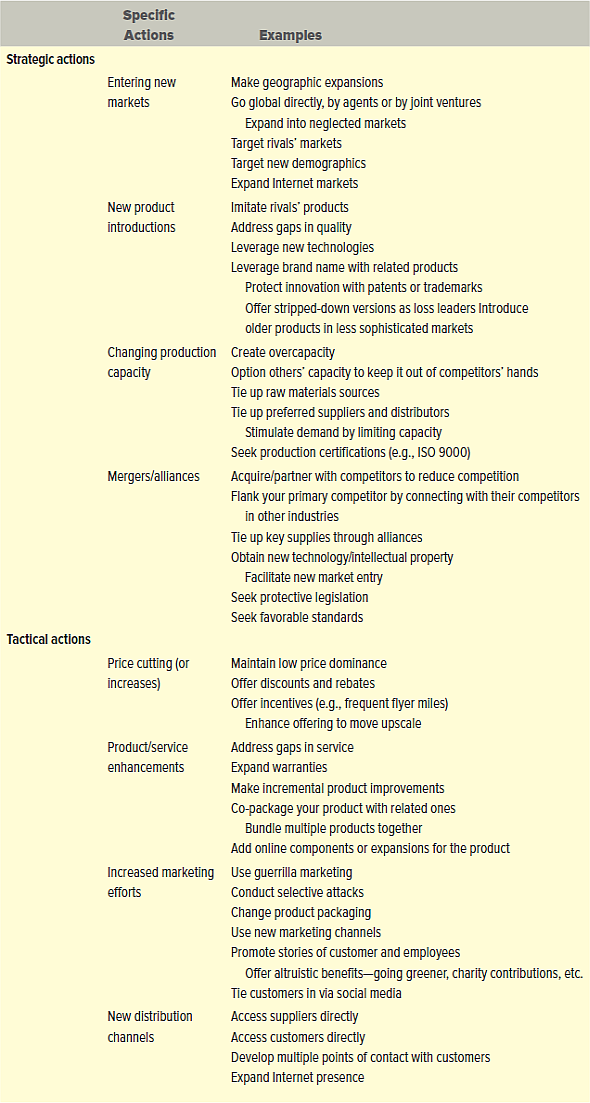
Sources: Adapted from G. Dess, A. Eisner, and G. T. (Tom) Lumpkin, Strategic Management: Text and Cases, 5th ed. (McGraw-Hill/Irwin, 2009), Exhibit 8.2, p. 300; M. J. Chen and D. C. Hambrick, "Speed, Stealth, and Selective Attack: How Small Firms Differ from Large Firms in Competitive Behavior," Academy of Management Journal 38, no. 2 (April 1, 1995), pp. 453-482; M. Davies, "Sales Promotions as a Competitive Strategy," Management Decision 30, no. 7 (December 31, 1992), www.emeraldinsight.com/journals.htm articleid=864603 show=abst ract (accessed June 20, 2012); W. J. Ferrier, K. G. Smith, and C. M. Grimm, "The Role of Competitive Action in Market Share Erosion and Industry Dethronement: A Study of Industry Leaders and Challengers," Academy of Management Journal 42, no. 4 (1999), pp. 372-388; R. A. Garda, "Use Tactical Pricing to Uncover Hidden Profits," Journal of Business Strategy 12, no. 5 (December 31, 1991), pp. 17-23.
Ronnie Scales had his heart set on an Internet consulting business specializing in SEO (search engine optimization), which involves designing websites with characteristics that help them appear high up in search result displays. Being on the first screen that people see can be worth a lot to a company selling on the web.
Ronnie had a strong background, with a bachelor's degree in management information system (MIS) with a marketing minor from a university in his hometown of Dallas. He had worked in the university's lab, and had done web design and SEO for campus organizations, local nonprofits, and a few students with online businesses. When he tried a perceptual map with cost and value benefits like expertise, his firm did not do well. After all, he was new to the industry so his experience was not as great as a lot of his competitors. Also, since SEO can be done remotely, he was competing with firms in India and Eastern Europe who charged less than he did. He felt there had to be some advantages of being physically near to the customer, but he was not sure how to leverage it.
What sort of tactics could he use to better position his SEO business for success in such a crowded industry
Pick two tactics from the list in Exhibit 7.3 and explain how they could be applied to Ronnie's business. Explain why you think those tactics would work.
EXHIBIT 7.3 Strategic and Tactical Competitive Actions
Sources: Adapted from G. Dess, A. Eisner, and G. T. (Tom) Lumpkin, Strategic Management: Text and Cases, 5th ed. (McGraw-Hill/Irwin, 2009), Exhibit 8.2, p. 300; M. J. Chen and D. C. Hambrick, "Speed, Stealth, and Selective Attack: How Small Firms Differ from Large Firms in Competitive Behavior," Academy of Management Journal 38, no. 2 (April 1, 1995), pp. 453-482; M. Davies, "Sales Promotions as a Competitive Strategy," Management Decision 30, no. 7 (December 31, 1992), www.emeraldinsight.com/journals.htm articleid=864603 show=abst ract (accessed June 20, 2012); W. J. Ferrier, K. G. Smith, and C. M. Grimm, "The Role of Competitive Action in Market Share Erosion and Industry Dethronement: A Study of Industry Leaders and Challengers," Academy of Management Journal 42, no. 4 (1999), pp. 372-388; R. A. Garda, "Use Tactical Pricing to Uncover Hidden Profits," Journal of Business Strategy 12, no. 5 (December 31, 1991), pp. 17-23.
Explanation Verified
Verified
Strategies and tactics are two things wh...

Entrepreneurial Small Business 4th Edition by Jerome Katz ,Richard Green

Why don’t you like this exercise?
Other Minimum 8 character and maximum 255 character
Character 255






