







 Chat with AI


Marketing 5th Edition by Dhruv Grewal,Michael Levy
Edition 5ISBN: 978-1259446290Marketing 5th Edition by Dhruv Grewal,Michael Levy
Edition 5ISBN: 978-1259446290 Exercise 5
IMAGES, SALES, BRANDS: HOW RED BULL USES VARIOUS SOCIAL MEDIA TECHNIQUES TO ACHIEVE ALL ITS OBJECTIVES
It isn't as if the social media strategy adopted by Red Bull-the energy drink that "gives you wings"-is a trade secret. Granted, the private company has a policy that discourages employees from giving interviews. But its overall strategy is clear from its actions and their outcomes. The success it has accrued from this strategy therefore isn't a matter of doing things differently than anyone else. It's a function of doing them better.
To begin, Red Bull distinguishes its goals for leveraging social media contacts. Is it hoping for more brand exposure, or is it pursuing sales increases Depending on its focus, it adopts distinct, appealing methods that are specific and unique to each social media platform. Then it implements these tactics consistently and comprehensively, to increase the chances that they will be widely shared and recognized.
Social Media for Name Recognition
When Felix Baumgartner (purposefully) fell to Earth from 127,852 feet up, it broke all sorts of records. His jump was from the highest height ever achieved by a human. During the 4-minute, 20-second freefall, he also reached greater speeds-up to Mach 1.25, faster than the speed of sound-than anyone else ever has. The event was a breakthrough on various levels. Baumgartner's pressure suit was the first version to be able to protect the human body in space but still enable maneuverability. To address the threat of ebullism (i.e., when liquid in the body evaporates due to high altitudes, causing a person's blood to literally boil), Baumgartner and his team derived new medical techniques with widespread applications. His parachute also adopted a new "reefed" design to reduce drifting, with clear implications for airdrops of materials and supplies.
In reporting on all these remarkable feats, Baumgartner's name was mentioned frequently-though not as frequently as the project that sponsored his jump and all the technology that went into supporting it: the Red Bull Stratos project. Every official mention of the event included the full name, such that Red Bull Stratos often appeared as a single term. It was not just the Stratos project. It was the Red Bull Stratos project.
And what a project it was, leading to the creation of not just scientific advances but also a remarkable video. That video, taken from the camera mounted on Baumgartner's helmet, features vast, picturesque views of Earth and the sense of plummeting. Red Bull immediately made it available for people to check out at their leisure. But the real target-the people whom Red Bull hoped would be most engaged by the video and the stunt in general-were extreme sports fanatics. These folks willingly put their bodies at risk on a regular basis to perform some cool stunt to cause their friends to marvel. For them, there may be no better stunt than having some guy fall from space. In full awareness of this appeal, Red Bull made sure that the video was prominent on its YouTube channel. On the day of the jump itself, approximately 8 million streamed the video live and in real time. Also on that day, the number of subscribers to Red Bull's YouTube channel increased by a remarkable 87,801.
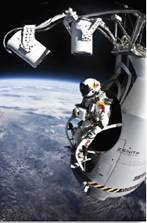
Sponsored by Red Bull, Felix Baumgartner's jump reached speeds of Mach 1.25.
On Twitter, recognizing that 140 characters was not nearly enough to communicate the awesomeness of the stunt, it simply used hashtags and links to connect followers to the video, whether through YouTube or on a Red Bull site. Although Red Bull's main Twitter feed did not exhibit any notable differences, the dedicated Red Bull Stratos Twitter feed prompted more than 20,000 mentions in tweets by others on that day.
The Red Bull Stratos Facebook page featured several photos during and after the jump. Just one shot of a landed Baumgartner, still in his space suit and on his knees beside his reefed parachute, prompted more than 20,000 comments, more than 50,000 shares, and nearly half a million likes.
Thus the example of the Red Bull Stratos project and its attendant coverage through social media suggests several things Red Bull did well. It knew its audience and its own goals, and it understood how different channels could help it attain those goals. To ensure that it appealed to the target audience, it engaged them in an exciting, never-before-tried, daredevil experience. Moreover, it shared the scientific lessons learned through the project, to give those who wanted it an education.
But it also spent a lot of money to get Baumgartner to space and back down again. And that meant that it needed to translate some of the brand awareness it developed into sales. Luckily for Red Bull, its social media strategy also has room for that effort.
Social Media for Performance
Red Bull does not just send athletes to space. It also sponsors them on the pitch, in the form of the New York Red Bull MLS team, which plays in Red Bull Arena in Harrison, New Jersey. In one recent game, the team's star forward Thierry Henry scored yet another goal. Afterward, he leaned, with his right arm up against the goal post and left hand on his hip. The pose, caught on camera, almost immediately became a Twitter meme as amateur photo editors placed him against a variety of backgrounds.
The team was quick to move on this social media coup. It rapidly posted the photo to its website and encouraged fans to vote for it as their favorite shot of the season. Immediately above and below the encouragement to engage with the brand also appeared links that would allow fans to purchase tickets for a full season, half season, or individual games.
Beyond these consumer-related uses of social and mobile media, Red Bulls' international sales efforts depend on "SoLoMo" (referring to social, location, and mobile) software. Users who download the Red Bull app receive alerts on their smartphones about in-store promotions as soon as they arrive at the retail site. If they also attend Red Bull events, such as a flugtag or BMX race, selected patrons even might receive a special invitation to come backstage to meet some of the stars of the show.
Each of Red Bull's mobile sales representatives is equipped with her or his own tablet computer, loaded with mobile software. Thus on visits to retail sites and vendors, the salespeople can provide the latest inventory information. They also present detailed analytics to show vendors how best to position their coolers of Red Bull products and how to line up the cans in the display case to encourage sales.
Combining the Uses of Social Media
When you are as good at engaging and exciting people through social media as Red Bull is, the next step might be to make social media your main focus. Although the privately held company has not publicized any such plans, commentators suggest that it appears poised to transform itself into a media company that just happens to sell energy drinks. The extent and amount of content it creates, featuring extreme sports and even sports it has created (ever hear of ice racing ), is similar in quality to sports videos produced by well-known networks. If Red Bull can convince networks to purchase its coverage of Shaun White on the half-pipe, it enters a new market. If Shaun White happens to be wearing a hat with the Red Bull logo, well then that's just an added bonus.
Such predictions actually resonate quite well with what Red Bull already does in social media. For example, though it maintains a plethora of Facebook pages and Twitter accounts for various events and locations, virtually none of them ever feature pictures of its drink product. Instead, they offer exciting in-sport shots or humorous images. Fans can-and do-comment, but Red Bull rarely responds. That may be because its primary goal is to establish an edgy, exciting image as a lifestyle brand, which it feels confident will translate into product sales.
How should Red Bull assess the effectiveness of these campaigns Describe how it should respond to insights gained by this assessment.
It isn't as if the social media strategy adopted by Red Bull-the energy drink that "gives you wings"-is a trade secret. Granted, the private company has a policy that discourages employees from giving interviews. But its overall strategy is clear from its actions and their outcomes. The success it has accrued from this strategy therefore isn't a matter of doing things differently than anyone else. It's a function of doing them better.
To begin, Red Bull distinguishes its goals for leveraging social media contacts. Is it hoping for more brand exposure, or is it pursuing sales increases Depending on its focus, it adopts distinct, appealing methods that are specific and unique to each social media platform. Then it implements these tactics consistently and comprehensively, to increase the chances that they will be widely shared and recognized.
Social Media for Name Recognition
When Felix Baumgartner (purposefully) fell to Earth from 127,852 feet up, it broke all sorts of records. His jump was from the highest height ever achieved by a human. During the 4-minute, 20-second freefall, he also reached greater speeds-up to Mach 1.25, faster than the speed of sound-than anyone else ever has. The event was a breakthrough on various levels. Baumgartner's pressure suit was the first version to be able to protect the human body in space but still enable maneuverability. To address the threat of ebullism (i.e., when liquid in the body evaporates due to high altitudes, causing a person's blood to literally boil), Baumgartner and his team derived new medical techniques with widespread applications. His parachute also adopted a new "reefed" design to reduce drifting, with clear implications for airdrops of materials and supplies.
In reporting on all these remarkable feats, Baumgartner's name was mentioned frequently-though not as frequently as the project that sponsored his jump and all the technology that went into supporting it: the Red Bull Stratos project. Every official mention of the event included the full name, such that Red Bull Stratos often appeared as a single term. It was not just the Stratos project. It was the Red Bull Stratos project.
And what a project it was, leading to the creation of not just scientific advances but also a remarkable video. That video, taken from the camera mounted on Baumgartner's helmet, features vast, picturesque views of Earth and the sense of plummeting. Red Bull immediately made it available for people to check out at their leisure. But the real target-the people whom Red Bull hoped would be most engaged by the video and the stunt in general-were extreme sports fanatics. These folks willingly put their bodies at risk on a regular basis to perform some cool stunt to cause their friends to marvel. For them, there may be no better stunt than having some guy fall from space. In full awareness of this appeal, Red Bull made sure that the video was prominent on its YouTube channel. On the day of the jump itself, approximately 8 million streamed the video live and in real time. Also on that day, the number of subscribers to Red Bull's YouTube channel increased by a remarkable 87,801.
Sponsored by Red Bull, Felix Baumgartner's jump reached speeds of Mach 1.25.
On Twitter, recognizing that 140 characters was not nearly enough to communicate the awesomeness of the stunt, it simply used hashtags and links to connect followers to the video, whether through YouTube or on a Red Bull site. Although Red Bull's main Twitter feed did not exhibit any notable differences, the dedicated Red Bull Stratos Twitter feed prompted more than 20,000 mentions in tweets by others on that day.
The Red Bull Stratos Facebook page featured several photos during and after the jump. Just one shot of a landed Baumgartner, still in his space suit and on his knees beside his reefed parachute, prompted more than 20,000 comments, more than 50,000 shares, and nearly half a million likes.
Thus the example of the Red Bull Stratos project and its attendant coverage through social media suggests several things Red Bull did well. It knew its audience and its own goals, and it understood how different channels could help it attain those goals. To ensure that it appealed to the target audience, it engaged them in an exciting, never-before-tried, daredevil experience. Moreover, it shared the scientific lessons learned through the project, to give those who wanted it an education.
But it also spent a lot of money to get Baumgartner to space and back down again. And that meant that it needed to translate some of the brand awareness it developed into sales. Luckily for Red Bull, its social media strategy also has room for that effort.
Social Media for Performance
Red Bull does not just send athletes to space. It also sponsors them on the pitch, in the form of the New York Red Bull MLS team, which plays in Red Bull Arena in Harrison, New Jersey. In one recent game, the team's star forward Thierry Henry scored yet another goal. Afterward, he leaned, with his right arm up against the goal post and left hand on his hip. The pose, caught on camera, almost immediately became a Twitter meme as amateur photo editors placed him against a variety of backgrounds.
The team was quick to move on this social media coup. It rapidly posted the photo to its website and encouraged fans to vote for it as their favorite shot of the season. Immediately above and below the encouragement to engage with the brand also appeared links that would allow fans to purchase tickets for a full season, half season, or individual games.
Beyond these consumer-related uses of social and mobile media, Red Bulls' international sales efforts depend on "SoLoMo" (referring to social, location, and mobile) software. Users who download the Red Bull app receive alerts on their smartphones about in-store promotions as soon as they arrive at the retail site. If they also attend Red Bull events, such as a flugtag or BMX race, selected patrons even might receive a special invitation to come backstage to meet some of the stars of the show.
Each of Red Bull's mobile sales representatives is equipped with her or his own tablet computer, loaded with mobile software. Thus on visits to retail sites and vendors, the salespeople can provide the latest inventory information. They also present detailed analytics to show vendors how best to position their coolers of Red Bull products and how to line up the cans in the display case to encourage sales.
Combining the Uses of Social Media
When you are as good at engaging and exciting people through social media as Red Bull is, the next step might be to make social media your main focus. Although the privately held company has not publicized any such plans, commentators suggest that it appears poised to transform itself into a media company that just happens to sell energy drinks. The extent and amount of content it creates, featuring extreme sports and even sports it has created (ever hear of ice racing ), is similar in quality to sports videos produced by well-known networks. If Red Bull can convince networks to purchase its coverage of Shaun White on the half-pipe, it enters a new market. If Shaun White happens to be wearing a hat with the Red Bull logo, well then that's just an added bonus.
Such predictions actually resonate quite well with what Red Bull already does in social media. For example, though it maintains a plethora of Facebook pages and Twitter accounts for various events and locations, virtually none of them ever feature pictures of its drink product. Instead, they offer exciting in-sport shots or humorous images. Fans can-and do-comment, but Red Bull rarely responds. That may be because its primary goal is to establish an edgy, exciting image as a lifestyle brand, which it feels confident will translate into product sales.
How should Red Bull assess the effectiveness of these campaigns Describe how it should respond to insights gained by this assessment.
Explanation Verified
Verified
RB is an energy drink. To create its own...

Marketing 5th Edition by Dhruv Grewal,Michael Levy

Why don’t you like this exercise?
Other Minimum 8 character and maximum 255 character
Character 255






