







 Chat with AI


Marketing 5th Edition by Dhruv Grewal,Michael Levy
Edition 5ISBN: 978-1259446290Marketing 5th Edition by Dhruv Grewal,Michael Levy
Edition 5ISBN: 978-1259446290 Exercise 4
LEVI STRAUSS, COTTON FARMERS, AND INTERNATIONAL PRODUCTION
Most people have multiple pairs of jeans, relying on them as a staple of their wardrobes. But few consumers really consider what has gone into each pair as they get dressed in the morning. Questions such as where they were made, how much material they contain, or the impact they have on the environment are less significant for most consumers. But for businesses such as Levi Strauss Co., they are critical to the company's long-term survival and success.
Levi's is a major consumer of cotton: A single pair of its 501 jeans uses nearly two pounds of cotton, and the vast majority of all Levi's products are made with cotton. Cotton needs water to grow, and jeans continue to require water throughout their life cycle, whether as part of the stone-wash softening process or in the laundry. By the time a pair of jeans bought today has reached the end of its life cycle, it will have used more than 900 gallons of water.
A decade ago, this water consumption was of less concern. But changes in rainfall patterns caused by global climate change are directly tying Levi's future to water: Less water means less moisture for cotton crops, and less cotton means Levi's will either have to incorporate more synthetics into its clothing-a significant change to its brand-or pay more for scarce raw materials. If the company pays more, the increased prices may be passed along to customers, possibly resulting in Levi's loyalists moving to other brands. A third alternative, reducing the cost of other garment materials such as buttons and zippers, affects both the brand and quality standards, though it can help control the end cost charged to consumers.
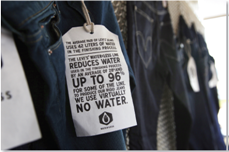
Levi's works with its suppliers to implement sustainable water use in the production of its jeans.
To address these challenges, Levi's is working with suppliers to implement more sustainable water use and other environmental practices as well as more responsible practices with regard to workers throughout its supply chain. These partnerships are challenging to instigate and oversee because cotton is raised in more than 100 countries and grown primarily on small, family-owned farms. Levi's began more than 20 years ago by creating a Terms of Engagement code of conduct that spells out what the company requires from its business partners in terms of social, ethical, legal, and environmental practices and employment standards. The agreement covers such issues as working ages, health and safety, and child labor, as well as wages, benefits, and disciplinary practices.
The company has also partnered with other large consumers of cotton, including H M, IKEA, Marks Spencer, and adidas; environmental organizations such as the World Wildlife Federation; and the Better Cotton Initiative, a cotton industry association, to study growing practices that reduce water and pesticide use.27 In one such study, conducted on a farm in India, cotton plants using a new drip irrigation system were taller and bore more flowers than those using traditional methods. The drip system reduced water use by about 70 percent and shortened the duration of electricity use for the system from three days to three hours. It also distributed fertilizer more evenly. Levi Strauss, IKEA, and adidas thus agreed to set aggressive goals for increasing the amount of this better cotton in their products. In addition, Levi Strauss has introduced a line of stone-washed denim that does not use water.
Another initiative aims to reorient the goals of the entire supply chain to produce more durable clothing options, rather than fast fashion. With input from Bangladeshi factory owners and cotton farmers from Pakistan, Levi Strauss has developed a Wellthread line of clothing that promises to last far longer than most other apparel items. By addressing the needs of its B2B partners, Levi Strauss hopes "to weave responsibility into every stage of design, manufacturing and usage, from the cotton fields to the factories to the market and beyond."
In conjunction with other members of the apparel industry and outdoor-wear makers such as Target, Nike, Patagonia, and REI, Levi's has adopted a software tool, the Eco Index, that helps clothing manufacturers determine the environmental and human impact of their products. These efforts go beyond water use to include every step of the garment's life cycle-from raw material production to disposal-and help companies make the most responsible decisions when sourcing and distributing their wares.
In pursuing more sustainable production, what steps of the B2B buying process will Levi Strauss need to revisit Which are likely to become less important More important
Most people have multiple pairs of jeans, relying on them as a staple of their wardrobes. But few consumers really consider what has gone into each pair as they get dressed in the morning. Questions such as where they were made, how much material they contain, or the impact they have on the environment are less significant for most consumers. But for businesses such as Levi Strauss Co., they are critical to the company's long-term survival and success.
Levi's is a major consumer of cotton: A single pair of its 501 jeans uses nearly two pounds of cotton, and the vast majority of all Levi's products are made with cotton. Cotton needs water to grow, and jeans continue to require water throughout their life cycle, whether as part of the stone-wash softening process or in the laundry. By the time a pair of jeans bought today has reached the end of its life cycle, it will have used more than 900 gallons of water.
A decade ago, this water consumption was of less concern. But changes in rainfall patterns caused by global climate change are directly tying Levi's future to water: Less water means less moisture for cotton crops, and less cotton means Levi's will either have to incorporate more synthetics into its clothing-a significant change to its brand-or pay more for scarce raw materials. If the company pays more, the increased prices may be passed along to customers, possibly resulting in Levi's loyalists moving to other brands. A third alternative, reducing the cost of other garment materials such as buttons and zippers, affects both the brand and quality standards, though it can help control the end cost charged to consumers.
Levi's works with its suppliers to implement sustainable water use in the production of its jeans.
To address these challenges, Levi's is working with suppliers to implement more sustainable water use and other environmental practices as well as more responsible practices with regard to workers throughout its supply chain. These partnerships are challenging to instigate and oversee because cotton is raised in more than 100 countries and grown primarily on small, family-owned farms. Levi's began more than 20 years ago by creating a Terms of Engagement code of conduct that spells out what the company requires from its business partners in terms of social, ethical, legal, and environmental practices and employment standards. The agreement covers such issues as working ages, health and safety, and child labor, as well as wages, benefits, and disciplinary practices.
The company has also partnered with other large consumers of cotton, including H M, IKEA, Marks Spencer, and adidas; environmental organizations such as the World Wildlife Federation; and the Better Cotton Initiative, a cotton industry association, to study growing practices that reduce water and pesticide use.27 In one such study, conducted on a farm in India, cotton plants using a new drip irrigation system were taller and bore more flowers than those using traditional methods. The drip system reduced water use by about 70 percent and shortened the duration of electricity use for the system from three days to three hours. It also distributed fertilizer more evenly. Levi Strauss, IKEA, and adidas thus agreed to set aggressive goals for increasing the amount of this better cotton in their products. In addition, Levi Strauss has introduced a line of stone-washed denim that does not use water.
Another initiative aims to reorient the goals of the entire supply chain to produce more durable clothing options, rather than fast fashion. With input from Bangladeshi factory owners and cotton farmers from Pakistan, Levi Strauss has developed a Wellthread line of clothing that promises to last far longer than most other apparel items. By addressing the needs of its B2B partners, Levi Strauss hopes "to weave responsibility into every stage of design, manufacturing and usage, from the cotton fields to the factories to the market and beyond."
In conjunction with other members of the apparel industry and outdoor-wear makers such as Target, Nike, Patagonia, and REI, Levi's has adopted a software tool, the Eco Index, that helps clothing manufacturers determine the environmental and human impact of their products. These efforts go beyond water use to include every step of the garment's life cycle-from raw material production to disposal-and help companies make the most responsible decisions when sourcing and distributing their wares.
In pursuing more sustainable production, what steps of the B2B buying process will Levi Strauss need to revisit Which are likely to become less important More important
Explanation Verified
Verified
Business to business marketing (B2B) is ...

Marketing 5th Edition by Dhruv Grewal,Michael Levy

Why don’t you like this exercise?
Other Minimum 8 character and maximum 255 character
Character 255






