







 Chat with AI


Marketing 5th Edition by Dhruv Grewal,Michael Levy
Edition 5ISBN: 978-1259446290Marketing 5th Edition by Dhruv Grewal,Michael Levy
Edition 5ISBN: 978-1259446290 Exercise 8
THE GLOBALIZATION OF THE MOST UBIQUITOUS OF AMERICAN CUISINES-THE HAMBURGER
From the Maharaja Mac in India to the Prosperity Burger prepared especially for the Chinese New Year celebrations, McDonald's has built a global fast-food empire under its golden arches. Only 31 percent of McDonald's revenue now comes from sales in the United States, and most of its international growth has come from the surging economies of Brazil, Russia, China, and India. A pioneer in overseas franchising, McDonald's has spared no effort in its attempts to penetrate foreign markets. In China, it plans to open one new outlet daily to meet its immediate goal of 2,000 stores. In Brazil, it created Latin America's first environmentally certified fast-food restaurant. A vast market defined by stark cultural differences, India has required a more modest approach that would allow McDonald's to develop its real estate and supply infrastructure, train its local workforce and management at its famed Hamburger University, and adjust the menu for vegetarian customers. The McAloo Tikki Burger has been a great success, and the company has started opening more McCafe storefronts.
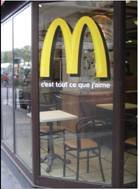
McDonald's France: I am loving it.
But McDonald's growth strategy relies on more than just added locations. In crowded cities, with real estate prices too high to build drive-through restaurants, the company has hired droves of motorbike drivers to bring Big Macs to customers. This nimble delivery approach is now a mainstay in cities from Beijing to Kuwait City. Online ordering will be next, though the challenge will be to reduce the cost of call centers to support this new distribution model. In addition, McDonald's keeps looking for new mobile innovations, such as mobile ordering or payment options, to keep up with consumer demand.
Fast-food restaurants enjoy some segment-specific benefits as they pursue such international expansion. Unlike retail brands, such as Walmart or Carrefour, restaurants pose less perceived competitive threats. Local eateries can exist side-by-side with a McDonald's, in a way that a mom-and-pop grocer cannot survive if an international hypermarket moves in next door.
But even considering the massive growth in rapidly transitioning economies, Europe still generates the bulk of foreign sales for McDonald's. In France, for example, "MacDo" restaurants attract crowds that line up outside for a bite of lunch. But lunch might mean something a little different in this case: French McDonald's offer menus that feature Camembert cheese on the burgers, Heineken, and a McBaguette. Once, the secret to McDonald's success was "lockstep" consistency, the fact that a meal in Memphis tasted the same as it did in Moscow or Madrid. But the novelty of the American hamburger stand has worn off in the new millennium, and with it McDonald's ability to export American culture as its staple commodity. A cheeseburger, fries, and Coke don't register the same level of excitement when the café next door and the bistro down the block are also serving burgers. More and more, the key to McDonald's future appears to be found in the DNA of the places it inhabits. And with it, suddenly the fast-food giant that to many represents the globalization of taste suddenly finds itself in a very unlikely position: as a defender of local cuisine."
The kosher burger has been a hit in Israel, and Indian consumers seem to appreciate the opening of McDonald's first vegetarian restaurant. However, most new growth comes from Russia, where the company has 245 locations and controls 70 percent of the booming fast-food business. Even as fast-food competitors face potential market saturation in the United States, Russian demand for quick burgers appears to be insatiable. Driving this Russian appetite has been the growth of a newly affluent middle class, with money to spend to dine out. Infrastructure development in Russia also has been a boon as cities open malls with food courts, highways are constructed with drive-through locations, and specialty suppliers of frozen food and packaging have appeared.
In the early years of Russian expansion, few private businesses existed to supply all the ingredients McDonald's needed to produce Big Macs and fries. The company solved the problem by building an enormous food processing plant outside Moscow. But it also worked to cultivate relationships with local Russian vendors and contractors to which it eventually could outsource its supply chain. Today, a grower who began selling cucumbers to McDonald's in 1990 has become the Pickle King of Russia, dominating the processed foods market.
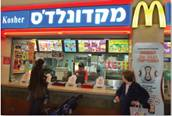
McDonald's is successful in Israel because of its kosher offerings.
Describe some of the global distribution strategies that McDonald's uses or might consider using to spread throughout the world.
From the Maharaja Mac in India to the Prosperity Burger prepared especially for the Chinese New Year celebrations, McDonald's has built a global fast-food empire under its golden arches. Only 31 percent of McDonald's revenue now comes from sales in the United States, and most of its international growth has come from the surging economies of Brazil, Russia, China, and India. A pioneer in overseas franchising, McDonald's has spared no effort in its attempts to penetrate foreign markets. In China, it plans to open one new outlet daily to meet its immediate goal of 2,000 stores. In Brazil, it created Latin America's first environmentally certified fast-food restaurant. A vast market defined by stark cultural differences, India has required a more modest approach that would allow McDonald's to develop its real estate and supply infrastructure, train its local workforce and management at its famed Hamburger University, and adjust the menu for vegetarian customers. The McAloo Tikki Burger has been a great success, and the company has started opening more McCafe storefronts.
McDonald's France: I am loving it.
But McDonald's growth strategy relies on more than just added locations. In crowded cities, with real estate prices too high to build drive-through restaurants, the company has hired droves of motorbike drivers to bring Big Macs to customers. This nimble delivery approach is now a mainstay in cities from Beijing to Kuwait City. Online ordering will be next, though the challenge will be to reduce the cost of call centers to support this new distribution model. In addition, McDonald's keeps looking for new mobile innovations, such as mobile ordering or payment options, to keep up with consumer demand.
Fast-food restaurants enjoy some segment-specific benefits as they pursue such international expansion. Unlike retail brands, such as Walmart or Carrefour, restaurants pose less perceived competitive threats. Local eateries can exist side-by-side with a McDonald's, in a way that a mom-and-pop grocer cannot survive if an international hypermarket moves in next door.
But even considering the massive growth in rapidly transitioning economies, Europe still generates the bulk of foreign sales for McDonald's. In France, for example, "MacDo" restaurants attract crowds that line up outside for a bite of lunch. But lunch might mean something a little different in this case: French McDonald's offer menus that feature Camembert cheese on the burgers, Heineken, and a McBaguette. Once, the secret to McDonald's success was "lockstep" consistency, the fact that a meal in Memphis tasted the same as it did in Moscow or Madrid. But the novelty of the American hamburger stand has worn off in the new millennium, and with it McDonald's ability to export American culture as its staple commodity. A cheeseburger, fries, and Coke don't register the same level of excitement when the café next door and the bistro down the block are also serving burgers. More and more, the key to McDonald's future appears to be found in the DNA of the places it inhabits. And with it, suddenly the fast-food giant that to many represents the globalization of taste suddenly finds itself in a very unlikely position: as a defender of local cuisine."
The kosher burger has been a hit in Israel, and Indian consumers seem to appreciate the opening of McDonald's first vegetarian restaurant. However, most new growth comes from Russia, where the company has 245 locations and controls 70 percent of the booming fast-food business. Even as fast-food competitors face potential market saturation in the United States, Russian demand for quick burgers appears to be insatiable. Driving this Russian appetite has been the growth of a newly affluent middle class, with money to spend to dine out. Infrastructure development in Russia also has been a boon as cities open malls with food courts, highways are constructed with drive-through locations, and specialty suppliers of frozen food and packaging have appeared.
In the early years of Russian expansion, few private businesses existed to supply all the ingredients McDonald's needed to produce Big Macs and fries. The company solved the problem by building an enormous food processing plant outside Moscow. But it also worked to cultivate relationships with local Russian vendors and contractors to which it eventually could outsource its supply chain. Today, a grower who began selling cucumbers to McDonald's in 1990 has become the Pickle King of Russia, dominating the processed foods market.
McDonald's is successful in Israel because of its kosher offerings.
Describe some of the global distribution strategies that McDonald's uses or might consider using to spread throughout the world.
Explanation Verified
Verified
The case shows the expansion of a famous...

Marketing 5th Edition by Dhruv Grewal,Michael Levy

Why don’t you like this exercise?
Other Minimum 8 character and maximum 255 character
Character 255






