







 Chat with AI


Contemporary Nutrition 3rd Edition by Gordon Wardlaw, Anne Smith, Angela Collene
Edition 3ISBN: 978-0-07-802134-3Contemporary Nutrition 3rd Edition by Gordon Wardlaw, Anne Smith, Angela Collene
Edition 3ISBN: 978-0-07-802134-3 Exercise 10
An Action Plan to Change or Maintain Weight Status
Now that you have assessed your current weight status, do you feel that you would like to make some changes? Following is a stepby-step guide to behavioral change. This process can be useful even for those satisfied with their current weight, as it can be appliedto changing exercise habits, self-esteem, and a variety of other behaviors (Fig. 7-20).
Becoming Aware of the Problem
By calculating your current weight status, you have already become aware of the problem, if one exists. From here, it is important to find out more information about the cause of the problem and whether it is worth working toward a change.
1. What are the factors that most influence your eating habits? Do you eat due to stress, boredom, or depression? Is volume of food your problem, or do you eat mainly the wrong foods for you? Take some time to assess the root causes of your eating habits.
2. Once you have more information about your specific eating practices, you must decide if it is worth changing these practices. A benefits and costs analysis can be a useful tool in evaluating whether it is worth your effort to make life changes. Use the following example as a guide for listing benefits and costs pertinent to your situation (Fig. 7-21).
Setting Goals
What can we accomplish, and how long will it take? Setting a realistic, achievable goal and allowing a reasonable amount of time to pursue it increase the likelihood of success.
1. Begin by determining the outcome you would like to achieve. If you are trying to change your eating behaviors to be more healthy, list your reasons for doing so (e.g., overall health, weight loss, self-esteem).
Overall goal:
__________________________________________________________________________________
__________________________________________________________________________________
Reasons to pursue goal:
__________________________________________________________________________________
__________________________________________________________________________________
__________________________________________________________________________________
2. Now list several steps that will be necessary to achieve your goal. Keep in mind, however, that it is generally best to change only a few specific behaviors at first-walking briskly for 60 minutes each day, reducing fat intake, using more whole-grain products, and not eating after 7 P.M. Attempting small and perhaps easier dietary changes first reduces the scope of the problem and increases the likelihood of success.
Steps toward achieving goal:
1. ________________________________________________________________________________
2. ________________________________________________________________________________
3. ________________________________________________________________________________
If you are having trouble deciphering the steps needed to achieve your goal, health professionals are an excellent resource for aid in planning.
Measuring Commitment
Now that you have collected information and know what is required to reach your goal, you must ask yourself, "Can I do this?" Commitment is an essential component in the success of behavioral change. Be honest with yourself. Permanent change is not quick or easy. Once you have decided that you have the commitment required to see this through, continue on to the following sections.
Making It Official with a Contract
Drawing up a behavioral contract often adds incentive to follow through with a plan. The contract could list goal behaviors and objectives, milestones for measuring progress, and regular rewards for meeting the terms of the contract. After finishing a contract, you should sign it in the presence of some friends. This encourages commitment.
Initially, plans should reward positive behaviors, and then they should focus on positive results. Positive behaviors, such as regular physical activity, eventually lead to positive outcomes, such as increased stamina.
Figure 7-22 is a sample contract for increasing physical activity. Keep in mind that this sample contract is only a suggestion; you can add your ideas as well.
Psyching Yourself Up
Once your contract is in place, you need to psych yourself up. Discouragement from peers and your temptations to stray from your plan need to be anticipated. Psyching yourself up can enable you to progress toward your goals in spite of others' attitudes and opinions. Almost everyone benefits from some assertiveness training when it comes to changing behaviors. The following are a few suggestions. Can you think of any others?
• No one's feelings should be hurt if you say, "No, thank you," firmly and repeatedly when others try to dissuade you from a plan. Tell them you have new diet behavior and your needs are important.
• You don't have to eat a lot to accommodate anyone-your mother, business clients, or the chef. For example, at a party with friends, you may feel you have to eat a lot to participate, but you don't. Another trap is ordering a lot just because someone else is paying for the meal.
• Learn ways to handle put-downs-inadvertent or conscious. An effective response can be to communicate feelings honestly, without hostility. Tell criticizers that they have annoyed or offended you, that you are working to change your habits and would really like understanding and support from them.
Practicing the Plan
Once you've set up a plan, the next step is to implement it. Start with a trial of at least 6 to 8 weeks. Thinking of a lifetime commitment can be overwhelming. Aim for a total duration of 6 months of new activities before giving up. We may have to persuade ourselves more than once of the value of continuing the program. The following are some suggestions to help keep a plan on track:
• Focus on reducing but not necessarily extinguishing undesirable behaviors. For example, it's usually unrealistic to say, "I'll never eat a certain food again." It's better to say, "I won't eat that problem food as often as before."
• Monitor progress. Note your progress in a diary and reward yourself according to your contract. While conquering some habits and seeing improvement, you may find yourself quite encouraged, even enthusiastic, about your plan of action. That can give you the impetus to move ahead with the program.
• Control environments. In the early phases of behavioral change, try to avoid problem situations, such as parties, coffee breaks, and favorite restaurants. Once new habits are firmly established, you can probably more successfully resist the temptations of these environments.
Reevaluating and Preventing Relapse
After practicing a program for several weeks to months, it is important to reassess the original plan. In addition, you may now be able to pinpoint other problem areas for which you need to plan appropriately.
1. Begin by taking a close and critical look at your original plan. Does it lead to the goals you set? Are there any new steps toward your goal that you feel capable of adding to your contract? Do you need new reinforcements? It may even be necessary to make a new contract. For permanent change, it is worth this time of reassessment.
2. In practicing your plan over the past weeks or months, you have likely experienced relapses. What triggered these relapses? To prevent a total retreat to your old habits, it is important to set up a plan for such relapses. You can do this by identifying high-risk situations, rehearsing a response, and remembering your goals.
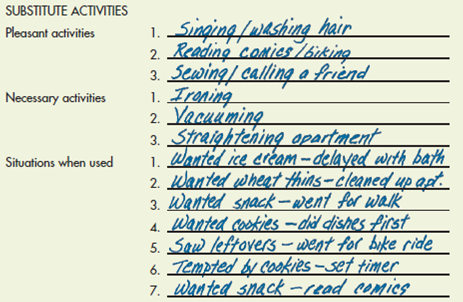
You may have noticed a behavior chain in some of your relapses. That is, the relapse may stem from a series of interconnected habitual activities. The way to break the chain is to first identify the activities, pinpoint the weak links, break those links, and substitute other behaviors. Figure 7-23 illustrates a sample behavior chain and a substitute activities list. Consider compiling a list based on your behavior chains.
Epilogue
If you have used the activities in this section, you are well on your way to permanent behavioral change. Recall that this exercise can be used for a variety of desired changes, including quitting smoking, increasing physical activity, and improving study habits. It is by no means an easy process, but the results can be well worth the effort. Overall, the keys to success are motivation (keeping the problem in the forefront of your mind), having a plan of action, securing the resources and skills needed for success, and looking for help from family, friends, or a group.
BEHAVIOR CHAIN
Identify the links in your eating response chain on the following diagram. Draw a line through the chain where it was interrupted. Add the link you substituted and the new chain of behavior this substitution started.
1. Fun activities (taking a walk, reading a book)
2. Necessary activities (cleaning a room, balancing your checkbook)
3. Incompatible activities (taking a shower)
4. Urge-delaying activities (setting a kitchen timer for 20 minutes before allowing yourself to eat) Using activities to interrupt behavior patterns that lead to inappropriate eating (or inactivity) can be a powerful means of changing habits.
Now that you have assessed your current weight status, do you feel that you would like to make some changes? Following is a stepby-step guide to behavioral change. This process can be useful even for those satisfied with their current weight, as it can be appliedto changing exercise habits, self-esteem, and a variety of other behaviors (Fig. 7-20).
Becoming Aware of the Problem
By calculating your current weight status, you have already become aware of the problem, if one exists. From here, it is important to find out more information about the cause of the problem and whether it is worth working toward a change.
1. What are the factors that most influence your eating habits? Do you eat due to stress, boredom, or depression? Is volume of food your problem, or do you eat mainly the wrong foods for you? Take some time to assess the root causes of your eating habits.
2. Once you have more information about your specific eating practices, you must decide if it is worth changing these practices. A benefits and costs analysis can be a useful tool in evaluating whether it is worth your effort to make life changes. Use the following example as a guide for listing benefits and costs pertinent to your situation (Fig. 7-21).
Setting Goals
What can we accomplish, and how long will it take? Setting a realistic, achievable goal and allowing a reasonable amount of time to pursue it increase the likelihood of success.
1. Begin by determining the outcome you would like to achieve. If you are trying to change your eating behaviors to be more healthy, list your reasons for doing so (e.g., overall health, weight loss, self-esteem).
Overall goal:
__________________________________________________________________________________
__________________________________________________________________________________
Reasons to pursue goal:
__________________________________________________________________________________
__________________________________________________________________________________
__________________________________________________________________________________
2. Now list several steps that will be necessary to achieve your goal. Keep in mind, however, that it is generally best to change only a few specific behaviors at first-walking briskly for 60 minutes each day, reducing fat intake, using more whole-grain products, and not eating after 7 P.M. Attempting small and perhaps easier dietary changes first reduces the scope of the problem and increases the likelihood of success.
Steps toward achieving goal:
1. ________________________________________________________________________________
2. ________________________________________________________________________________
3. ________________________________________________________________________________
If you are having trouble deciphering the steps needed to achieve your goal, health professionals are an excellent resource for aid in planning.
Measuring Commitment
Now that you have collected information and know what is required to reach your goal, you must ask yourself, "Can I do this?" Commitment is an essential component in the success of behavioral change. Be honest with yourself. Permanent change is not quick or easy. Once you have decided that you have the commitment required to see this through, continue on to the following sections.
Making It Official with a Contract
Drawing up a behavioral contract often adds incentive to follow through with a plan. The contract could list goal behaviors and objectives, milestones for measuring progress, and regular rewards for meeting the terms of the contract. After finishing a contract, you should sign it in the presence of some friends. This encourages commitment.
Initially, plans should reward positive behaviors, and then they should focus on positive results. Positive behaviors, such as regular physical activity, eventually lead to positive outcomes, such as increased stamina.
Figure 7-22 is a sample contract for increasing physical activity. Keep in mind that this sample contract is only a suggestion; you can add your ideas as well.
Psyching Yourself Up
Once your contract is in place, you need to psych yourself up. Discouragement from peers and your temptations to stray from your plan need to be anticipated. Psyching yourself up can enable you to progress toward your goals in spite of others' attitudes and opinions. Almost everyone benefits from some assertiveness training when it comes to changing behaviors. The following are a few suggestions. Can you think of any others?
• No one's feelings should be hurt if you say, "No, thank you," firmly and repeatedly when others try to dissuade you from a plan. Tell them you have new diet behavior and your needs are important.
• You don't have to eat a lot to accommodate anyone-your mother, business clients, or the chef. For example, at a party with friends, you may feel you have to eat a lot to participate, but you don't. Another trap is ordering a lot just because someone else is paying for the meal.
• Learn ways to handle put-downs-inadvertent or conscious. An effective response can be to communicate feelings honestly, without hostility. Tell criticizers that they have annoyed or offended you, that you are working to change your habits and would really like understanding and support from them.
Practicing the Plan
Once you've set up a plan, the next step is to implement it. Start with a trial of at least 6 to 8 weeks. Thinking of a lifetime commitment can be overwhelming. Aim for a total duration of 6 months of new activities before giving up. We may have to persuade ourselves more than once of the value of continuing the program. The following are some suggestions to help keep a plan on track:
• Focus on reducing but not necessarily extinguishing undesirable behaviors. For example, it's usually unrealistic to say, "I'll never eat a certain food again." It's better to say, "I won't eat that problem food as often as before."
• Monitor progress. Note your progress in a diary and reward yourself according to your contract. While conquering some habits and seeing improvement, you may find yourself quite encouraged, even enthusiastic, about your plan of action. That can give you the impetus to move ahead with the program.
• Control environments. In the early phases of behavioral change, try to avoid problem situations, such as parties, coffee breaks, and favorite restaurants. Once new habits are firmly established, you can probably more successfully resist the temptations of these environments.
Reevaluating and Preventing Relapse
After practicing a program for several weeks to months, it is important to reassess the original plan. In addition, you may now be able to pinpoint other problem areas for which you need to plan appropriately.
1. Begin by taking a close and critical look at your original plan. Does it lead to the goals you set? Are there any new steps toward your goal that you feel capable of adding to your contract? Do you need new reinforcements? It may even be necessary to make a new contract. For permanent change, it is worth this time of reassessment.
2. In practicing your plan over the past weeks or months, you have likely experienced relapses. What triggered these relapses? To prevent a total retreat to your old habits, it is important to set up a plan for such relapses. You can do this by identifying high-risk situations, rehearsing a response, and remembering your goals.
You may have noticed a behavior chain in some of your relapses. That is, the relapse may stem from a series of interconnected habitual activities. The way to break the chain is to first identify the activities, pinpoint the weak links, break those links, and substitute other behaviors. Figure 7-23 illustrates a sample behavior chain and a substitute activities list. Consider compiling a list based on your behavior chains.
Epilogue
If you have used the activities in this section, you are well on your way to permanent behavioral change. Recall that this exercise can be used for a variety of desired changes, including quitting smoking, increasing physical activity, and improving study habits. It is by no means an easy process, but the results can be well worth the effort. Overall, the keys to success are motivation (keeping the problem in the forefront of your mind), having a plan of action, securing the resources and skills needed for success, and looking for help from family, friends, or a group.
BEHAVIOR CHAIN
Identify the links in your eating response chain on the following diagram. Draw a line through the chain where it was interrupted. Add the link you substituted and the new chain of behavior this substitution started.
1. Fun activities (taking a walk, reading a book)
2. Necessary activities (cleaning a room, balancing your checkbook)
3. Incompatible activities (taking a shower)
4. Urge-delaying activities (setting a kitchen timer for 20 minutes before allowing yourself to eat) Using activities to interrupt behavior patterns that lead to inappropriate eating (or inactivity) can be a powerful means of changing habits.
Explanation


This question doesn’t have an expert verified answer yet, let Quizplus AI Copilot help.

Contemporary Nutrition 3rd Edition by Gordon Wardlaw, Anne Smith, Angela Collene

Why don’t you like this exercise?
Other Minimum 8 character and maximum 255 character
Character 255






