







 Chat with AI


Ecology 7th Edition by Manuel Molles
Edition 7ISBN: 978-0077837280Ecology 7th Edition by Manuel Molles
Edition 7ISBN: 978-0077837280 Exercise 1
Ecologists explore the relationships between organisms and environment using the methods of science. The series of boxes called "Investigating the Evidence" that are found throughout the chapters of this book discuss various aspects of the scientific method and its application to ecology. While each box describes only a small part of science, taken together, they represent a substantial introduction to the philosophy, techniques, and practice of ecological science.
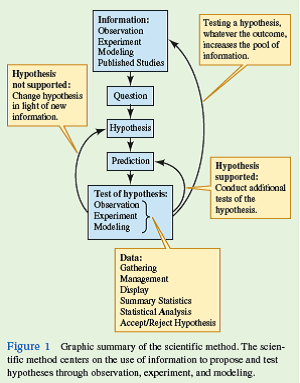
Let us begin this distributed discussion with the most basic point. What is science The word science comes from a Latin word meaning "to know." Broadly speaking, science is a way of obtaining knowledge about the natural world using certain formal procedures. Those procedures, which make up what we call "the scientific method," are outlined in figure 1. Despite a great diversity of approaches to doing science, sound scientific studies have many methodological characteristics in common. The most universal and critical aspects of the scientific method are: asking interesting questions and forming testable hypotheses.

Questions and Hypotheses
What do scientists do Simply put, scientists ask and attempt to find answers to questions about the natural world. Questions are the guiding lights of the scientific process. Without them, exploration of nature lacks focus and yields little understanding of the world. Let's consider a question asked by an ecologist discussed in this chapter. The main question asked by Robert MacArthur in his studies of warblers (p. 4) was something like the following: "How can several species of insect-eating warblers live in the same forest without one species eventually excluding the others through competition " While this focus on questions may seem obvious, one of the most common questions asked of scientists at seminars and professional meetings is, "What is your question "
If scientists are in the business of asking questions about nature, where does a hypothesis enter the process
A hypothesis is a possible answer to a question. MacArthur's main hypothesis (possible answer to his question) was: "Several warbler species are able to coexist because each species feeds on insects living in different zones within trees."
Once a scientist or team of scientists proposes a hypothesis (or multiple alternative hypotheses), the next step in the scientific method is to determine its validity by testing predictions that follow from the hypothesis. Three fundamental ways to test hypotheses are through observation, experiments, and modeling. These approaches, which are all represented in figure 1 , will be discussed in detail in the "Investigating the Evidence" boxes and in the research discussed in later chapters.
How does the development of new research tools, such as canopy cranes and stable isotope analysis, affect the process of science as outlined by figure 1 of this "Investigating the Evidence" box
Let us begin this distributed discussion with the most basic point. What is science The word science comes from a Latin word meaning "to know." Broadly speaking, science is a way of obtaining knowledge about the natural world using certain formal procedures. Those procedures, which make up what we call "the scientific method," are outlined in figure 1. Despite a great diversity of approaches to doing science, sound scientific studies have many methodological characteristics in common. The most universal and critical aspects of the scientific method are: asking interesting questions and forming testable hypotheses.
Questions and Hypotheses
What do scientists do Simply put, scientists ask and attempt to find answers to questions about the natural world. Questions are the guiding lights of the scientific process. Without them, exploration of nature lacks focus and yields little understanding of the world. Let's consider a question asked by an ecologist discussed in this chapter. The main question asked by Robert MacArthur in his studies of warblers (p. 4) was something like the following: "How can several species of insect-eating warblers live in the same forest without one species eventually excluding the others through competition " While this focus on questions may seem obvious, one of the most common questions asked of scientists at seminars and professional meetings is, "What is your question "
If scientists are in the business of asking questions about nature, where does a hypothesis enter the process
A hypothesis is a possible answer to a question. MacArthur's main hypothesis (possible answer to his question) was: "Several warbler species are able to coexist because each species feeds on insects living in different zones within trees."
Once a scientist or team of scientists proposes a hypothesis (or multiple alternative hypotheses), the next step in the scientific method is to determine its validity by testing predictions that follow from the hypothesis. Three fundamental ways to test hypotheses are through observation, experiments, and modeling. These approaches, which are all represented in figure 1 , will be discussed in detail in the "Investigating the Evidence" boxes and in the research discussed in later chapters.
How does the development of new research tools, such as canopy cranes and stable isotope analysis, affect the process of science as outlined by figure 1 of this "Investigating the Evidence" box
Explanation Verified
Verified
The most essential requirement of any scientific study or research is relevant data and statistics. These can only be deduced through prolonged and complete observation and an analysis of the respective issue. This requires long durations of manual study. This manual study can now be done with the effective aid of tools known as research tools. Canopy cranes and stable isotope analysis are examples of research tools.
The impact of a research tool on its respective field can be calculated via the variance in the time taken to do the same task without the tool. Another important criterion for its evaluation is how much it increases the productive data collection. Let us consider the tools one by one to understand their effect on study.
The Canopy Cranes
These cranes can cover a height of required area as per the studies. They can elongate vertically as well as horizontally up to their maximum utility limitation. The methodology and effects are as follows:
• The most important part of its utilization was in the study of forest ecosystem components, such as nutrient supply, which involved flora and fauna inhabiting the highest trees. Such a task used to require the climbing of trees, and the topmost area could not be viewed. However, when canopy cranes are used, the same study is easier, less time-consuming, and less cumbersome.
• Photosynthesis analysis requires sampling the highest producer level to make the average estimate practical. This has been made easier, faster, and larger in scale by canopy cranes.
• Migration studies are an important aspect in ecological and population studies. These studies involve viewing the inhabitants of the highest trees. The usage of canopy cranes enables ecologists to observe the changes in a species' population in a specific area, regardless of how high its habitat is. Also, the observation area becomes far clearer when the study involves monitoring from a higher level than on the ground.
Stable Isotope Analysis:
This analysis is the study of substances with the help of specific element isotopes. These isotopes usually do not have radioactivity, and those few that do have half-lives beyond the length of the study. This technology has been a milestone achievement in biochemical analysis.
Science is made up of living components. Their abundance, relativity, nutrition, metabolism, toxicity, population, migration, and other parameters can be analyzed by studying specific elements or compound accumulations through stable isotope analysis. The methodology and effect:
• Food web, food chain analysis has become more effective and productive with the help of stable isotopes in their respective areas of study. For example, instead of counting to find the number of producers in an ecosystem, one can employ a carbon isotope (stable) and analyze its presence in the specific live flora or algae. This would reduce time and give an accurate number of samples studied.
• The migration of a species can be estimated through stable isotope study. For instance, in order to understand the migration of a bird species from temperate to tropic regions, the food of that bird species can be laced with the stable isotope in the temperate region. Later, the blood samples of birds inhabiting the tropic region can be studied at regular intervals, and the presence of the same stable isotope would show the migrated bird. Hence, the total number of migrants can be calculated.
• All of the above mentioned parameters have become less time-consuming and more relevance-oriented with experimental proof since the employment of these tools.
As explained above, the usage of new tools make the information-gathering methodology is less time-consuming and less complicated. Hence, it improves experimentation and modeling. This is directly linked to the hypothesis and prediction of results, so these also benefit from the new techniques.
Hence, it can be concluded that these new tools improve the scientific method.
The impact of a research tool on its respective field can be calculated via the variance in the time taken to do the same task without the tool. Another important criterion for its evaluation is how much it increases the productive data collection. Let us consider the tools one by one to understand their effect on study.
The Canopy Cranes
These cranes can cover a height of required area as per the studies. They can elongate vertically as well as horizontally up to their maximum utility limitation. The methodology and effects are as follows:
• The most important part of its utilization was in the study of forest ecosystem components, such as nutrient supply, which involved flora and fauna inhabiting the highest trees. Such a task used to require the climbing of trees, and the topmost area could not be viewed. However, when canopy cranes are used, the same study is easier, less time-consuming, and less cumbersome.
• Photosynthesis analysis requires sampling the highest producer level to make the average estimate practical. This has been made easier, faster, and larger in scale by canopy cranes.
• Migration studies are an important aspect in ecological and population studies. These studies involve viewing the inhabitants of the highest trees. The usage of canopy cranes enables ecologists to observe the changes in a species' population in a specific area, regardless of how high its habitat is. Also, the observation area becomes far clearer when the study involves monitoring from a higher level than on the ground.
Stable Isotope Analysis:
This analysis is the study of substances with the help of specific element isotopes. These isotopes usually do not have radioactivity, and those few that do have half-lives beyond the length of the study. This technology has been a milestone achievement in biochemical analysis.
Science is made up of living components. Their abundance, relativity, nutrition, metabolism, toxicity, population, migration, and other parameters can be analyzed by studying specific elements or compound accumulations through stable isotope analysis. The methodology and effect:
• Food web, food chain analysis has become more effective and productive with the help of stable isotopes in their respective areas of study. For example, instead of counting to find the number of producers in an ecosystem, one can employ a carbon isotope (stable) and analyze its presence in the specific live flora or algae. This would reduce time and give an accurate number of samples studied.
• The migration of a species can be estimated through stable isotope study. For instance, in order to understand the migration of a bird species from temperate to tropic regions, the food of that bird species can be laced with the stable isotope in the temperate region. Later, the blood samples of birds inhabiting the tropic region can be studied at regular intervals, and the presence of the same stable isotope would show the migrated bird. Hence, the total number of migrants can be calculated.
• All of the above mentioned parameters have become less time-consuming and more relevance-oriented with experimental proof since the employment of these tools.
As explained above, the usage of new tools make the information-gathering methodology is less time-consuming and less complicated. Hence, it improves experimentation and modeling. This is directly linked to the hypothesis and prediction of results, so these also benefit from the new techniques.
Hence, it can be concluded that these new tools improve the scientific method.

Ecology 7th Edition by Manuel Molles

Why don’t you like this exercise?
Other Minimum 8 character and maximum 255 character
Character 255






