







 Chat with AI


Ecology 7th Edition by Manuel Molles
Edition 7ISBN: 978-0077837280Ecology 7th Edition by Manuel Molles
Edition 7ISBN: 978-0077837280 Exercise 20
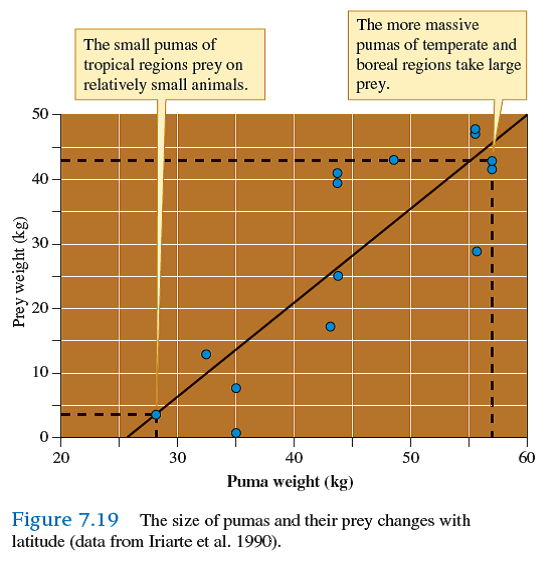
The data of Iriarte and colleagues (1990) suggest that prey size may favor a particular body size among pumas (see fig. 7.19 ). However, this variation in body size also correlates well with latitude; the larger pumas live at high latitudes. Consequently, this variation in body size has been interpreted as the result of selection for efficient temperature regulation. Homeothermic animals are often larger at high latitudes, a pattern called Bergmann's rule. Larger animals, with lower surface area relative to their mass, would be theoretically better at conserving heat. Smaller animals, with higher surface area relative to their mass, would be theoretically better at keeping cool. So what determines predator size Is predator size determined by climate, predator-prey interactions, or both Design a study of the influence of the environment on the size of homeothermic predators.
Explanation Verified
Verified
A homeothermic predator is an animal tha...

Ecology 7th Edition by Manuel Molles

Why don’t you like this exercise?
Other Minimum 8 character and maximum 255 character
Character 255






