



expand icon
book Ecology 7th Edition by Manuel Molles cover

Ecology 7th Edition by Manuel Molles

Edition 7ISBN: 978-0077837280
book Ecology 7th Edition by Manuel Molles cover

Ecology 7th Edition by Manuel Molles

Edition 7ISBN: 978-0077837280
Exercise 1
In chapter 14 we reviewed how to calculate the standard error
In chapter 14 we reviewed how to calculate the standard error     which is an estimate of variation among means of samples drawn from a population. Here, we will use the standard error to calculate a confidence interval. A confidence interval is a range of values within which the true population mean occurs with a particular probability. That probability, which is called the level of confidence, is calculated as 1 minus the significance level, a , which is generally 0.05: Level of confidence = 1 -  Level of confidence = 0.05 = 0.95 Using this level of confidence produces what is called a 95% confidence interval that is calculated as follows:      A Student's t table, available in most statistics textbooks, summarizes the values of a statistical distribution known as the Student's t distribution. The value of t we use for calculating a confidence interval is determined by the degrees of freedom ( n - 1) and the significance level, which in this case is = 0.05. Let's calculate a 95% confidence interval using the body length measurements for the sample of loach minnows, Tiaroga cobitis, that we used to calculate a mean and standard error in chapter 14 (see p. 314):                 With this confidence interval, we can say that there is a 95% probability that the true mean body length in this population of loach minnows is somewhere between 60.63 mm (56.2 mm + 4.43 mm) and 51.77 mm (56.2 mm - 4.43 mm). This is shown graphically in figure 1 , along with the mean and 95% confidence interval for the sample of loach minnows from the Gila River that we first considered in chapter 14 (p. 314). Notice that the 95% confidence interval for the Gila River sample is much smaller. This smaller confidence interval is the result of the larger sample size from the Gila River ( n = 50), which produced a smaller standard error     and a smaller critical t value (2.01), since the degrees of freedom is 49. As a consequence of having a larger sample, our estimate of the true population mean has been narrowed to a much smaller range for the Gila River population of loach minnows.  What is the 95% confidence interval for the Gila River sample of loach minnows which is an estimate of variation among means of samples drawn from a population. Here, we will use the standard error to calculate a confidence interval. A confidence interval is a range of values within which the true population mean occurs with a particular probability. That probability, which is called the level of confidence, is calculated as 1 minus the significance level, a , which is generally 0.05:
Level of confidence = 1 -
Level of confidence = 0.05 = 0.95
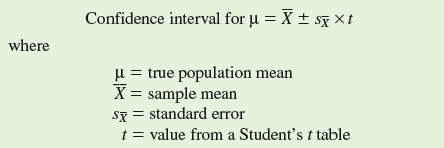
Using this level of confidence produces what is called a 95% confidence interval that is calculated as follows:
In chapter 14 we reviewed how to calculate the standard error     which is an estimate of variation among means of samples drawn from a population. Here, we will use the standard error to calculate a confidence interval. A confidence interval is a range of values within which the true population mean occurs with a particular probability. That probability, which is called the level of confidence, is calculated as 1 minus the significance level, a , which is generally 0.05: Level of confidence = 1 -  Level of confidence = 0.05 = 0.95 Using this level of confidence produces what is called a 95% confidence interval that is calculated as follows:      A Student's t table, available in most statistics textbooks, summarizes the values of a statistical distribution known as the Student's t distribution. The value of t we use for calculating a confidence interval is determined by the degrees of freedom ( n - 1) and the significance level, which in this case is = 0.05. Let's calculate a 95% confidence interval using the body length measurements for the sample of loach minnows, Tiaroga cobitis, that we used to calculate a mean and standard error in chapter 14 (see p. 314):                 With this confidence interval, we can say that there is a 95% probability that the true mean body length in this population of loach minnows is somewhere between 60.63 mm (56.2 mm + 4.43 mm) and 51.77 mm (56.2 mm - 4.43 mm). This is shown graphically in figure 1 , along with the mean and 95% confidence interval for the sample of loach minnows from the Gila River that we first considered in chapter 14 (p. 314). Notice that the 95% confidence interval for the Gila River sample is much smaller. This smaller confidence interval is the result of the larger sample size from the Gila River ( n = 50), which produced a smaller standard error     and a smaller critical t value (2.01), since the degrees of freedom is 49. As a consequence of having a larger sample, our estimate of the true population mean has been narrowed to a much smaller range for the Gila River population of loach minnows.  What is the 95% confidence interval for the Gila River sample of loach minnows
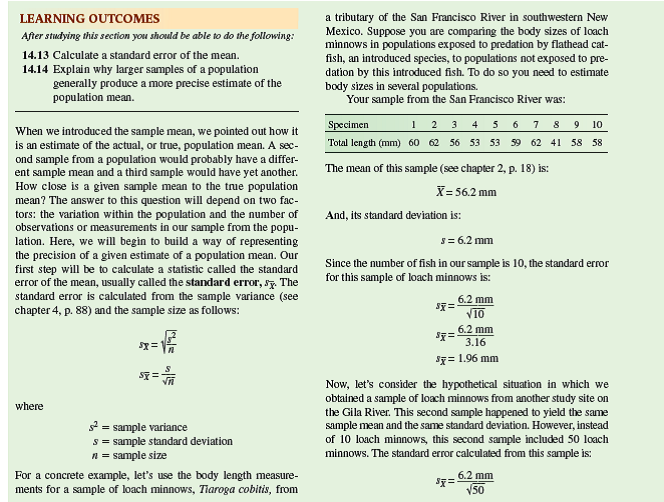
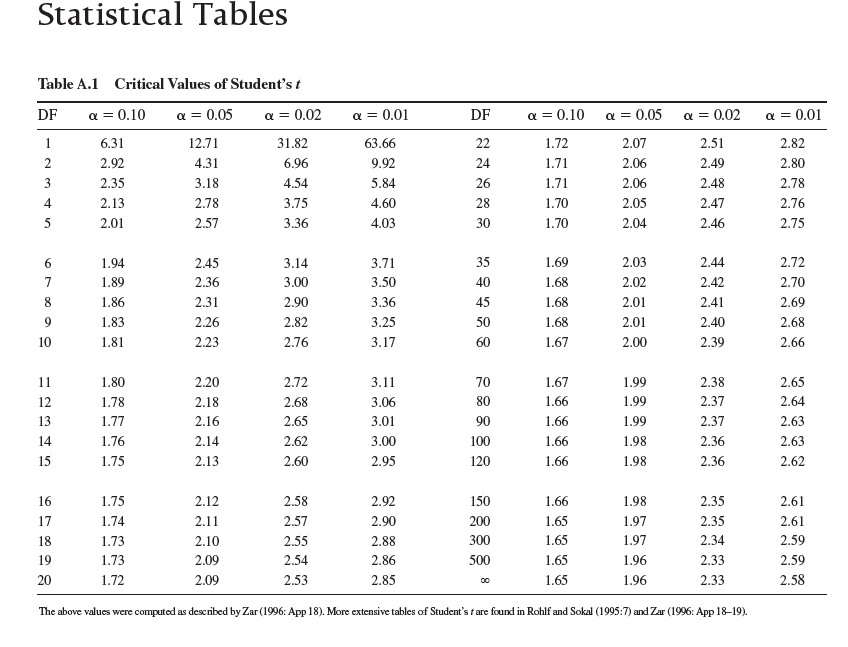
A Student's t table, available in most statistics textbooks, summarizes the values of a statistical distribution known as the Student's t distribution. The value of t we use for calculating a confidence interval is determined by the degrees of freedom ( n - 1) and the significance level, which in this case is = 0.05. Let's calculate a 95% confidence interval using the body length measurements for the sample of loach minnows, Tiaroga cobitis, that we used to calculate a mean and standard error in chapter 14 (see p. 314):
In chapter 14 we reviewed how to calculate the standard error     which is an estimate of variation among means of samples drawn from a population. Here, we will use the standard error to calculate a confidence interval. A confidence interval is a range of values within which the true population mean occurs with a particular probability. That probability, which is called the level of confidence, is calculated as 1 minus the significance level, a , which is generally 0.05: Level of confidence = 1 -  Level of confidence = 0.05 = 0.95 Using this level of confidence produces what is called a 95% confidence interval that is calculated as follows:      A Student's t table, available in most statistics textbooks, summarizes the values of a statistical distribution known as the Student's t distribution. The value of t we use for calculating a confidence interval is determined by the degrees of freedom ( n - 1) and the significance level, which in this case is = 0.05. Let's calculate a 95% confidence interval using the body length measurements for the sample of loach minnows, Tiaroga cobitis, that we used to calculate a mean and standard error in chapter 14 (see p. 314):                 With this confidence interval, we can say that there is a 95% probability that the true mean body length in this population of loach minnows is somewhere between 60.63 mm (56.2 mm + 4.43 mm) and 51.77 mm (56.2 mm - 4.43 mm). This is shown graphically in figure 1 , along with the mean and 95% confidence interval for the sample of loach minnows from the Gila River that we first considered in chapter 14 (p. 314). Notice that the 95% confidence interval for the Gila River sample is much smaller. This smaller confidence interval is the result of the larger sample size from the Gila River ( n = 50), which produced a smaller standard error     and a smaller critical t value (2.01), since the degrees of freedom is 49. As a consequence of having a larger sample, our estimate of the true population mean has been narrowed to a much smaller range for the Gila River population of loach minnows.  What is the 95% confidence interval for the Gila River sample of loach minnows
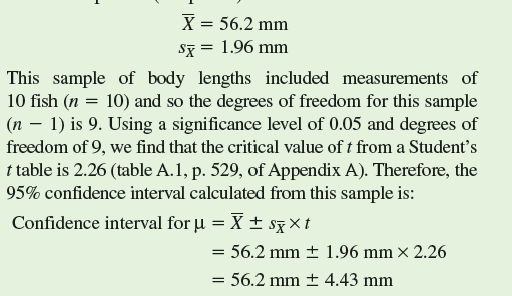
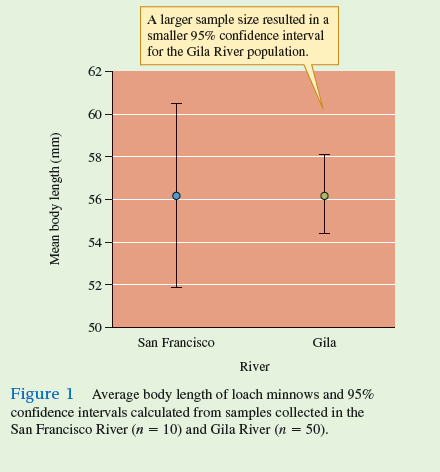
With this confidence interval, we can say that there is a 95% probability that the true mean body length in this population of loach minnows is somewhere between 60.63 mm (56.2 mm + 4.43 mm) and 51.77 mm (56.2 mm - 4.43 mm).
This is shown graphically in figure 1 , along with the mean and 95% confidence interval for the sample of loach minnows from the Gila River that we first considered in chapter 14 (p. 314). Notice that the 95% confidence interval for the Gila River sample is much smaller. This smaller confidence interval is the result of the larger sample size from the Gila River ( n = 50), which produced a smaller standard error
In chapter 14 we reviewed how to calculate the standard error     which is an estimate of variation among means of samples drawn from a population. Here, we will use the standard error to calculate a confidence interval. A confidence interval is a range of values within which the true population mean occurs with a particular probability. That probability, which is called the level of confidence, is calculated as 1 minus the significance level, a , which is generally 0.05: Level of confidence = 1 -  Level of confidence = 0.05 = 0.95 Using this level of confidence produces what is called a 95% confidence interval that is calculated as follows:      A Student's t table, available in most statistics textbooks, summarizes the values of a statistical distribution known as the Student's t distribution. The value of t we use for calculating a confidence interval is determined by the degrees of freedom ( n - 1) and the significance level, which in this case is = 0.05. Let's calculate a 95% confidence interval using the body length measurements for the sample of loach minnows, Tiaroga cobitis, that we used to calculate a mean and standard error in chapter 14 (see p. 314):                 With this confidence interval, we can say that there is a 95% probability that the true mean body length in this population of loach minnows is somewhere between 60.63 mm (56.2 mm + 4.43 mm) and 51.77 mm (56.2 mm - 4.43 mm). This is shown graphically in figure 1 , along with the mean and 95% confidence interval for the sample of loach minnows from the Gila River that we first considered in chapter 14 (p. 314). Notice that the 95% confidence interval for the Gila River sample is much smaller. This smaller confidence interval is the result of the larger sample size from the Gila River ( n = 50), which produced a smaller standard error     and a smaller critical t value (2.01), since the degrees of freedom is 49. As a consequence of having a larger sample, our estimate of the true population mean has been narrowed to a much smaller range for the Gila River population of loach minnows.  What is the 95% confidence interval for the Gila River sample of loach minnows and a smaller critical t value (2.01), since the degrees of freedom is 49. As a consequence of having a larger sample, our estimate of the true population mean has been narrowed to a much smaller range for the Gila River population of loach minnows.
What is the 95% confidence interval for the Gila River sample of loach minnows
Explanation
Verified
like image
like image

A confidence interval is a range of valu...

close menu
Ecology 7th Edition by Manuel Molles
cross icon

