







 Chat with AI


Entrepreneurial Small Business 2nd Edition by Jerome Katz , Richard Green
Edition 2ISBN: 978-1259573798Entrepreneurial Small Business 2nd Edition by Jerome Katz , Richard Green
Edition 2ISBN: 978-1259573798 Exercise 20
THE LANDLORDS: INVESTMENTS IN COMMERCIAL REAL ESTATE
Greg, Chris, and Nancy are midcareer high school teachers in the Pittsburgh area. They love their jobs, are very dedicated, and plan to stay on until they are eligible for retirement in about 15 or 20 years. The three teachers and friends have met on several occasions to brainstorm ideas for an outside business partnership. With kids about to enter college and a somewhat pessimistic outlook toward their retirement pensions, the three want to make some extra money.
Their financial goals are to supplement their annual incomes by $10,000 to $15,000 each for college tuition purposes and to build an equity base of about $300,000 each for retirement.
Following several meetings, some consultation with friends and advisers, and some local market research, they have settled on the business of commercial real estate investment, more specifically, multiunit rental properties.
The Pittsburgh and surrounding communities are currently experiencing and are projected to sustain above-average growth in both jobs and housing. In fact, there is a current shortage of both rental units and single-family housing in the area. As a result, rents have increased steadily during the past three to five years and currently average:
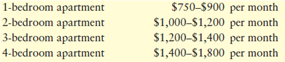
Tenants are responsible for heat, hot water, and electricity. Landlords provide parking and maintenance.
Interest rates are very low at this time and are therefore very attractive for borrowing and investing purposes. Greg has learned that local banks will finance commercial properties for up to 25 years at 6 percent interest. In addition, those banks will provide loans for up to 85 percent of assessed property values.
Multi-unit apartment buildings in the area range from $300,000 to $600,000 depending on size, condition, and neighborhood location. Most buildings include three to six separate units ranging from one to four bedrooms in size.
Greg, Chris, and Nancy want to locate and purchase enough buildings to meet their financial goals. Each building must therefore generate enough rental income to offset all costs and generate an after-tax profit. The buildings must also be carefully selected with regard to their expected growth in appreciation.
In addition to building and outside maintenance, the landlords are responsible for mortgage payments, city water and sewer bills, insurance, and local taxes. The IRS requires that depreciation be spread over a 28-year period.
The landlords each have $30,000 to invest for down payments on properties. One of their advisers urged them to set aside a portion of that amount for working capital depending on their cash flow outlook.
One adviser mentioned putting aside a portion of their money for working capital. How much would you recommend they put aside On what do you base your suggestion
Greg, Chris, and Nancy are midcareer high school teachers in the Pittsburgh area. They love their jobs, are very dedicated, and plan to stay on until they are eligible for retirement in about 15 or 20 years. The three teachers and friends have met on several occasions to brainstorm ideas for an outside business partnership. With kids about to enter college and a somewhat pessimistic outlook toward their retirement pensions, the three want to make some extra money.
Their financial goals are to supplement their annual incomes by $10,000 to $15,000 each for college tuition purposes and to build an equity base of about $300,000 each for retirement.
Following several meetings, some consultation with friends and advisers, and some local market research, they have settled on the business of commercial real estate investment, more specifically, multiunit rental properties.
The Pittsburgh and surrounding communities are currently experiencing and are projected to sustain above-average growth in both jobs and housing. In fact, there is a current shortage of both rental units and single-family housing in the area. As a result, rents have increased steadily during the past three to five years and currently average:
Tenants are responsible for heat, hot water, and electricity. Landlords provide parking and maintenance.
Interest rates are very low at this time and are therefore very attractive for borrowing and investing purposes. Greg has learned that local banks will finance commercial properties for up to 25 years at 6 percent interest. In addition, those banks will provide loans for up to 85 percent of assessed property values.
Multi-unit apartment buildings in the area range from $300,000 to $600,000 depending on size, condition, and neighborhood location. Most buildings include three to six separate units ranging from one to four bedrooms in size.
Greg, Chris, and Nancy want to locate and purchase enough buildings to meet their financial goals. Each building must therefore generate enough rental income to offset all costs and generate an after-tax profit. The buildings must also be carefully selected with regard to their expected growth in appreciation.
In addition to building and outside maintenance, the landlords are responsible for mortgage payments, city water and sewer bills, insurance, and local taxes. The IRS requires that depreciation be spread over a 28-year period.
The landlords each have $30,000 to invest for down payments on properties. One of their advisers urged them to set aside a portion of that amount for working capital depending on their cash flow outlook.
One adviser mentioned putting aside a portion of their money for working capital. How much would you recommend they put aside On what do you base your suggestion
Explanation Verified
Verified
The case shows that planning for entrepr...

Entrepreneurial Small Business 2nd Edition by Jerome Katz , Richard Green

Why don’t you like this exercise?
Other Minimum 8 character and maximum 255 character
Character 255






