







 Chat with AI


Campbell Biology 11th Edition by Lisa Urry,Michael Cain,Steven Wasserman,Peter Minorsky,Jane Reece
Edition 11ISBN: 978-0134093413Campbell Biology 11th Edition by Lisa Urry,Michael Cain,Steven Wasserman,Peter Minorsky,Jane Reece
Edition 11ISBN: 978-0134093413 Exercise 12
Analyzing Polypeptide Sequence Data
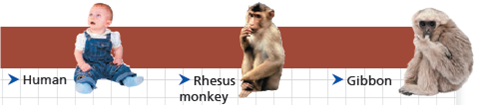
Are Rhesus Monkeys or Gibbons More Closely Related to Humans In this exercise, you will look at amino acid sequence data for the polypeptide chain of hemoglobin, often called -globin. You will then interpret the data to hypothesize whether the monkey or the gibbon is more closely related to humans.
How Such Experiments Are Done Researchers can isolate the polypeptide of interest from an organism and then determine the amino acid sequence. More frequently, the DNA of the relevant gene is sequenced, and the amino acid sequence of the polypeptide is deduced from the DNA sequence of its gene.
Data from the Experiments In the data below, the letters give the sequence of the 146 amino acids in -globin from humans, rhesus monkeys, and gibbons. Because a complete sequence would not fit on one line here, the sequences are broken into three segments. The sequences for the three different species are aligned so that you can compare them easily. For example, you can see that for all three species, the first amino acid is V (valine) and the 146th amino acid is H (histidine).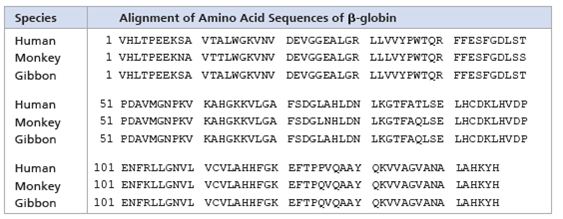
Scan the monkey and gibbon sequences, letter by letter, circling any amino acids that do not match the human sequence.
(a) How many amino acids differ between the monkey and the human sequences
(b) Between the gibbon and human
Are Rhesus Monkeys or Gibbons More Closely Related to Humans In this exercise, you will look at amino acid sequence data for the polypeptide chain of hemoglobin, often called -globin. You will then interpret the data to hypothesize whether the monkey or the gibbon is more closely related to humans.
How Such Experiments Are Done Researchers can isolate the polypeptide of interest from an organism and then determine the amino acid sequence. More frequently, the DNA of the relevant gene is sequenced, and the amino acid sequence of the polypeptide is deduced from the DNA sequence of its gene.
Data from the Experiments In the data below, the letters give the sequence of the 146 amino acids in -globin from humans, rhesus monkeys, and gibbons. Because a complete sequence would not fit on one line here, the sequences are broken into three segments. The sequences for the three different species are aligned so that you can compare them easily. For example, you can see that for all three species, the first amino acid is V (valine) and the 146th amino acid is H (histidine).
Scan the monkey and gibbon sequences, letter by letter, circling any amino acids that do not match the human sequence.
(a) How many amino acids differ between the monkey and the human sequences
(b) Between the gibbon and human
Explanation Verified
Verified
The degree of the arrangement of the mol...

Campbell Biology 11th Edition by Lisa Urry,Michael Cain,Steven Wasserman,Peter Minorsky,Jane Reece

Why don’t you like this exercise?
Other Minimum 8 character and maximum 255 character
Character 255






