



expand icon
book Campbell Biology 11th Edition by Lisa Urry,Michael Cain,Steven Wasserman,Peter Minorsky,Jane Reece cover

Campbell Biology 11th Edition by Lisa Urry,Michael Cain,Steven Wasserman,Peter Minorsky,Jane Reece

Edition 11ISBN: 978-0134093413
book Campbell Biology 11th Edition by Lisa Urry,Michael Cain,Steven Wasserman,Peter Minorsky,Jane Reece cover

Campbell Biology 11th Edition by Lisa Urry,Michael Cain,Steven Wasserman,Peter Minorsky,Jane Reece

Edition 11ISBN: 978-0134093413
Exercise 16
Are you a victim of fish fraud
When buying salmon, perhaps you prefer the more expensive wild-caught Pacific salmon ( Oncorhynchus species) over farmed Atlantic salmon ( Salmo salar ). But studies reveal that about 40% of the time, you aren't getting the fish you paid for! Watch the video in the MasteringBiology Study Area for more information. Are you a victim of fish fraud  When buying salmon, perhaps you prefer the more expensive wild-caught Pacific salmon ( Oncorhynchus species) over farmed Atlantic salmon ( Salmo salar ). But studies reveal that about 40% of the time, you aren't getting the fish you paid for! Watch the video in the MasteringBiology Study Area for more information.      ABC News Video: Fake Fish in Stores and Restaurants    Instructors : A version of this Problem- Solving Exercise can be assigned in Chapter 5 of MasteringBiology. A more extensive investigation is in Chapter 26 of MasteringBiology. In this exercise, you will investigate whether a piece of salmon has been fraudulently labeled.  Your Approach  The principle guiding your investigation is that DNA sequences from within a species or from closely related species are more similar to each other than are sequences from more distantly related species. Your Data  You've been sold a piece of salmon labeled as coho salmon ( Oncorhynchus kisutch ). To see whether your fish was labeled correctly, you will compare a short DNA sequence from your sample to standard sequences from the same gene for three salmon species. The sequences are:    How many bases differ between (a) O. kisutch and your fish sample (b) O. keta and the sample (c) S. salar and the sample Are you a victim of fish fraud  When buying salmon, perhaps you prefer the more expensive wild-caught Pacific salmon ( Oncorhynchus species) over farmed Atlantic salmon ( Salmo salar ). But studies reveal that about 40% of the time, you aren't getting the fish you paid for! Watch the video in the MasteringBiology Study Area for more information.      ABC News Video: Fake Fish in Stores and Restaurants    Instructors : A version of this Problem- Solving Exercise can be assigned in Chapter 5 of MasteringBiology. A more extensive investigation is in Chapter 26 of MasteringBiology. In this exercise, you will investigate whether a piece of salmon has been fraudulently labeled.  Your Approach  The principle guiding your investigation is that DNA sequences from within a species or from closely related species are more similar to each other than are sequences from more distantly related species. Your Data  You've been sold a piece of salmon labeled as coho salmon ( Oncorhynchus kisutch ). To see whether your fish was labeled correctly, you will compare a short DNA sequence from your sample to standard sequences from the same gene for three salmon species. The sequences are:    How many bases differ between (a) O. kisutch and your fish sample (b) O. keta and the sample (c) S. salar and the sample
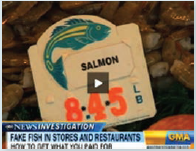

ABC News Video: Fake Fish in Stores and Restaurants Are you a victim of fish fraud  When buying salmon, perhaps you prefer the more expensive wild-caught Pacific salmon ( Oncorhynchus species) over farmed Atlantic salmon ( Salmo salar ). But studies reveal that about 40% of the time, you aren't getting the fish you paid for! Watch the video in the MasteringBiology Study Area for more information.      ABC News Video: Fake Fish in Stores and Restaurants    Instructors : A version of this Problem- Solving Exercise can be assigned in Chapter 5 of MasteringBiology. A more extensive investigation is in Chapter 26 of MasteringBiology. In this exercise, you will investigate whether a piece of salmon has been fraudulently labeled.  Your Approach  The principle guiding your investigation is that DNA sequences from within a species or from closely related species are more similar to each other than are sequences from more distantly related species. Your Data  You've been sold a piece of salmon labeled as coho salmon ( Oncorhynchus kisutch ). To see whether your fish was labeled correctly, you will compare a short DNA sequence from your sample to standard sequences from the same gene for three salmon species. The sequences are:    How many bases differ between (a) O. kisutch and your fish sample (b) O. keta and the sample (c) S. salar and the sample
Instructors : A version of this Problem- Solving Exercise can be assigned in Chapter 5 of MasteringBiology. A more extensive investigation is in Chapter 26 of MasteringBiology.
In this exercise, you will investigate whether a piece of salmon has been fraudulently labeled.
Your Approach
The principle guiding your investigation is that DNA sequences from within a species or from closely related species are more similar to each other than are sequences from more distantly related species.
Your Data
You've been sold a piece of salmon labeled as coho salmon ( Oncorhynchus kisutch ). To see whether your fish was labeled correctly, you will compare a short DNA sequence from your sample to standard sequences from the same gene for three salmon species. The sequences are: Are you a victim of fish fraud  When buying salmon, perhaps you prefer the more expensive wild-caught Pacific salmon ( Oncorhynchus species) over farmed Atlantic salmon ( Salmo salar ). But studies reveal that about 40% of the time, you aren't getting the fish you paid for! Watch the video in the MasteringBiology Study Area for more information.      ABC News Video: Fake Fish in Stores and Restaurants    Instructors : A version of this Problem- Solving Exercise can be assigned in Chapter 5 of MasteringBiology. A more extensive investigation is in Chapter 26 of MasteringBiology. In this exercise, you will investigate whether a piece of salmon has been fraudulently labeled.  Your Approach  The principle guiding your investigation is that DNA sequences from within a species or from closely related species are more similar to each other than are sequences from more distantly related species. Your Data  You've been sold a piece of salmon labeled as coho salmon ( Oncorhynchus kisutch ). To see whether your fish was labeled correctly, you will compare a short DNA sequence from your sample to standard sequences from the same gene for three salmon species. The sequences are:    How many bases differ between (a) O. kisutch and your fish sample (b) O. keta and the sample (c) S. salar and the sample
How many bases differ between (a) O. kisutch and your fish sample (b) O. keta and the sample (c) S. salar and the sample
Explanation
Verified
like image
like image

The sample Sequence is compared with the...

close menu
Campbell Biology 11th Edition by Lisa Urry,Michael Cain,Steven Wasserman,Peter Minorsky,Jane Reece
cross icon

