







 Chat with AI


Campbell Biology 11th Edition by Lisa Urry,Michael Cain,Steven Wasserman,Peter Minorsky,Jane Reece
Edition 11ISBN: 978-0134093413Campbell Biology 11th Edition by Lisa Urry,Michael Cain,Steven Wasserman,Peter Minorsky,Jane Reece
Edition 11ISBN: 978-0134093413 Exercise 3
How Much New Cytoplasm and Plasma Membrane Are Made by a Growing Yeast Cell The unicellular yeast Saccharomyces cerevisiae divides by budding off a small new cell that then grows to full size. During its growth, the new cell synthesizes new cytoplasm, which increases its volume, and new plasma membrane, which increases its surface area. In this exercise, you will use a scale bar to determine the sizes of a mature parent yeast cell and a cell budding from it. You will then calculate the volume and surface area of each cell. You will use your calculations to determine how much cytoplasm and plasma membrane the new cell needs to synthesize to grow to full size.
How the Experiment Was Done Yeast cells were grown under conditions that promoted division by budding. The cells were then viewed with a differential interference contrast light microscope and photographed.
Data from the Experiment This light micrograph shows a budding yeast cell about to be released from the mature parent cell: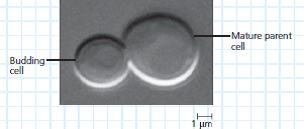
As the new cell grows, its plasma membrane needs to expand to contain the increased volume of the cell. (a) Calculate the surface area of each cell using the formula for the surface area of a sphere: A = 4 r 2 (b) How much area of new plasma membrane will the new cell have to synthesize as it matures
How the Experiment Was Done Yeast cells were grown under conditions that promoted division by budding. The cells were then viewed with a differential interference contrast light microscope and photographed.
Data from the Experiment This light micrograph shows a budding yeast cell about to be released from the mature parent cell:
As the new cell grows, its plasma membrane needs to expand to contain the increased volume of the cell. (a) Calculate the surface area of each cell using the formula for the surface area of a sphere: A = 4 r 2 (b) How much area of new plasma membrane will the new cell have to synthesize as it matures
Explanation Verified
Verified
As the new cell grows, the plasma membra...

Campbell Biology 11th Edition by Lisa Urry,Michael Cain,Steven Wasserman,Peter Minorsky,Jane Reece

Why don’t you like this exercise?
Other Minimum 8 character and maximum 255 character
Character 255






