







 Chat with AI


Campbell Biology 11th Edition by Lisa Urry,Michael Cain,Steven Wasserman,Peter Minorsky,Jane Reece
Edition 11ISBN: 978-0134093413Campbell Biology 11th Edition by Lisa Urry,Michael Cain,Steven Wasserman,Peter Minorsky,Jane Reece
Edition 11ISBN: 978-0134093413 Exercise 1
Are insulin mutations the cause of three infants' neonatal diabetes
Insulin is a hormone that acts as a key regulator of blood glucose level. In some cases of neonatal diabetes, the gene coding for the insulin protein has a nucleotide-pair substitution mutation that alters the protein structure enough to cause it to malfunction. How can you identify a nucleotide-pair substitution and determine its effect on the amino acid sequence
Now that it's possible to sequence an individual's whole genome, doctors can use that DNA sequence information to diagnose diseases and identify new treatments. For example, the insulin gene sequence of a patient with neonatal diabetes can be analyzed to determine if it has a mutation and, if so, its effect.
Watch the video in the Mastering-Biology Study area to see how genome sequencing is changing medicine.

ABC News video: Using genome Sequencing to Diagnose gene-based Diseases
In this exercise, you will determine the effect of mutations present in a portion of diabetes patients' insulin gene sequences.
Your Approach Suppose you are a medical geneticist presented with three infant patients, all of whom have a nucleotide-pair substitution in their insulin gene. It is your job to analyze each mutation to figure out the effect of the mutation on the amino acid sequence of the insulin protein. To identify the mutation in each patient, you will compare his or her individual insulin complementary Dna (cDNA) sequence to that of the wild-type cDNA. (cDNA is a double-stranded DNA molecule that is based on the mRNA sequence and thus contains only the portion of a gene that is translated-introns are not included. cDNA sequences are commonly used to compare the coding regions of genes.) Identifying the codons that have been changed will tell you which, if any, amino acids are altered in the patient's insulin protein.
Your Data You will analyze the cDNA codons for amino acids 35-54 (of the 110 amino acids) of each patient's insulin protein, so the start codon (AUG) is not present. The sequences of the wild-type cDNA and the patients' cDNA are shown below, arranged in codons.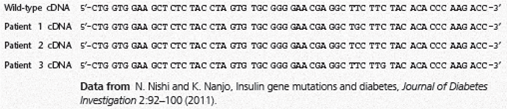
Use a codon table (see Figure 17.6) to identify the amino acid that will be made by the codon with the mutation in each patient's insulin sequence, and compare it to the amino acid made by the codon in the corresponding wild-type sequence. As is standard practice with DNA sequences, the cDNA coding (nontemplate) strand has been provided, so to convert it to mRNA for use with the codon table, you just need to change t to U. classify each patient's nucleotide-pair substitution mutation: Is it a silent, missense, or nonsense mutation explain, for each answer.
Insulin is a hormone that acts as a key regulator of blood glucose level. In some cases of neonatal diabetes, the gene coding for the insulin protein has a nucleotide-pair substitution mutation that alters the protein structure enough to cause it to malfunction. How can you identify a nucleotide-pair substitution and determine its effect on the amino acid sequence
Now that it's possible to sequence an individual's whole genome, doctors can use that DNA sequence information to diagnose diseases and identify new treatments. For example, the insulin gene sequence of a patient with neonatal diabetes can be analyzed to determine if it has a mutation and, if so, its effect.
Watch the video in the Mastering-Biology Study area to see how genome sequencing is changing medicine.
ABC News video: Using genome Sequencing to Diagnose gene-based Diseases
In this exercise, you will determine the effect of mutations present in a portion of diabetes patients' insulin gene sequences.
Your Approach Suppose you are a medical geneticist presented with three infant patients, all of whom have a nucleotide-pair substitution in their insulin gene. It is your job to analyze each mutation to figure out the effect of the mutation on the amino acid sequence of the insulin protein. To identify the mutation in each patient, you will compare his or her individual insulin complementary Dna (cDNA) sequence to that of the wild-type cDNA. (cDNA is a double-stranded DNA molecule that is based on the mRNA sequence and thus contains only the portion of a gene that is translated-introns are not included. cDNA sequences are commonly used to compare the coding regions of genes.) Identifying the codons that have been changed will tell you which, if any, amino acids are altered in the patient's insulin protein.
Your Data You will analyze the cDNA codons for amino acids 35-54 (of the 110 amino acids) of each patient's insulin protein, so the start codon (AUG) is not present. The sequences of the wild-type cDNA and the patients' cDNA are shown below, arranged in codons.
Use a codon table (see Figure 17.6) to identify the amino acid that will be made by the codon with the mutation in each patient's insulin sequence, and compare it to the amino acid made by the codon in the corresponding wild-type sequence. As is standard practice with DNA sequences, the cDNA coding (nontemplate) strand has been provided, so to convert it to mRNA for use with the codon table, you just need to change t to U. classify each patient's nucleotide-pair substitution mutation: Is it a silent, missense, or nonsense mutation explain, for each answer.
Explanation


This question doesn’t have an expert verified answer yet, let Quizplus AI Copilot help.

Campbell Biology 11th Edition by Lisa Urry,Michael Cain,Steven Wasserman,Peter Minorsky,Jane Reece

Why don’t you like this exercise?
Other Minimum 8 character and maximum 255 character
Character 255






