







 Chat with AI


Campbell Biology 11th Edition by Lisa Urry,Michael Cain,Steven Wasserman,Peter Minorsky,Jane Reece
Edition 11ISBN: 978-0134093413Campbell Biology 11th Edition by Lisa Urry,Michael Cain,Steven Wasserman,Peter Minorsky,Jane Reece
Edition 11ISBN: 978-0134093413 Exercise 5
How Can DNA Sequence Data Be Used to Track Flu Virus Evolution During Pandemic Waves
In 2009, an influenza A H1N1virus caused a pandemic, and the virus has continued to resurface in outbreaks across the world. Researchers in Taiwan were curious about why the virus kept appearing despite widespread flu vaccine initiatives. They hypothesized that newly evolved variants of the H1N1 virus were able to evade human immune system defenses. To test this hypothesis, they needed to determine if each wave of the flu infection was caused by a different H1N1 variant strain.
How the Experiment Was Done Scientists obtained the genome sequences for 4,703 virus isolates collected from patients with H1N1 flu in Taiwan. They compared the sequences in different strains for the viral hemagglutinin (HA) gene, and based on mutations that had occurred, arranged the isolates into a phylogenetic tree (see Figure 20.5 for information on how to read phylogenetic trees).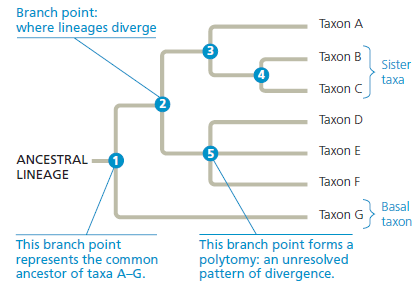
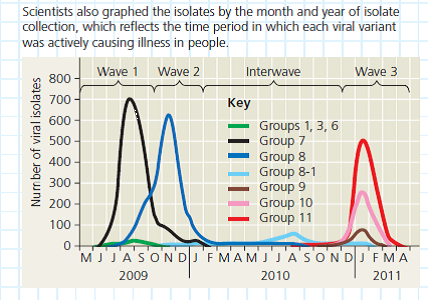
Data from the Experiment In the phylogenetic tree; each branch tip is one variant strain of the H1N1 virus with a unique HA gene sequence. The tree is a way to visualize a working hypothesis about the evolutionary relationships between H1N1 variants.
Interpret the Data
The phylogenetic tree shows the hypothesized evolutionary relationship between the variant strains of H1N1 virus. The more closely connected two variants are, the more alike they are in terms of HA gene sequence. Each fork in a branch, called a node, shows where two lineages separate due to different accumulated mutations. The length of the branches is a measure of how many DNA sequence differences there are between the variants, thus how distantly related they are. Referring to the phylogenetic tree, which variants are more closely related to each other: A/Taiwan1018/2011 and A/Taiwan/552/2011 or A/Taiwan1018/2011 and A/Taiwan/8542/2009 Explain your answer.
In 2009, an influenza A H1N1virus caused a pandemic, and the virus has continued to resurface in outbreaks across the world. Researchers in Taiwan were curious about why the virus kept appearing despite widespread flu vaccine initiatives. They hypothesized that newly evolved variants of the H1N1 virus were able to evade human immune system defenses. To test this hypothesis, they needed to determine if each wave of the flu infection was caused by a different H1N1 variant strain.
How the Experiment Was Done Scientists obtained the genome sequences for 4,703 virus isolates collected from patients with H1N1 flu in Taiwan. They compared the sequences in different strains for the viral hemagglutinin (HA) gene, and based on mutations that had occurred, arranged the isolates into a phylogenetic tree (see Figure 20.5 for information on how to read phylogenetic trees).
Data from the Experiment In the phylogenetic tree; each branch tip is one variant strain of the H1N1 virus with a unique HA gene sequence. The tree is a way to visualize a working hypothesis about the evolutionary relationships between H1N1 variants.
Interpret the Data
The phylogenetic tree shows the hypothesized evolutionary relationship between the variant strains of H1N1 virus. The more closely connected two variants are, the more alike they are in terms of HA gene sequence. Each fork in a branch, called a node, shows where two lineages separate due to different accumulated mutations. The length of the branches is a measure of how many DNA sequence differences there are between the variants, thus how distantly related they are. Referring to the phylogenetic tree, which variants are more closely related to each other: A/Taiwan1018/2011 and A/Taiwan/552/2011 or A/Taiwan1018/2011 and A/Taiwan/8542/2009 Explain your answer.
Explanation Verified
Verified
A phylogenetic tree is a diagram depicti...

Campbell Biology 11th Edition by Lisa Urry,Michael Cain,Steven Wasserman,Peter Minorsky,Jane Reece

Why don’t you like this exercise?
Other Minimum 8 character and maximum 255 character
Character 255






