







 Chat with AI


Campbell Biology 11th Edition by Lisa Urry,Michael Cain,Steven Wasserman,Peter Minorsky,Jane Reece
Edition 11ISBN: 978-0134093413Campbell Biology 11th Edition by Lisa Urry,Michael Cain,Steven Wasserman,Peter Minorsky,Jane Reece
Edition 11ISBN: 978-0134093413 Exercise 8
Researchers studied genetic variation in the marine mussel Mytilus edulis around Long Island, New York. They measured the frequency of a particular allele (lap94) for an enzyme involved in regulating the mussel's internal saltwater balance. The researchers presented their data as a series of pie charts linked to sampling sites within Long Island Sound, where the salinity is highly variable, and along the coast of the open ocean, where salinity is constant: 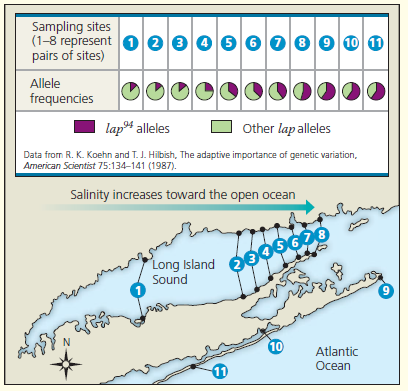
a. Create a data table for the 11 sampling sites by estimating the frequency of lap 94 from the pie charts. (Hint: Think of each pie chart as a clock face to help you estimate the proportion of the shaded area.) (b) Graph the frequencies for sites 1-8 to show how the frequency of this allele changes with increasing Evaluate how the data from sites 9 - 11 compare with the date from the sites within the sound. (c) Construct a hypothesis that for the following observations: (1) The lap 94 allele helps mussels maintain osmatic balance in water with a high salt concentration but is costly to use in less salty water; and (2) mussels produce larvae that can disperse long distances before they settle on rocks and grow into adults.
a. Create a data table for the 11 sampling sites by estimating the frequency of lap 94 from the pie charts. (Hint: Think of each pie chart as a clock face to help you estimate the proportion of the shaded area.) (b) Graph the frequencies for sites 1-8 to show how the frequency of this allele changes with increasing Evaluate how the data from sites 9 - 11 compare with the date from the sites within the sound. (c) Construct a hypothesis that for the following observations: (1) The lap 94 allele helps mussels maintain osmatic balance in water with a high salt concentration but is costly to use in less salty water; and (2) mussels produce larvae that can disperse long distances before they settle on rocks and grow into adults.
Explanation Verified
Verified

Campbell Biology 11th Edition by Lisa Urry,Michael Cain,Steven Wasserman,Peter Minorsky,Jane Reece

Why don’t you like this exercise?
Other Minimum 8 character and maximum 255 character
Character 255






