







 Chat with AI


Campbell Biology 11th Edition by Lisa Urry,Michael Cain,Steven Wasserman,Peter Minorsky,Jane Reece
Edition 11ISBN: 978-0134093413Campbell Biology 11th Edition by Lisa Urry,Michael Cain,Steven Wasserman,Peter Minorsky,Jane Reece
Edition 11ISBN: 978-0134093413 Exercise 4
Is hybridization promoting insecticide resistance in mosquitoes that transmit malaria
Malaria is a leading cause of human illness and mortality worldwide, witH₂00 million people infected and 600,000 deaths each year. In the 1960s, the incidence of malaria was reduced owing to the use of insecticides that killed mosquitoes in the genus Anopheles , which transmit the disease from person to person. But today, mosquitoes are becoming resistant to insecticides-causing a resurgence in malaria.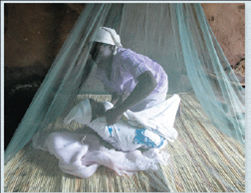

Insecticide-treated bed nets have helped reduce cases of malaria in many countries, but resistance to insecticides is rising in mosquito populations.
Instructors : A version of this Problem-Solving Exercise can be assigned in MasteringBiology.
In this exercise, you will investigate whether alleles encoding resistance to insecticides have been transferred between closely related species of Anopheles.
Your Approach
The principle guiding your investigation is that DNA analyses can detect the transfer of resistance alleles between closely related mosquito species. To find out whether such transfers have occurred, you will analyze DNA results from two species of mosquitoes that transmit malaria ( Anopheles gambiae and A. coluzzii ) and from A. gambiae × A. coluzzii hybrids.
Your Data
Resistance to DDT and other insecticides in Anopheles is affected by a sodium channel gene, kdr. The r allele of this gene confers resistance, while the wild type (1/1) genotype is not resistant. researchers sequenced the kdr gene from mosquitoes collected in Mali during three time periods: pre-2006 (2002 and 2004), 2006, and post-2006 (2009-2012). A. gambiae and A. coluzzii were collected during all three time periods, but their hybrids only occurred in 2006, the first year that insecticide-treated bed nets were used to reduce the spread of malaria. A likely explanation is that the introduction of the treated bed nets may have briefly favored hybrid individuals, which are usually at a selective disadvantage.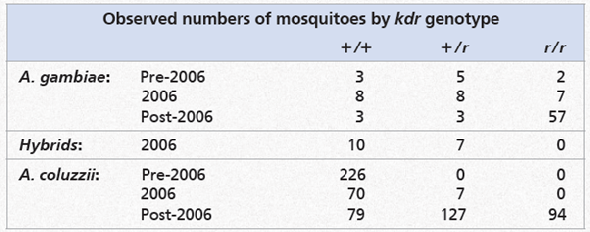
Predict how the transfer of the r allele to A. coluzzii populations could affect the number of malaria case in the years immediately following the transfer.
Malaria is a leading cause of human illness and mortality worldwide, witH₂00 million people infected and 600,000 deaths each year. In the 1960s, the incidence of malaria was reduced owing to the use of insecticides that killed mosquitoes in the genus Anopheles , which transmit the disease from person to person. But today, mosquitoes are becoming resistant to insecticides-causing a resurgence in malaria.
Insecticide-treated bed nets have helped reduce cases of malaria in many countries, but resistance to insecticides is rising in mosquito populations.
Instructors : A version of this Problem-Solving Exercise can be assigned in MasteringBiology.
In this exercise, you will investigate whether alleles encoding resistance to insecticides have been transferred between closely related species of Anopheles.
Your Approach
The principle guiding your investigation is that DNA analyses can detect the transfer of resistance alleles between closely related mosquito species. To find out whether such transfers have occurred, you will analyze DNA results from two species of mosquitoes that transmit malaria ( Anopheles gambiae and A. coluzzii ) and from A. gambiae × A. coluzzii hybrids.
Your Data
Resistance to DDT and other insecticides in Anopheles is affected by a sodium channel gene, kdr. The r allele of this gene confers resistance, while the wild type (1/1) genotype is not resistant. researchers sequenced the kdr gene from mosquitoes collected in Mali during three time periods: pre-2006 (2002 and 2004), 2006, and post-2006 (2009-2012). A. gambiae and A. coluzzii were collected during all three time periods, but their hybrids only occurred in 2006, the first year that insecticide-treated bed nets were used to reduce the spread of malaria. A likely explanation is that the introduction of the treated bed nets may have briefly favored hybrid individuals, which are usually at a selective disadvantage.
Predict how the transfer of the r allele to A. coluzzii populations could affect the number of malaria case in the years immediately following the transfer.
Explanation


This question doesn’t have an expert verified answer yet, let Quizplus AI Copilot help.

Campbell Biology 11th Edition by Lisa Urry,Michael Cain,Steven Wasserman,Peter Minorsky,Jane Reece

Why don’t you like this exercise?
Other Minimum 8 character and maximum 255 character
Character 255






